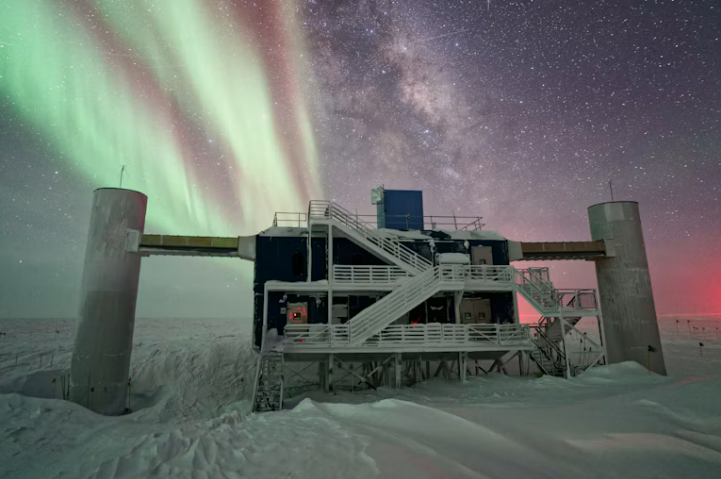
The 2026 Nobel Prize in Physics was awarded to Francis Halzen for decisive contributions to the IceCube Neutrino Observatory and the discovery of high energy neutrinos of astrophysical origin. This recognition marks a major advance in our ability to study the universe through particles that travel almost unimpeded across cosmic distances. The achievement rests on decades of effort to transform a cubic kilometer of Antarctic ice into a detector capable of capturing signals from the most energetic events in the cosmos.
Neutrinos are elementary particles that possess almost no mass and no electric charge. They interact with other matter only through the weak nuclear force and gravity, which means they pass through ordinary material with extraordinary ease. Billions of neutrinos stream through every square centimeter of the Earth each second, most of them produced in the nuclear reactions that power the Sun. Far rarer are the high energy neutrinos that originate in distant cosmic accelerators. These particles carry energies millions or even billions of times greater than those of solar neutrinos. Because they travel in straight lines and suffer almost no absorption or deflection, they serve as unique messengers from regions that remain opaque to light, radio waves, or other forms of electromagnetic radiation.
Detection of such elusive particles requires an enormous volume of transparent material in which a rare interaction can produce a visible signal. At the IceCube Neutrino Observatory, located at the Amundsen Scott South Pole Station, that material is the deep, ultra pure glacial ice. Strings of digital optical modules, each containing a sensitive photomultiplier tube, were lowered into holes drilled more than a kilometer into the ice. In total more than five thousand such modules form a three dimensional array that fills roughly one cubic kilometer. When a high energy neutrino collides with a nucleus in the ice, it can create a charged particle such as a muon or an electron. That charged particle travels faster than the speed of light in the ice and therefore emits a faint cone of blue light known as Cherenkov radiation. The optical modules record the arrival times and intensities of these photons. From the pattern of light, scientists reconstruct the direction, energy, and flavor of the original neutrino.
The scientific payoff has been profound. In 2013 IceCube reported the first clear evidence of a diffuse flux of high energy neutrinos arriving from beyond the solar system. Subsequent observations identified specific sources. One notable event was linked to a blazar, an active galaxy powered by a supermassive black hole whose relativistic jet pointed toward Earth. Later analyses revealed a steady emission of neutrinos from the nearby active galaxy NGC 1068. IceCube has also mapped high energy neutrinos coming from within our own Milky Way, offering a new view of galactic cosmic ray production. These detections open the field of neutrino astronomy and contribute to multi messenger astronomy, in which information from neutrinos, photons, and gravitational waves can be combined. The particles reveal the sites of the most violent particle accelerators in the universe, places where protons and nuclei are boosted to energies far beyond those reachable by human made colliders. They also constrain models of dark matter, cosmic ray origins, and the densest environments near black holes and neutron stars.
Beyond the purely scientific domain, the extreme properties of neutrinos have invited reflection in other fields of human inquiry. In certain theological discussions, some writers have speculated that the risen body of Christ, described in scripture as capable of appearing and disappearing and of passing through closed doors, might be composed of or analogous to neutrinos. The argument rests on the particles nearly complete ability to traverse ordinary matter while still carrying energy and information. Proponents suggest that a body formed of such particles could retain physical presence yet remain unconstrained by the barriers of ordinary flesh. This idea remains outside the methods and claims of experimental physics. It functions as a metaphorical bridge between the observed behavior of nature and traditional accounts of resurrection. Neutrinos themselves are not claimed by any laboratory to constitute divine substance. Rather, their ghostlike passage through the Earth and their origin in distant cataclysms supply a modern image that some find resonant with older theological language about a body that is both real and free of ordinary limitations.
The IceCube results therefore operate on two levels. On the empirical level they enlarge the catalog of cosmic messengers and sharpen our understanding of the engines that drive the most energetic phenomena in the universe. On the reflective level they remind us that the natural world continues to furnish images capable of stimulating thought across disciplinary boundaries. The observatory continues to collect data, and planned upgrades will increase its sensitivity to lower energy events and improve its ability to resolve individual sources. As the sample of astrophysical neutrinos grows, the map of the high energy universe will become clearer. The particles that once seemed almost impossible to capture now serve as reliable guides to regions of space that light alone cannot fully illuminate. In this way the work recognized by the 2026 Nobel Prize advances both the precise science of particle astrophysics and the broader human effort to comprehend the cosmos and our place within it.