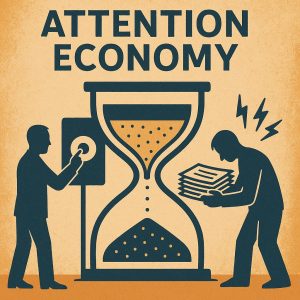
In the bustling marketplace of the 21st century, a new commodity reigns supreme: our attention. Economists and technologists alike have dubbed it “the new oil”, a finite, precious resource that fuels entire industries. Unlike traditional oil, attention is extracted not from the earth but from the depths of human consciousness. Every scroll, click, notification, and binge-watch represents a tiny transaction in what has come to be known as the attention economy. Platforms compete fiercely for this resource, designing algorithms that hijack our impulses, keeping us glued to screens for hours on end. The stakes are high, not merely for corporate profits, but for the very integrity of our inner lives.
The attention economy thrives on a simple premise: time spent equals value captured. Social media giants, streaming services, news aggregators, and gaming apps all vie for our limited cognitive bandwidth. They employ sophisticated techniques and variable rewards akin to slot machines, infinite scrolling, personalized dopamine hits to ensure we return again and again. What began as tools for connection and information have morphed into sophisticated attention merchants. Their success is measured in engagement metrics: minutes per session, daily active users, and ad impressions. In this ecosystem, our focus becomes the raw material refined into targeted advertising and behavioral data.
This relentless competition exacts a profound toll. Our minds, once capable of deep contemplation and sustained effort, now fragment under constant interruption. Studies in cognitive science reveal that frequent task-switching erodes working memory and reduces our ability to engage in complex reasoning. The average person checks their phone dozens of times daily, each glance pulling them away from the present moment. We live in a state of perpetual partial attention, skimming surfaces rather than diving into depths. The quiet spaces necessary for creativity, reflection, and genuine relationship shrink dramatically.
The ancient Socratic imperative to “know thyself” and live an examined life feels more urgent and more difficult than ever. Socrates challenged his fellow Athenians to question assumptions, probe their beliefs, and pursue virtue through disciplined inquiry. Today, that examined life competes against an endless stream of mediated experiences. We consume curated realities: filtered images of others’ lives, algorithmically selected opinions, and highlight reels that distort our sense of what is normal or desirable. This mediation creates distance between ourselves and raw reality. Instead of encountering the world directly through face-to-face conversation, unfiltered observation, or solitary thought. We experience it through screens that shape, amplify, and often distort.
Kierkegaard, the 19th-century Danish philosopher, diagnosed a similar tendency in his own time. He observed how people distract themselves with trivialities and social busyness to evade the discomfort of self-examination. The “crowd” and the aesthetic life of immediate pleasure offered easy escapes from the ethical and religious demands of authentic existence. In our era, the attention economy supercharges this evasion. Endless entertainment and information overload serve as modern equivalents of Kierkegaard’s distractions. We numb existential anxiety with notifications, avoid confronting personal failings by comparing ourselves to idealized online personas, and postpone meaningful decisions amid the noise. The result is a subtle spiritual atrophy: a life lived on the surface, rich in stimulation but impoverished in substance.
Nowhere is this more evident than in the domain of spiritual life. Traditions across cultures have long emphasized practices of stillness, prayer, meditation, and contemplation disciplines that require undivided attention. The desert fathers, Zen practitioners, and Christian mystics all cultivated inner silence to encounter the divine or the deeper self. Yet in the attention economy, even spirituality becomes mediated and commodified. Apps promise mindfulness in five-minute increments, complete with streaks and badges to gamify inner peace. Online sermons and virtual communities offer connection without the friction of real community. Evangelization itself adapts to the platforms, competing for likes and shares rather than fostering genuine transformation. While digital tools can extend reach, they risk reducing profound mysteries to consumable content, where depth gives way to virality.
The challenge before us is to reclaim our minds to embrace what might be called an unmediated life. This does not mean rejecting technology entirely, which would be both impractical and Luddite. Rather, it calls for intentional sovereignty over our attention. We must recognize attention as a sacred resource, not to be auctioned off to the highest bidder but stewarded for what truly matters.
Reclaiming attention begins with awareness. Simple practices like tracking screen time can reveal patterns of habitual distraction. Digital minimalism curating apps, setting boundaries, and creating tech-free zones that helps restore agency. More profoundly, we need to rebuild capacities for presence. Reading physical books without multitasking, engaging in face-to-face conversations without glancing at phones, and practicing solitude free from devices cultivate the mental muscles weakened by constant connectivity. Nature walks, manual crafts, and undistracted prayer or meditation offer antidotes to mediated existence.
Philosophically, this reclamation aligns with the examined life. It demands regular self-inquiry: What am I giving my attention to, and why? Am I living according to my values or reacting to external prompts? Kierkegaard’s call to move beyond the aesthetic sphere into ethical and religious commitment finds new resonance here. In an age of distraction, choosing depth over breadth, commitment over novelty, becomes a radical act. It requires courage to sit with boredom, uncertainty, and the discomfort of unfiltered self-knowledge rather than escaping into the next dopamine hit.
Communities play a vital role. Families and friendships that prioritize unhurried presence resist the atomizing effects of the attention economy. Educational institutions can teach digital literacy not merely as technical skill but as character formation equipping young people to navigate algorithms without being controlled by them. Religious and philosophical traditions must recover their emphasis on contemplative practices, adapting them thoughtfully to contemporary realities without succumbing to the logic of engagement metrics.
The spiritual dimension remains central. An unmediated life opens space for transcendence for encountering reality, others, and the divine without intermediaries constantly shaping the experience. It allows evangelization to flow from authentic witness rather than performative content. In a world saturated with noise, the quiet testimony of a focused, integrated life carries unique power.
Of course, systemic forces complicate individual efforts. Platform design prioritizes addiction over well-being, and economic incentives favor engagement over enrichment. Regulatory approaches, such as stricter data privacy rules or algorithmic transparency, may help level the playing field. Yet relying solely on external solutions risks passivity. True reclamation begins within, with the daily choice to direct attention deliberately.
As we navigate this attention-saturated age, the stakes extend beyond personal productivity or mental health. They touch the core of human flourishing: our ability to love, create, reason, and seek truth. The attention economy promises endless connection and stimulation but delivers isolation and superficiality. Reclaiming our minds invites us into a richer existence, one marked by presence, depth, and intentionality.
The path forward echoes ancient wisdom updated for our time. Socrates urged examination; Kierkegaard warned against distraction; spiritual masters modeled silence. In response, we can cultivate habits of attention that honor our humanity. By choosing the unmediated over the mediated, the examined over the distracted, we resist the reduction of our lives to data points and reclaim the fullness of conscious experience. This is not merely resistance. It is the pursuit of a life well-lived, worthy of our irreplaceable attention.