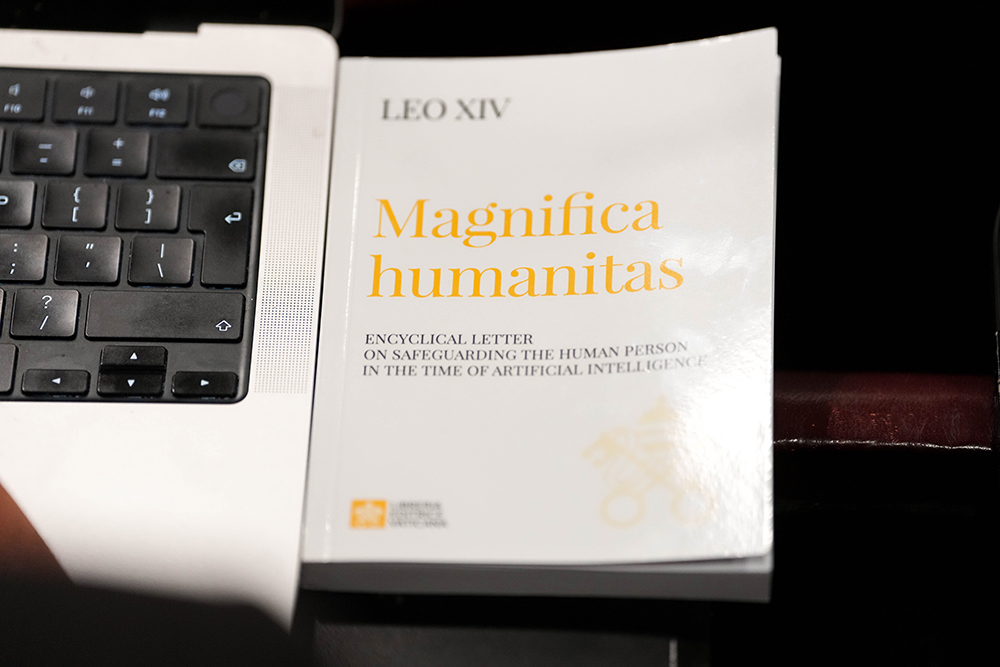
In a move that echoes the bold pastoral vision of his predecessor more than a century ago, Pope Leo XIV has released his first encyclical, addressing the transformative power of artificial intelligence. Titled Magnifica Humanitas, the document positions the Church as a prophetic voice in the digital age. Just as Pope Leo XIII confronted the upheavals of the Industrial Revolution in Rerum Novarum (1891), Pope Leo XIV now invites the world to navigate the promises and perils of AI with wisdom, prudence, and an unwavering commitment to human dignity. We are facing a choice the tower of Babel or rebuilding of the city of Jerusalem. The Church cannot escape these new development but has the challenge to accompany humanity as we tide a new revolution.
The encyclical arrives at a pivotal moment. Artificial intelligence is reshaping economies, workplaces, education, healthcare, and even personal relationships at unprecedented speed. Algorithms influence decisions from loan approvals to criminal sentencing. Generative tools create art, literature, and code that rival human output. Yet alongside these marvels come profound questions: What becomes of human labour when machines outperform us? How do we safeguard truth when deepfakes proliferate? Can a society that delegates moral reasoning to computation retain its soul? What about wars and the need for peace ? Pope Leo XIV does not offer simplistic answers . Instead, he employs what we might call “divine pedagogy” meeting humanity where it is, in the midst of its technological achievements and anxieties, and gently guiding it toward greater flourishing. He direct in his assertion. He says artificial intelligence needs to be disarrmed .
The Holy Father begins by celebrating the magnificence of the human person, created in the image and likeness of God. He marvels at the ingenuity that allows finite creatures to craft systems capable of pattern recognition, language generation, and complex problem-solving. This creative capacity, he writes, reflects the divine spark within us. Humanity’s ability to develop AI is not a threat to God’s sovereignty but a participation in the ongoing work of creation. In this sense, technological progress can be a form of stewardship, extending care to the sick, expanding knowledge, and alleviating drudgery. The Pope highlights examples of AI assisting in medical diagnostics in underserved regions and optimizing resource distribution during humanitarian crises, underscoring technology’s potential to serve the common good.
Yet this celebration is tempered by caution. Pope Leo XIV warns against uncritical adoption of AI, identifying several grave dangers. First is the risk of dehumanization. When efficiency becomes the sole metric, human workers risk being reduced to mere data points or displaced without adequate support. The encyclical calls for new forms of solidarity in an age of automation, urging governments, businesses, and communities to ensure that technological gains benefit all, particularly the vulnerable. This builds directly on the social teachings of the Church dignity of labour, just wages, and the dignity of the person over profit.
A second concern is the erosion of truth and moral agency. AI systems trained on vast datasets inevitably reflect the biases, limitations, and ideologies of their creators and the data they consume. The Pope cautions that over-reliance on artificial intelligence for decision-making could dull human conscience and responsibility. He points to the ethical minefield of autonomous weapons, manipulative social algorithms that exploit human weakness, and the subtle ways in which AI might reshape our understanding of reality itself. In a powerful passage, he reminds readers that truth is not merely information but a relational reality rooted in the Logos the Divine Word. Machines may process data, but wisdom belongs to persons formed by virtue, community, and encounter with the living God.
The encyclical addresses the spiritual dimension with particular depth. Pope Leo XVI expresses concern over transhumanist ideologies that envision merging human consciousness with machines or achieving immortality through technology. Such visions, he argues, betray a misunderstanding of human nature. Our dignity lies not in escaping mortality or limitations but in embracing them with hope, love, and trust in divine providence. True human enhancement, he suggests, comes through education, moral formation, friendship, and prayer not through silicon implants or algorithmic governance. Here the Pope’s public theology shines: he speaks not only to believers but to all people of goodwill, framing these issues in terms accessible to secular society while remaining grounded in Christian anthropology.
Echoing Rerum Novarum, which defended workers’ rights amid industrial exploitation, Magnifica Humanitas proposes concrete principles for AI governance. It advocates for international cooperation to establish ethical standards that prioritize transparency, accountability, and human oversight. Regulations should protect privacy, prevent monopolistic control of powerful models, and ensure that developing nations are not left behind in the AI race. The principle of common good and subsidiarity guided decisions made at the most local level applies powerfully here: families, local communities, and nations should retain agency rather than surrendering it to distant tech conglomerates or unaccountable algorithms.
The document also explores AI’s impact on culture and education. While acknowledging the value of AI tutors and creative tools, the Pope stresses the irreplaceable role of human teachers who model character and inspire wonder. He calls for a renewed emphasis on the humanities, philosophy, and theology to balance technical training. Young people must learn not only how to use AI but how to judge when not to use it and when silence, contemplation, or face-to-face encounter better serve truth and love.
Particularly moving is the encyclical’s treatment of the poor and marginalized. Pope Leo XIV insists that AI must not become another instrument of exclusion. Predictive policing that entrenches racial bias, healthcare algorithms that favor the wealthy, or job automation that devastates traditional communities all these demand prophetic critique. The Church, he says, must stand with those displaced by technology, advocating for retraining, universal basic services where appropriate, and economic models that place human dignity at the center.
Throughout the text, the Holy Father’s tone remains hopeful. He rejects both blind techno-optimism and paralyzing technophobia. Humanity has faced revolutions before the agricultural, industrial, and digital and emerged transformed yet still called to the same fundamental vocation: to love God and neighbor. AI, like steam power or electricity, is a tool. Its moral character depends on how we wield it. The encyclical closes with a call to prayerful discernment, inviting scientists, ethicists, policymakers, and ordinary believers to collaborate in shaping a future where technology serves rather than supplants the human person.
The relevance of Magnifica Humanitas to our time cannot be overstated. We live in an era of rapid capability growth in large language models, computer vision, and autonomous systems. Companies race to deploy ever-more-powerful AI while governments scramble to regulate. Public discourse often swings between utopian hype and apocalyptic fear. Into this polarized environment, the Pope offers measured, humane guidance rooted in a rich tradition of social thought. His emphasis on the person as an end, never a means, provides a crucial counterweight to purely utilitarian approaches that dominate much of Silicon Valley thinking.
For the Catholic Church, this encyclical represents continuity and development. It applies timeless principles like, dignity of the human person,solidarity, subsidiarity, the preferential option for the poor to novel circumstances. For the wider world, it models constructive engagement: neither retreating from technology nor uncritically embracing it. Religious leaders, technologists, and policymakers would do well to study its arguments carefully.
As humanity stands at the threshold of an AI-shaped future, Pope Leo XIVreminds us that our greatest innovations must ultimately serve our deepest identity. We are not algorithms or data streams but beloved children of God, endowed with reason, freedom, and the capacity for self-giving love. By approaching artificial intelligence with both wonder and wisdom, caution and creativity, we honour that dignity and participate more fully in the divine plan for creation.
In an age hungry for moral clarity amid technological disruption, Magnifica Humanitas stands as a beacon. It calls all of us believers and skeptics alike to lift our gaze beyond immediate utility toward the integral development of every human person. The revolution is here. The question remains: will we shape it according to the demands of justice and love, or allow it to reshape us in ways that diminish what makes life truly human? Pope Leo XIV has given us a compelling vision for choosing the former. Without suffering, without love , without hope humanity cannot seek transcendence. To work to bring the civilization our love, we have the challenge to abandon the reigning technocratic paradigm that reduces humans to simply numbers and promote efficiency.