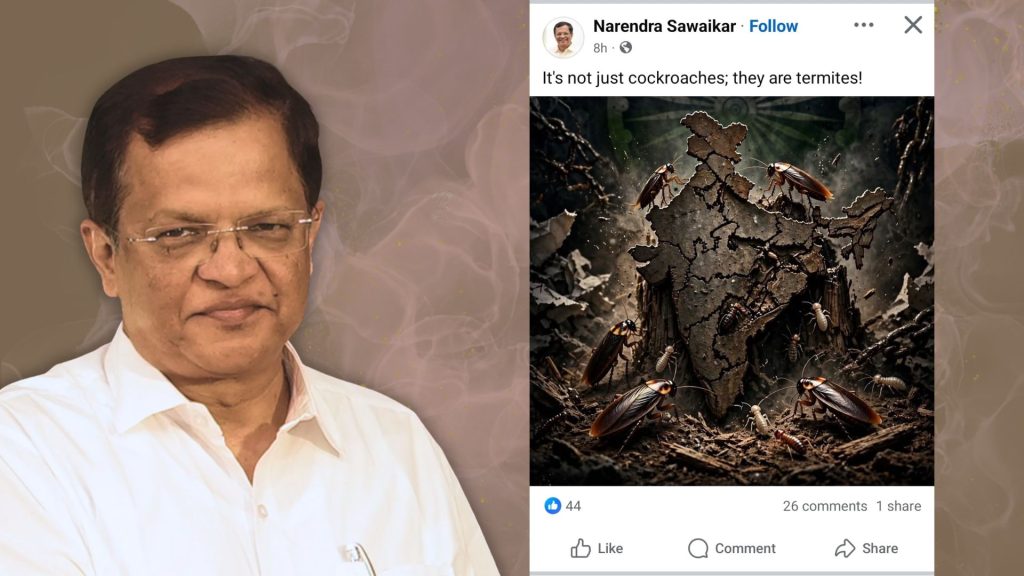
The political landscape of Goa, where coconut palms sway like indifferent spectators to the drama unfolding below, Goa BJP Vice President Narendra Sawaikar has achieved something remarkable. Amidst the usual cacophony of accusations and counter-accusations, he has uttered a profound truth wrapped in a derogatory insult. By branding protesting Goan youth as “termites” those silent, relentless wood-munchers , he didn’t just score a cheap social media point. He delivered an unwitting prophecy. It is quite possible these very “termites,” far from being mere pests, are poised to chew through the foundations of the BJP’s power structure in the coming elections, leaving behind nothing but a hollow shell of what once seemed an impregnable fortress.
Let us pause and appreciate the poetic justice here. Sawaikar’s now-infamous post – “Cockroaches with the termites! Save the nation!” was aimed at students rallying against issues like the NEET-UG paper leak and broader governmental accountability. The outrage was swift and predictable. Protests erupted at Azad Maidan in Panaji. Opposition parties decried the language as disgraceful and dehumanising. Demands for apologies echoed louder than the waves crashing on Miramar beach. Yet, in the grand tradition of political satire, Sawaikar deserves not condemnation but a quiet round of applause for his accidental entomological insight. Termites, after all, are nature’s ultimate recyclers. They thrive in darkness, work in colonies, and possess an unerring ability to locate and dismantle structural weaknesses. If that doesn’t describe the emerging youth resistance in Goa, what does?
Picture the scene: a state long celebrated for its laid-back vibe, its vibrant culture, and its beaches that draw dreamers from across the world. But beneath the tourist brochures lies a growing discontent among the young. Jobs are scarce. Educational scandals erode trust. Migration drains talent. And in response to legitimate protests, a senior BJP leader reaches for the insect kingdom for metaphors. How fitting, then, that these so-called termites are now embracing the label with the enthusiasm of revolutionaries adopting a battle cry. One young protester, Maithily Chumbalkar, captured it perfectly: she declared herself a termite ready to feast on the “government’s fortress of corrupt power.” In that moment, satire and reality merged into something potent.
The beauty of termites lies in their invisibility and persistence. Unlike flashy locusts that descend with fanfare and strip fields bare overnight, termites operate methodically. They tunnel through beams, weaken load-bearing walls, and turn solid oak into fragile powder – all while the homeowner remains blissfully unaware until the roof caves in. Translate this to Goan politics, and the parallels are deliciously uncomfortable for the BJP. For years, the party has projected an image of stability and development. Yet, cracks have been widening. Youth unemployment pushes talented Goans to seek opportunities elsewhere. Public frustration simmers over governance issues, from infrastructure woes to perceived cronyism. Each unaddressed grievance is another tunnel dug by the colony.
Sawaikar’s remark, intended perhaps as a dismissive swipe at opposition-linked protests, has instead galvanised the very group it sought to diminish. Students and young citizens, already mobilised through candlelight marches and social media campaigns, now wear the termite badge as a badge of honour. They are not chaotic destroyers; they are precise, organised, and driven by a vision for a better Goa. They demand transparency in examinations, accountability from leaders, and opportunities that match their aspirations. In short, they are doing what any healthy democracy requires: holding power to account. But to an establishment accustomed to deference, this feels like an infestation.
Let us delve deeper into why these termites pose such an existential threat. First, demographics are destiny. Goa’s youth represents a significant voting bloc, one that is increasingly tech-savvy, connected, and impatient with outdated rhetoric. Traditional campaign strategies relying on caste equations, loyalty networks, and top-down directives falter when confronted with a generation fluent in digital organising and allergic to condescension. Sawaikar’s post, far from intimidating, has provided the perfect rallying meme. Nothing unites the young quite like being patronised by their elders in power.
Second, the issues at stake are structural. The NEET controversies are not isolated incidents but symptoms of deeper malaise in education and opportunity. When young people see their futures compromised by leaks, delays, and opaque processes, resentment builds like moisture inviting termite invasion. Add to this the broader economic anxieties: the tourism sector’s uneven recovery, the challenges of balancing development with environmental preservation, and the sense that Goa’s unique identity is being diluted. These are not abstract policy debates; they are personal. And personal grievances make for highly motivated voters or, in this metaphor, highly efficient foragers.
Third, the BJP’s own responses risk accelerating the damage. Clarifications that the post “referred to no one” come across as evasive rather than reassuring. Heavy-handed measures, such as FIRs against protesters, only confirm the narrative of arrogant and authoritarian overreach. Each such action is like applying a fresh coat of paint over wood already riddled with tunnels . It looks fine temporarily but fools no one who taps the surface. The termites, meanwhile, continue their quiet work.
One can almost imagine the internal BJP meetings where strategists scratch their heads. “How did a simple post backfire so spectacularly?” The answer lies in underestimating the resilience and creativity of Goa’s young. These are not fragile snowflakes but determined builders of a new political reality. They understand social media better than many veterans. They form alliances across traditional divides. And crucially, they remember. Insults have a long shelf life in the digital age; they become fuel for mobilisation.
Satire thrives on exaggeration, but here reality is already providing ample material. The BJP, once seen as a disciplined force, now finds itself defending against charges of disconnect. Opposition parties, sensing opportunity, are amplifying the youth voice. Even some within the broader ecosystem are whispering about the need for course correction. Yet the more the establishment digs in, the more it invites further munching. Termites don’t negotiate with the structures they inhabit; they simply consume what no longer serves.
As Goa hurtles toward the next assembly elections, the metaphor grows ever more apt. The grand banyan tree of BJP influence, with its sprawling branches of organisational machinery and roots in various communities, appears mighty from afar. But close inspection reveals soft spots: disillusioned cadres, frustrated local leaders, and a youth cohort ready to repurpose the wood for something new. The termites are not vandals; they are agents of necessary decomposition, clearing space for fresh growth.
Will the BJP heed the warning implicit in Sawaikar’s truth-telling? Will they engage constructively with the concerns of the young, addressing root causes rather than swatting at symptoms? Or will they double down, deploying more insecticides in the form of rhetoric and restrictions, only to discover that the colony has already spread too far?
In the end, Sawaikar has done the state a curious service. By naming the “termites,” he has highlighted the very force that could reshape Goan politics. These young citizens, far from being destructive pests, embody the regenerative spirit of democracy. They challenge complacency. They demand better. And in doing so, they threaten to dismantle not the idea of good governance, but the particular version of it that has grown stagnant.
So here’s to the termites of Goa , who are industrious, underestimated, and undeniably effective. They may not wear suits or wave party flags with practised ease, but they possess something more powerful: the quiet determination to eat away at what no longer works. As the election season approaches, the sound of munching grows louder. The fortress trembles. And somewhere, Narendra Sawaikar might be reflecting on the old adage: be careful of what insects you invoke.
The feast is just beginning. And the menu, it seems, features BJP complacency as the main course. Goa’s youth, those magnificent termites, are dining well. Bon appétit indeed.