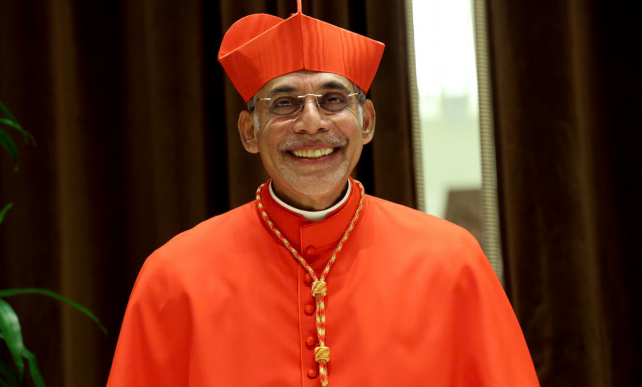
Cardinal Filipe Neri Ferrão of Goa and Daman offered a profound reflection on the state of families during a major gathering at the Vatican marking ten years since the publication of Amoris Laetitia. As president of both the Conference of Catholic Bishops of India and the Federation of Asian Bishops Conferences, he spoke from the lived experience of the Church across a vast continent that holds half of humanity. His words centered on the reality beauty and challenges of family life today and called the Church to a deeper listening and accompaniment.
In the local churches of Asia the family is recognized as a privileged place of revelation. It is there that life is received, relationships are formed, Gospel values are transmitted and faith is lived through unique personal histories. When pastoral workers adopt listening as a basic attitude, they discover that the realities beauty and challenges of families converge to reveal the presence and action of God in a mysterious way. In India and across Asia, the family remains the bedrock of society and the foundational cell of the domestic Church. Yet the same families reveal that family life is undergoing profound and radical transitions.
Three shifts stand out as particularly significant. The first concerns, the identity nature and composition of the family. Traditional joint and extended families are increasingly giving way to smaller nuclear households. New forms of partnership and cohabitation are emerging amid changing understandings of gender and relationships in urban settings. The growing reality of interfaith marriages in multi-religious societies raises new questions about the practice and transmission of faith within the home.
The second shift is from rootedness to mobility. Rapid urbanization economic growth new development models and greater access to education are prompting more people to move both within their countries and across borders in search of better opportunities. As a result many families entrusted to pastoral care are no longer households connected to a single parish. Their lives stretch across distances and require new forms of accompaniment that follow them rather than wait for them to return to a fixed place.
The third shift concerns the existential condition of families. India and Asia share a common paradox. Growth is rapid but unequal. Opportunities are expanding but access to them remains discriminatory. Economic insecurity, poverty unemployment and uncertainty about the future weigh heavily on many households. In addition, Christian families in many parts of the region must live amid growing religious polarization and hostility which makes the public expression and transmission of faith increasingly difficult.
Despite these pressures, Christian families in India and Asia continue to reveal three kinds of beauty. The first is the beauty of relationship. It is seen especially in the care offered to children the elderly, the infirm and the vulnerable. In such tender acts families lend visibility to God’s love shining through self sacrifice sustained by patience and sealed with fidelity. The second is the beauty of resilience and hope. Even amid poverty migration and uncertainty families continue to create positive spaces for joy and hope. The third is the beauty of dialogue. Amid Asia’s immense religious and cultural diversity families constantly encounter new avenues new horizons and new experiences of dialogue.
When Amoris Laetitia was received ten years ago the churches of India and Asia listened first to families. That listening shaped the way they walk with them. Marriage preparation is now understood as the start of a lifelong journey. Spiritual renewal and counseling are offered to couples and children. Formation of families and lay leaders continues over time. Pastoral work itself has become a place of discernment. Leaders do not arrive with ready made answers. They discern together with families and in doing so they learn how the Church herself is being asked to change.
This experience has led to a clear call for a shift in approach. The Church must move from mission to families, to mission among families. Families are not simply receivers of care. They are the Church’s partners in mission. Pastoral leaders cannot guide people by standing far off and pointing at a distant destination. They need to be both a lighthouse and a streetlight. One shows the horizon. The other lights the next step and walks alongside. Fragility is not the absence of grace. If the Church listens well it hears wisdom and faithfulness alongside pain. The question is not what families are missing but what God is already doing in their midst.
Ten years after Amoris Laetitia and the synod on the family the Church sees that there is no single stereotype of an ideal family. Instead there is a challenging mosaic of diverse realities marked by joys hopes struggles and wounds. The family is not only a place to which the Church brings the Gospel. It is also a place from which the Gospel comes alive from one generation to another from one family to another and from families to society. In this light the central question for synodal discernment becomes clear. What is the Holy Spirit asking the Church to change not only in what it does for families but in how it understands accompanies and empowers them as protagonists of the Gospel and as enduring places of God’s revelation?
Cardinal Ferrão’s reflection invites the entire Church to look at families with new eyes. It calls for humility in recognizing that the Spirit is already at work in ordinary homes amid ordinary struggles. It urges creativity in responding to the real conditions of mobility economic pressure and cultural change. Above all it insists that families themselves are agents of the Church’s mission rather than passive recipients of programs. When the Church walks with them listens to them and learns from them the Gospel becomes more fully a lived reality that can renew both the domestic Church and the wider society.
This vision does not ignore difficulty. It takes seriously the wounds of poverty migration religious tension and the fragmentation of traditional structures. At the same time it refuses to reduce families to their problems. By focusing on the beauty that persists in care resilience and dialogue the Cardinal points to sources of strength that pastoral ministry can encourage and build upon. The result is a more realistic more hopeful and more collaborative approach to family life in a rapidly changing world.
In the end the reflection returns to a fundamental conviction. The family remains a privileged place where God continues to reveal himself. When the Church listens carefully accompanies faithfully and empowers generously it discovers that the Gospel is already taking root in the soil of ordinary family life. From that soil it can grow and spread bringing light and hope to a world that still needs the witness of faithful love.