Introduction
Every Goan knows the wound, even if we pretend it is settled.
Konkani is the mother tongue of Goa. In 1987 the Goa Official Language Act made Konkani the official language and declared Devanagari as its official script. The Sahitya Akademi had already recognized Konkani in Devanagari in 1975.
On the ground, the fact is different: the oldest printed Konkani is in Romi – Roman script – since 1556. The entire Catholic literary archive, the tiatr, the novenas, the first Konkani grammar by Thomas Stephens, the songs of Alfred Rose, the poetry of Manoharrai Sardesai’s father in his early years, is in Romi. The Hindu Saraswat archive, revitalized after 1960, and the post-liberation educational state, chose Nagari.
So we live with one language and two bodies. In school, Nagari. On the stage, Romi. In the Official Language Act, Nagari alone is official. In the heart, both claim to be mother.
The debate is presented as linguistic: which script is more scientific, more Indian, more suitable. Anasemia says this debate is not about scripts at all. It is about a crypt.
Part I: The Tool – Anasemia in short
For Nicolas Abraham and Maria Torok, a word or a sign is not just a tool that describes. It is a tomb that buries what could not be mourned.
Their method, anasemia, reads a concept backward – ana – to the bodily scene it hides. It distinguishes two psychic operations: introjection, where an empty mouth learns to speak loss and thus grows, and incorporation, where a full mouth swallows the lost object whole and keeps it preserved alive inside as a crypt. The carrier of the crypt is a cryptophore. He carries a phantom that belongs to his ancestors.
Applied to language politics, anasemia asks: what unmourned dead is being kept alive inside the letter itself?
Part II: Application – The Two Scripts as Two Crypts
1. Script: From Scriptum to Wound
Script comes from scribere, to scratch, to wound the surface to make a mark.
Anasemic reversal: to write is to wound. Every script wounds the tongue in a different place.
Romi wounds the tongue with the colonial memory. Nagari wounds the tongue with the nationalist trace that hides it’s upper caste memory. The Konkani tongue, which lived for centuries without a standardized script, was primarily spoken, sung, prayed. It did not need to wound itself to exist. The demand that it choose one wound to be legitimate is the original trauma.
This is why the 1987 Act does not settle. It says: one language, one script. Anasemia says: that sentence is itself a crypt. It says one while burying two.
2. Romi: The (Un)Homed Mother
Romi comes from Roma, but in Goa it does not mean Rome. It means home. It is the script in which a Goan Catholic learned to write Mog, love, Dukha, sorrow, before he learned any other alphabet.
Anasemic reading of Romi:
Romi is not a script. It is an encrypted mother.
Why? Because Romi Konkani carries inside it two dead that were never mourned:
a. The dead Portuguese who gave the alphabet but also criminalized the language. The first Konkani books were printed in Romi to destroy Konkani based culture. Later the same Romi became the vehicle to preserve Konkani against Portuguese. The colonizer is both murderer and midwife. That ambivalence was never put into words. It was incorporated. So Romi carries the Portuguese dead inside it, perfectly preserved, neither fully loved nor fully hated. When a Hindu upper caste masking as a nationalist sees Romi, he does not see letters. He sees that unmourned Portuguese ghost.
b. The dead ancestor who left no written archive because his Konkani was oral. For the Catholic, Romi became proof: we preserved Konkani when it was banned. That pride encrypts a guilt: did we preserve it by breaking it from our kinship?
Thus Romi in Goa functions as Torok’s crypt: a living cemetery. The Catholic who writes in Romi is not just writing. He is keeping his mother tongue alive inside a foreign alphabet so that it cannot be taken away. This is incorporation – a full mouth that refuses to mourn the loss of an indigenous script that never existed. The mouth stays full of amchea Bapa in Roman letters, refusing to translate.
The symptom of this crypt is hyper-visibility on stage and invisibility in law. Tiatr in Romi fills theatres and halls but gets no official patronage. The language lives but is legally dead.
3. Nagari: The (Over)Homed Father
Nagari means city, civilized, belonging to the nagara. Devanagari means script of the city of the gods.
Anasemic reading of Nagari in Goa:
Nagari in Goa does not function as a neutral scientific script. It functions as an encrypted father that is out to castrate other scripts.
It carries inside it two dead that were never mourned:
a. The dead Marathi dominance that suppressed Konkani as a dialect. For a century, Goan Hindu elites wrote in Marathi in Nagari to prove their caste respectability. When Konkani was recognized in Nagari, it was both liberation from Marathi and continuation of the same script. The same Nagari that was used to say Konkani does not exist was now used to say Konkani exists. That reversal was never mourned. It was incorporated. So Nagari Konkani in Goa often writes with Marathi syntax, Marathi prestige, inside Konkani words. The father it tried to kill is kept alive inside its own alphabet.
b. The dead idea of a pan-Indian Hindu nation where all languages must return to Devanagari to be truly Indian. Nagari was chosen not because Konkani speakers demanded it – the majority of Konkani speakers in 1987 were Romi users – but because the state needed Konkani to look Indian enough to replace Marathi as official. Nagari became proof of Indianness. So Nagari carries the phantom of the nation inside it. When a Catholic sees official Nagari Konkani, he does not see letters. He sees a citizenship test: prove you are Indian, not alien.
The symptom of this crypt is hyper-visibility in law and invisibility on the ground. Nagari Konkani is official, taught, awarded, but struggles to produce a living popular literature that Goans speak at the market. It is legally alive but socially ghostly.
4. The Real War: Introjection Failed
Abraham and Torok would say: both scripts are doing incorporation, not introjection.
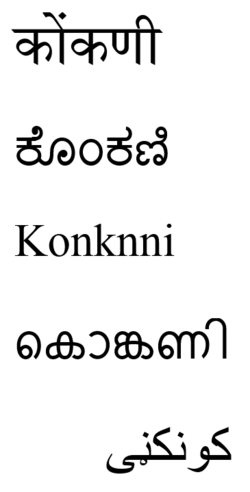
Introjection would have been: Konkani is an oral mother that can be written in many scripts, as it has been for centuries – in Romi, Nagari, Kannada, Malayali, Perso-Arabic and now in Gujrati . To mourn its lack of one original script, and then to name that lack in law, would be to say: Konkani is trans-scriptural. Let the child write in the script of his home, and let the state transliterate, not legislate.
Instead, Goa incorporated. The Official Language Act swallowed one script whole and kept the other as a dead body inside it. The Act says Konkani in Devanagari is official. The bracketed (Un)official Romi Konkani is kept alive inside Goa as a phantom official language is celebrated in tiatr competitions on the same day it is denied official status in schools.
The result is the classic cryptophore state: Goans carry two alphabets in one mouth. The mouth is full. It cannot speak freely because each script reminds it of a dead it has not buried.
The Romi writer must prove he is not an outsider.
The Nagari writer must prove he is not a Marathi follower( outsider).
Neither is allowed to simply be a Konkani writer.
Conclusion: How to Empty the Mouth
The cure for a script war is not to win it.
Anasemia teaches that a crypt is opened not by choosing one dead over the other, but by giving both dead a proper burial through words.
For Goa that would mean linguistic introjection:
Say aloud: Romi preserved Konkani when power banned it. That is not colonial. That is resistance.
Say aloud: Nagari gave Konkani a national dignity after it was called a dialect. That is not communal. That is recovery.
Say aloud: Konkani had no original script because it was born in the mouth, not the hand. Its true script is the voice.
Then the law could do what psychoanalysis does: not declare one script official and the other tolerated, but declare Konkani officially trans-scriptural, with transliteration as state duty. Let official documents be in both scripts, as the Constitution does with Hindi and English. Let the child’s home script be his school script.
Until then, we remain (Un)Homed in our own mother tongue , carrying our mother’s two bodies inside one mouth, unable to kiss either fully.
That is not a language policy. It is an unmourned history that has learned to spell.