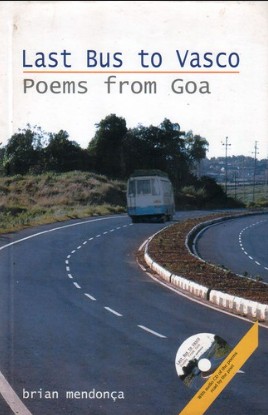
In Brian Mendonça’s evocative collection Last Bus to Vasco: Poems from Goa, the title poem and its companions serve as a poignant elegy for a homeland in flux. One feels the urgency in lines that capture the ebb tide on the Zuari, where the barges furrow the seabed and the waters turn a muddy grey under the morning sun. These verses, born from the perspective of a traveler-poet oscillating between Delhi’s bustle and Goa’s shores, evoke a profound sense of transit not just physical journeys by bus, train, or ferry, but the cultural and existential passage of a people watching their world transform. Mendonça’s work laments the erasure of heritage, the felling of ancient trees, and the quiet dissolution of places, smells, and memories. It is a call to board that last bus before the route vanishes forever.
This poetic sensibility resonates powerfully today against the backdrop of what many Goans term “De-Goanization”the gradual dilution of Goan identity, culture, language, and demographic character in the face of unchecked tourism, large-scale real estate development, migration inflows, and economic pressures that prioritize profit over rootedness. Goa, once a distinctive mosaic of Konkani traditions, Portuguese-inflected customs, Catholic and Hindu syncretism, and vibrant village life, risks becoming a commodified backdrop for outsiders. Traditional occupations fade as land is sold, forests give way to concrete, and local voices are drowned out in the cacophony of seasonal visitors and external investors. The “last bus” feels increasingly like the final opportunity for authentic Goans to steer their collective destiny.
Friedrich Nietzsche’s concept of the “Last Man” in Thus Spoke Zarathustra offers a stark philosophical mirror for this crisis. Nietzsche warns of a future populated by complacent figures who have invented happiness through comfort and smallness: “Alas, the time of the most despicable man is coming, he that is no longer able to despise himself. Behold, I show you the last man. … ‘We have discovered happiness’ say the last men, and they blink.” These Last Men ask no grand questions what is love? creation? longing? a star? and shrink the earth to fit their modest desires for warmth, security, and entertainment. They blink passively as vitality drains away.
Applied to contemporary Goa, the Last Man archetype warns against a passive acceptance of De-Goanization. It is easy to blink at the influx of outsiders transforming coastal villages into tourist enclaves, at the sale of ancestral properties, or at the marginalization of Konkani in daily affairs. Comfort derived from tourism revenue or urban amenities can seduce communities into making everything small reducing a rich cultural tapestry to beach shacks, parties, and real estate flips. The Last Goan, in this framing, becomes the complacent inheritor who watches heritage dissolve without resistance, content with the superficial “happiness” of economic trickle-down while deeper roots wither.
Yet Mendonça’s poetry rejects such fatalism. In “Requiem to a Sal,” he mourns a felled tree with visceral intensity:
“They came
Armed with axes,
And split its bark with gashes
In a frenzied madness.
…
Stroke after stroke
They hack relentlessly,
Until,
With a mighty shudder
What was, ceases to be.
‘New buildings coming up’ they said.”
The poem cries out against the loss: “O hear my cry piteous Mankind! / As years roll by, and you multiply, / Will we be bereft of Nature’s supply?” This is no passive blinking. It is a lament that demands awakening, a refusal to let the last sal tree, the last traditional bhattkar home, or the last authentic Goan feast become mere relics.
The “Last Goan,” then, need not embody Nietzschean decline. Reimagined as the final authentic guardian or better, the vanguard, it becomes a figure of agency. Every Goan today can claim this mantle: the last generation with living memory of pre-boom Goa, the last fluent speakers of certain dialects, the last stewards of communal harmony rooted in centuries of coexistence. To take charge of destiny means rejecting the Last Man’s blink and embracing creative, defiant action to preserve and evolve Goan identity.
De-Goanization manifests on multiple fronts. Demographically, rapid in-migration alters village compositions, straining resources and social fabrics. Economically, land speculation prices out locals, converting paddy fields and orchards into villas and resorts. Culturally, globalized consumerism overshadows festivals, cuisine, and crafts, while environmental degradation deforestation, polluted rivers like the Zuari threatens the very landscapes that inspired Mendonça’s verses. Political responses have sometimes lagged, caught between development imperatives and identity concerns. The result is a slow erosion: Goan youth migrating out for opportunities, elders lamenting lost susegad (the famed laid-back spirit), and a growing sense that Goa is becoming unrecognizable to itself.
Countering this requires Goans—each as a “Last Goan”to seize initiative. Local entrepreneurship in sustainable tourism, agro-ecology, and cultural revival can reclaim economic agency. Strengthening Konkani education and literature, supporting writers like Damodar Mauzo or Pundalik Naik alongside Mendonça, nurtures linguistic pride. Community cooperatives for land stewardship, heritage mapping, and eco-activism can resist unchecked development. Political mobilization through panchayats, civil society, and informed voting must prioritize Goan-centric policies: regulated migration, heritage zoning, and investment in local talent.
Nietzsche’s Last Man thrives in apathy; the Last Goan must cultivate creative contempt for complacency. Mendonça’s traveler-poet, writing from afar yet tethered to Goa, models this: documenting loss while affirming beauty and urging action. Poems that dissolve “places, smells, memories, distances” under night zephyrs remind us that identity is fluid yet anchored. Goans in the diaspora, too, carry this responsibility—remittances paired with cultural advocacy, or skills brought home for renewal.
The path forward is not nostalgic isolation but dynamic stewardship. Goa’s hybrid history that includes Portuguese, Indian, indigenous equips it uniquely for synthesis rather than surrender. By drawing on thinkers like Francisco Luís Gomes or Tristão de Bragança Cunha, historical advocates for Goan agency, modern voices can forge a future where tourism enriches rather than erodes, and development serves rootedness.
Ultimately, the last bus to Vasco is boarding now. Will Goans watch it depart, blinking like Nietzsche’s Last Men, or will each rise as the Last Goan taking the wheel, charting destiny, and ensuring that the muddy grey waters of the Zuari reflect not just loss, but renewed clarity and purpose? The choice defines whether Goa remains a living culture or becomes a faded postcard. In Mendonça’s words and Nietzsche’s warning lies the imperative: awaken, create, and claim what is yours before the final stop.