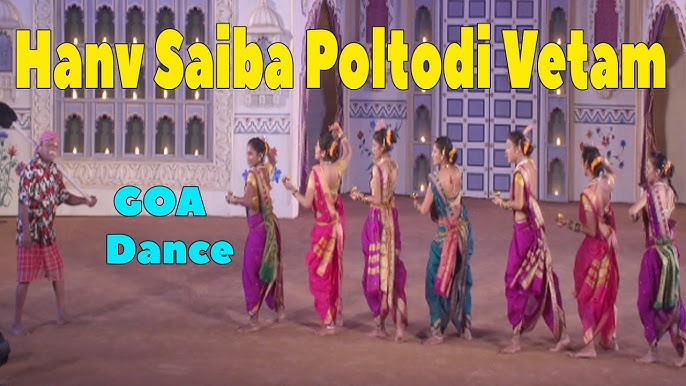
Dekhni stands as one of the most captivating expressions of Goan cultural identity, a semi-classical folk dance and song form that weaves together the intricate threads of indigenous traditions and colonial legacies. Emerging from the vibrant social and religious life of Goa during Portuguese rule, Dekhni performances typically feature women dancers in elegant Indian attire, gracefully balancing small clay lamps known as divlis on their hands. These performances blend fluid, expressive Indian dance movements with rhythmic and melodic elements drawn from Western music. Among the most beloved and iconic pieces in the Dekhni repertoire is “Hanv Saiba Poltoddi Veta,” often translated as “I Am Crossing to the Other Side of the River.” This song, composed in the late 19th century by Carlos Eugenio Ferreira, captures themes of desire, negotiation, and playful seduction while serving as a profound example of cultural resistance achieved through the creative imitation, or mimesis, of Western musical forms particularly the violin.
The song tells a lively narrative rooted in local folklore. It depicts temple dancers, reminiscent of traditional kolvont or devadasi figures, who need to cross a river to attend a wedding. They approach a boatman with charm and offerings, pleading for passage. The lyrics, written in Konkani, are direct and evocative:
“I am going across the river, sir, to attend Damu’s wedding… Show me the way… Take this, sir!”
The dancers offer anklets, nose rings, and other jewelry, which the boatman initially refuses before eventually relenting. In live performances, the artists enact this scene with sinuous, hypnotic movements, building tension through gesture and expression until resolution. The piece is often accompanied by a mix of instruments: the deep, resonant beats of the traditional Goan ghumot drum provide the indigenous pulse, while Western strings especially the violin carry soaring melodic lines that give the music its distinctive elegance and emotional depth.
To understand the song’s significance, one must look at the historical context of Goa under Portuguese colonial administration, which lasted more than four and a half centuries. From the early 16th century, Portuguese colonizers introduced Western education, religion, and arts into Goan society. Parish schools and church choirs became centers for musical training, where local musicians learned European techniques, including Gregorian chant, harmony, and the playing of instruments like the violin. The violin, in particular, became deeply embedded in Goan musical life. It was not just an imported novelty but a tool of cultural assimilation promoted through religious and educational institutions. Goan musicians achieved remarkable proficiency, with some even crafting high-quality violins locally. This instrument, associated with European classical traditions, waltzes, and salon music, came to symbolize the colonizer’s cultural dominance.
In “Hanv Saiba Poltoddi Veta,” the violin plays a central role. Its bright, expressive tones weave through the composition, providing lyrical phrases and rhythmic drive that echo European musical structures. These violin melodies float above the Konkani lyrics and the earthy percussion of local drums, creating a rich, layered sound. On the surface, this appears to be straightforward adoption Goan artists embracing the musical language of their rulers. Yet, a closer examination reveals something far more complex and subversive: a deliberate strategy of mimesis that transforms imitation into an act of quiet resistance.
The concept of mimicry in postcolonial contexts, as explored by thinkers like Homi K. Bhabha, helps illuminate this dynamic. Mimicry occurs when the colonized imitate the colonizer’s culture, producing something that is “almost the same, but not quite.” This slight difference creates ambivalence and undermines the authority of the original. In the case of Dekhni, the mimicry of Western violin techniques does not result in a faithful copy of European music. Instead, it generates a hybrid form that disrupts colonial binaries. The violin is bent to serve local narratives stories of female agency, sensual negotiation, and community rituals that draw from pre-colonial Hindu temple traditions even as they exist within a Christian-influenced Goan society. By infusing European melodic sophistication with Konkani language, folk rhythms, and indigenous dance, performers assert their own cultural vitality rather than surrendering to assimilation.
This hybridity functions as resistance in several interconnected ways. First, it preserves and revitalizes local identity. While colonial policies encouraged the adoption of Portuguese language, music, and customs, forms like Dekhni allowed Goans to maintain linguistic and performative sovereignty. The Konkani lyrics keep the song firmly rooted in the lived experiences of the people, recounting tales that resonate with Goan social life, including the crossing of literal rivers as well as metaphorical boundaries between tradition and modernity, desire and restraint. The violin’s Western elegance polishes these stories without erasing their essence, creating an art form that feels authentically Goan precisely because of its blended nature.
Second, the mimicry carries an element of subtle mockery and subversion. The graceful Dekhni dance, performed with poise and seduction to violin accompaniment, can be interpreted as playfully parodying colonial ideals of “civilized” European performance. Where colonial authorities sought to impose refined Western arts as superior, Goan artists demonstrated how those same tools could amplify indigenous sensuality and wit. The boatman’s reluctant yielding in the song mirrors broader themes of negotiation with power offering just enough of the colonizer’s language to gain passage, while ultimately steering the cultural journey on local terms. This ambivalence exposes the incompleteness of colonial control: the more perfectly the violin is played in a Goan context, the more clearly it reveals the creativity and resilience of the people who have made it their own.
Third, Dekhni highlights the creative power of cultural blending. Goa’s history is one of constant exchange, with influences flowing between Hindu, Catholic, and folk traditions. The song emerged in regions such as Bardez, Ilhas, and Salcete, areas known for rich musical innovation. Musicians trained in church settings brought their skills back to community celebrations, weddings, and festivals, where Dekhni thrived. The result is a “rapsodia Ibero-Indiana”, a creolized musical expression that reflects colonial reality while actively reshaping it. Far from being passive recipients of Western music, Goan artists actively remade the violin into an instrument of local storytelling and emotional expression.
The enduring popularity of “Hanv Saiba Poltoddi Veta” underscores its cultural importance. The piece continues to feature prominently at Goan weddings, cultural festivals, and diaspora gatherings around the world. It has inspired adaptations in films and modern musical interpretations, where contemporary artists experiment with new arrangements while honoring the original fusion. In today’s globalized world, the song offers a powerful reminder of how cultures navigate power imbalances. What began as a colonial imposition, the violin has become a native voice within a distinctly Goan soundscape. Younger generations of musicians and dancers continue to perform it, finding fresh relevance in its themes of crossing boundaries and claiming agency.
Ultimately, “Hanv Saiba Poltoddi Veta” exemplifies the transformative potential of artistic mimicry. Through the violin’s strains, Goans did not merely copy Western music; they dialogued with it, challenged it, and reinvented it. This process of mimesis turned a symbol of domination into one of empowerment, producing a hybrid art form that resists erasure and celebrates complexity. In an era when cultural identities face pressures from both globalization and revivalist purism, Dekhni offers a model of strength through synthesis. The song’s river crossing becomes a metaphor for cultural survival: navigating turbulent historical waters with grace, charm, and unyielding creativity.
By embracing and subverting the colonizer’s musical language, Goan performers in Dekhni have crafted something enduring and alive. “Hanv Saiba Poltoddi Veta” stands not only as a beautiful piece of music and dance but as a testament to the human capacity to resist through art that enable the remaking imposed forms into expressions of identity, resilience, and joy. Its violin melodies continue to echo across time, reminding us that true cultural power often lies in the spaces between imitation and innovation. This is why Goan-ness is mimetic form of resistance .