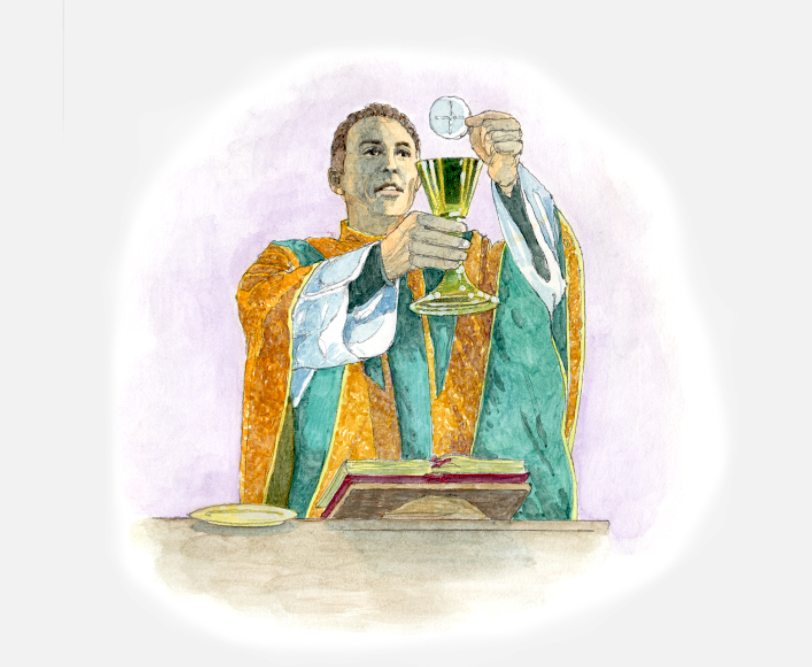
In an age marked by rapid secularization, social fragmentation, and cultural upheaval, the role of the priest stands at a crossroads. Traditionally, the priesthood has been associated with the sacred spaces of the altar and the pulpit sites of Eucharistic celebration and proclamation of the Gospel. Yet, the deeper call of ordination extends far beyond these confines. It invites priests to embody Christ’s presence in every sphere of human life. The challenge today is to transform markets, universities, media outlets, social platforms, and cultural arenas into new altars and pulpits where faith encounters the world not as a stranger but as a servant.
This vision demands a profound shift: from an inward-looking, self-seeking Church to a servant model of communion. It points toward a synodal Church that walks not only with its own members but with the entire society. The late Fr. Bolmax Pereira of Goa stands as a luminous example of this vocation lived fully. A parish priest, professor, environmental activist, and unwavering voice for the marginalized, Fr. Bolmax demonstrated that priesthood finds its authenticity when it steps into the messiness of public life.
Fr. Bolmax Pereira served as the parish priest of St. Francis Xavier Church in Chicalim. Ordained in 2004, he earned a Ph.D. and became known not merely for liturgical duties but for his fierce advocacy for environmental justice, organic farming, and the rights of the poor. He confronted land misuse, defended Goa’s natural heritage, and lent his voice to the voiceless. In doing so, he turned public discourse, local governance, and community activism into extensions of his priestly ministry. His life was not confined to the sacristy; it unfolded in fields, public meetings, and struggles for ecological balance. He showed that the priest is called to be alter Christus another Christ not only at the altar but in the arena of societal transformation.
The temptation for the Church has often been to retreat into a comfortable interiority. Clergy and laity alike can become preoccupied with internal affairs maintenance of institutions, preservation of traditions, or safeguarding ecclesiastical power. This self-referential mode risks turning the Church into a self-serving entity rather than a beacon of hope. Jesus Himself modeled a different way. He preached in synagogues but also in marketplaces, on hillsides, and at dinner tables. He healed in public spaces and challenged the powerful in the temple courts. His priesthood eternal and universal was exercised in the world for the world.
Today’s challenge is to rediscover this outward orientation. The market, once seen as a purely secular domain of commerce, can become a new altar where ethical business practices, fair wages, and solidarity with workers reflect the Gospel’s concern for human dignity. Priests and lay faithful engaged in economics can prophetically question exploitative systems, advocate for the common good, and promote enterprises that serve people rather than mere profit. Similarly, the university becomes a pulpit when Catholic intellectuals and chaplains foster dialogue between faith and reason, challenging relativism while engaging honestly with contemporary thought. Education should form not just competent professionals but persons of conscience attuned to truth, beauty, and goodness.
Media and social media present perhaps the most urgent frontier. In an era dominated by digital narratives, the Church cannot afford to cede this space. Platforms reach billions. Priests who courageously enter these arenas offering thoughtful commentary, countering misinformation, or simply sharing the joy of the Gospel turn algorithms into avenues of evangelization. Yet this requires wisdom. It is not about seeking viral fame but about authentic witness. Fr. Bolmax’s example of fearless public engagement, even when it drew controversy, reminds us that prophetic voice in the media age demands both courage and charity.
Culture, too, must be claimed as sacred ground. Art, literature, music, and film shape the human imagination. A priesthood exercised in cultural spheres involves supporting artists who explore transcendent themes, critiquing dehumanizing trends in popular entertainment, and fostering beauty that lifts the soul toward God. The synodal Church envisions this as a collective journey: clergy walking alongside laity, listening to the cries of the excluded, and discerning together how to respond.
This movement toward a servant model echoes the theology of the Second Vatican Council, particularly in its call to read the signs of the times and interpret them in light of the Gospel. It aligns with the emphasis on a “poor Church for the poor” and synodality as a style of being Church together. Synodality is not merely about internal Church processes listening sessions or consultative bodies but about a Church that listens to the world, learns from it, and serves it humbly.
Moving outward requires conversion at multiple levels. First, priests must be formed not only in theology and liturgy but in social doctrine, communication skills, and cultural fluency. Seminaries should prepare candidates to engage confidently with professionals in diverse fields. Second, the laity must be empowered as co-responsible agents of the Kingdom. The priesthood of the ordained finds fulfillment when it awakens the common priesthood of all believers. Third, structures within the Church need reform: less clericalism, more collaboration; less bureaucracy, more missionary zeal.
Challenges abound. Entering public spaces exposes one to criticism, misunderstanding, and even hostility as Fr. Bolmax experienced when his words in a sermon led to legal proceedings. There is the risk of dilution of the Gospel message or co-option by political ideologies. Yet withdrawal is not an option. The Gospel is incarnational; it must take flesh in history.
A synodal Church in society means dialogue with other faiths, with non-believers, with scientists, artists, and policymakers. It means being present in ecological crises, migration tragedies, technological disruptions, and cultural battles over life and family. It calls for a priesthood that consoles the afflicted, challenges the comfortable, and builds bridges where division reigns.
Fr. Bolmax Pereira embodied this. As tributes poured in after his passing, he was remembered as more than a Catholic priest he was the voice of the poor, the defender of nature, and a servant of humanity. His commitment to organic farming, education, and social justice showed priesthood as integral mission. He did not leave his faith at the church door; he carried the altar into the world.
The path forward is demanding. It requires prayerful discernment, communal support, and bold imagination. Parishes can initiate outreach programs that address local needs. Dioceses might create ministries focused on media, environment, and professional ethics. Individual priests, inspired by figures like Fr. Bolmax, can discern specific calls whether in academia, journalism, or community organizing while remaining rooted in sacramental life.
Ultimately, this challenge renews the Church’s relevance. In a world hungry for meaning, authenticity, and justice, a servant Church offers not judgment from afar but companionship on the journey. It transforms the priesthood from a sacred profession into a total gift of self for the world’s salvation.
As we reflect on Fr. Bolmax’s legacy, may it inspire a new generation of priests and laypeople to step beyond familiar walls. The altar and pulpit remain central, but they are launching pads, not endpoints. The true measure of priesthood lies in how deeply it penetrates the realities of human existence. bringing Christ where He is most needed: in boardrooms and classrooms, on screens and streets, in policies and protests.
This is the synodal vision: a Church walking together with humanity, serving humbly, proclaiming boldly, and loving relentlessly. It is a high calling, but one worthy of the One who washed His disciples’ feet and laid down His life for all.