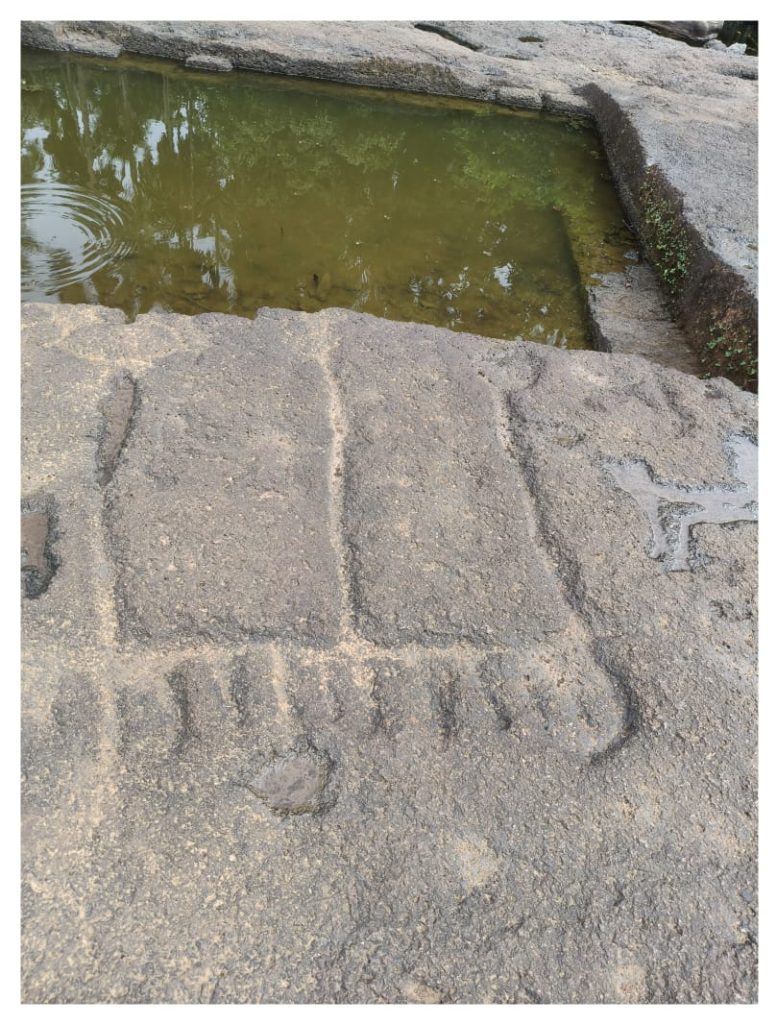
In the riverine landscapes of South Goa, where the Kushavati flows through verdant hills, lies a silent testament to one of India’s most ancient human settlements. The Usgalimal rock engravings, also known as Usgalimol or Pansaimol petroglyphs, sprawl across a vast laterite bedrock spanning thousands of square meters. Discovered in 1993 by alert local farmers and archaeologists, these carvings emerge dramatically when the river recedes, offering a fleeting glimpse into a world that predates recorded history by millennia.
The site features an astonishing array of imagery: symbols of fertility cults, intricate representations of religious cosmology, the enigmatic Triskelion, engravings of animals, oversized human footprints, animal hoof prints, dynamic scenes of humans chasing prey, and distinctive “x-ray” style bulls that reveal internal structures in a manner reminiscent of ancient symbolic art worldwide. These are not casual doodles but deliberate, community-crafted expressions etched into stone with tools from a pre-metal age. Notably absent are motifs associated with later agricultural revolutions :no ploughs, no bullock carts, no birds in typical domesticated contexts, and crucially, no horses. This absence strongly suggests the carvings belong to a period far earlier than the Chalcolithic or even Neolithic eras, potentially dating back around 8,000 years or more to Mesolithic hunter-gatherer societies.
This prehistoric canvas points to the Kush people, early tribal inhabitants who are credited with laying the foundations of what is sometimes called the Kusavati or Curdi civilization along the riverbanks. The Kushavati region appears to have supported sustained human activity long before the arrival of Indo-Aryan influences or the structured varna systems that would later define much of India’s social landscape. The rock art speaks of a society deeply connected to nature, ritual, and cosmology focused on fertility, hunting, and perhaps shamanistic practices rather than settled agrarian hierarchies or temple-based worship that characterized later periods.
The story deepens with the fate of Curdi village itself. Nestled along the Kushavati, Curdi was a living link to these ancient roots. The construction of the Selaulim Dam in the 1970s-80s submerged much of the village and surrounding areas, displacing around 643 families. This modern development not only erased physical traces of continuous habitation but also forced the relocation of sacred elements. A revered Mother Goddess idol from Curdi was carefully transferred to the Malsa temple in Verna. Significantly, this Mother Goddess predates the Mahadev Temple in the region, which was itself shifted closer to the dam. The primacy of the feminine divine here hints at a pre-historic matriarchal or matrifocal culture in Goa, where goddess worship and female-centered rituals may have held central importance before patriarchal structures gained prominence.
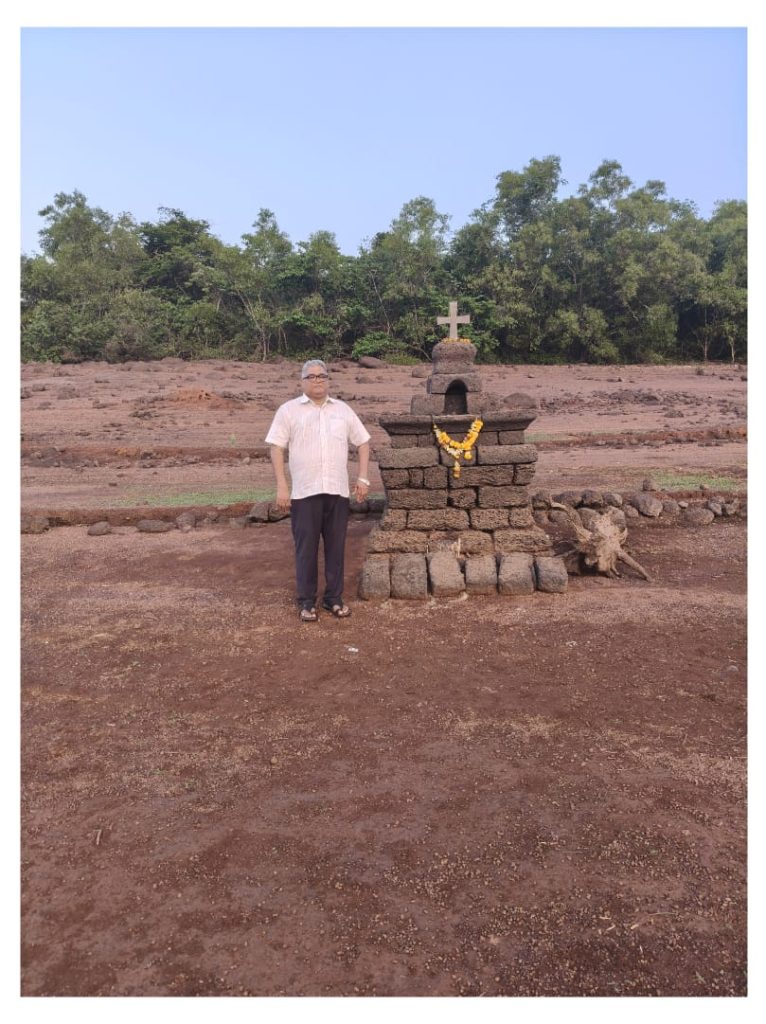
Catholic communities in our times like the Hindu brethren in the area faced similar upheaval, abandoning homes, chapel, crosses and ancestral lands to resettle in places like Vadem and other parts of Sanguem. The dam’s reservoir created a poignant phenomenon: for most of the year, Curdi lies underwater, a submerged ghost village that resurfaces briefly in drier months, revealing remnants of old structures and reminding visitors of layered displacements both ancient and modern.
These discoveries profoundly destabilize long-held assumptions about Goa’s history, particularly those tied to upper-caste narratives. Central to many traditional accounts is the legend of Parashurama, the Brahmin warrior avatar of Vishnu. According to this myth, Parashurama reclaimed the land of Goa from the sea by shooting an arrow, creating the Konkan coast and settling it with Brahmin communities, notably the Saraswat Brahmins. This story has often been invoked to frame Brahmins as the original civilizers and rightful inheritors of Goan land, positioning their arrival as the foundational moment of Goan culture and society.
The Usgalimal engravings and the evidence of Kushavati’s deep antiquity challenge this timeline and narrative head-on. If human settlements with sophisticated artistic and ritual expressions existed 8,000 years ago thousands of years before the conventional dating of Parashurama’s arrival or the spread of Vedic-Brahminical influences then Goa was neither an empty slate nor a blank canvas awaiting Brahminical “creation.” Instead, it was home to indigenous tribal groups with their own rich cosmologies, social organizations, and spiritual traditions. The matriarchal undertones, evidenced by the older Mother Goddess, further may question assumptions of an inherently patriarchal Brahminical order as primordial.
This prehistoric reality raises uncomfortable questions for reigning historical assumptions among many Goans, especially those invested in upper-caste interpretations. It suggests that the dominant cultural narrative may have overlaid, absorbed, or marginalized earlier layers rather than representing an unbroken origin story. The Kush people’s legacy implies that Goa’s identity is far more plural and ancient than any single migration or divine intervention myth allows. Tribal contributions, often sidelined in favor of later Hindu, Portuguese, or Brahmin-centric histories, emerge as foundational.
Archaeologically, the site aligns with broader patterns in Western India, where rock art reveals complex Mesolithic and early Neolithic societies engaged in symbolic thinking long before metal tools or large-scale agriculture. The lack of later technological markers reinforces the depth of this antiquity. Yet, despite its significance, Usgalimal remains somewhat under-protected and vulnerable, its full context still unfolding through ongoing study. The carvings’ periodic submersion mirrors the submergence of Curdi, symbolizing how both natural forces and human development can bury but not entirely erase the past.
For contemporary Goa, grappling with issues of identity, tourism, development, and cultural preservation, these findings offer a powerful corrective. They invite a rethinking of who “belongs” to Goa and whose stories define its heritage. Rather than viewing history through the lens of later arrivals and dominant castes, the rock art encourages embracing a deeper continuity that includes indigenous tribes, matrifocal elements, and diverse spiritual expressions.
The Mother Goddess at Malsa stands as a quiet guardian of this older way. Her precedence over Mahadev temples underscores that fertility, earth, and feminine power were once at the heart of Goan sacred life. In a region transformed by dams, colonialism, and migrations, the resurfacing of Curdi and the Usgalimal carvings each summer season serve as annual reminders: Goa’s story did not begin with an arrow from the Sahyadri mountains. It began with anonymous artists etching their world onto stone by the Kushavati, building a civilization whose echoes still question and enrich our understanding today.
This prehistoric settlement destabilizes not by negation but by expansion. It does not erase later histories but demands they be placed in proper perspective as chapters in a much longer book. For Goans navigating modern identities amid globalization and internal debates over caste, land, and belonging, the ancient carvings provide a foundation rooted in resilience, creativity, and deep time. They whisper that true heritage lies in acknowledging all layers, from the submerged villages and riverbed etchings to the temples and communities that followed. In doing so, Goa can forge a more inclusive narrative, one where the Kushavati’s ancient voices find their rightful place alongside others in the chorus of its past.