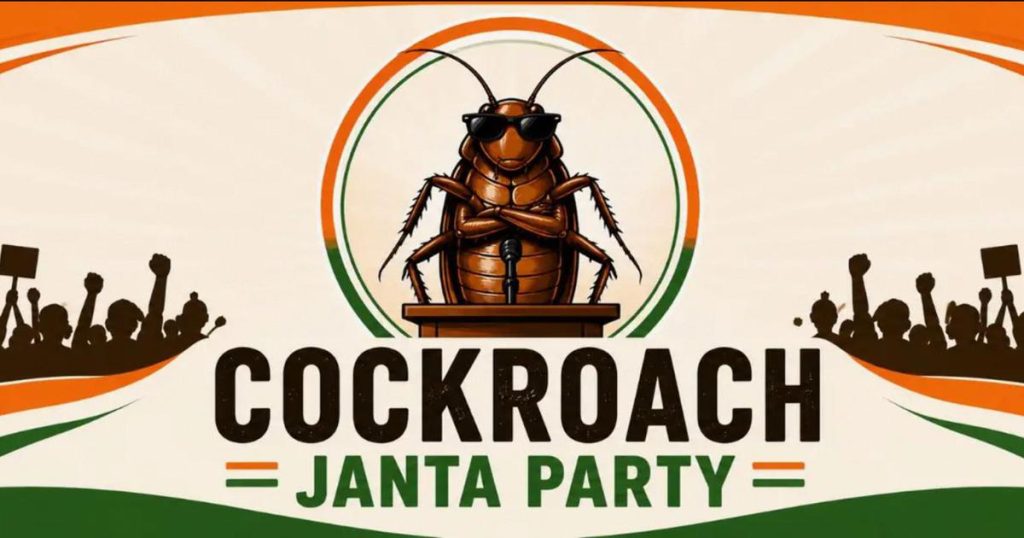
In the digital age, political discourse no longer unfolds primarily in legislative halls or editorial pages. It thrives through rapid-fire memes, ironic hashtags, and participatory satire that spread virally across social media platforms. Philosopher Glenn Anderau, in his work on the function of memes in political discourse, explains how these cultural units act as powerful tools for framing narratives, forging collective identities, and challenging established power structures. Memes simplify complex issues into emotionally resonant, easily shareable packages that allow ordinary citizens to remix dominant stories and create new discursive subject positions. The sudden rise of the Cockroach Janta Party (CJP) in India stands as a vivid example of this dynamic, transforming how young Indians perceive and engage with politics, especially in relation to the ruling Bharatiya Janata Party (BJP).
The movement originated in mid-May 2026 during a Supreme Court hearing. The Chief Justice reportedly used strong language while addressing concerns over unemployed youth entering professions with questionable qualifications. He likened certain individuals to “cockroaches” and “parasites” who later become vocal activists or social media critics attacking institutions. Although the remark was clarified as targeting only those with fake degrees, it triggered immediate backlash among India’s vast youth population already frustrated by high unemployment rates, repeated exam paper leaks, and a feeling of systemic neglect. Instead of remaining silent victims of the slur responded with creative defiance. Abhijeet Dipke, a 30-year-old public relations professional, quickly created the Cockroach Janta Party as a satirical project on social media. By proudly embracing the derogatory label, the “party” positioned itself as the collective voice of the so-called “lazy and unemployed” cockroaches, the resilient survivors who refuse to be crushed.
The idea caught fire almost instantly. Social media handles dedicated to the party gained millions of followers within days, at one point reportedly outpacing even major political parties on platforms like Instagram. Thousands signed up through a simple online form. The movement adopted a tongue-in-cheek yet pointed manifesto that described itself as secular, socialist, and democratic while celebrating “laziness” as a form of honest resistance. Its demands touched on real issues: greater institutional accountability, checks on media misinformation, women’s reservation in important positions, and limits on political defections. The cockroach became a powerful symbol hardy, adaptable, and impossible to eradicate representing survival amid economic hardship and political turbulence. Memes flooded timelines: cockroaches surviving floods and insecticide sprays, satirical songs, parody manifestos, and AI-generated visuals. What began as a joke rapidly evolved into a decentralized, participatory digital phenomenon with state-level variations and attention from opposition voices.
This viral trajectory highlights the unique power of memetic politics in contemporary India. Conventional parties typically rely on hierarchical structures, large rallies, and tightly controlled messaging. The Cockroach Janta Party, by contrast, grows organically from the bottom up. Anyone can create, remix, or circulate content using shared templates. This participatory nature aligns closely with Anderau’s insights: memes function as argumentative devices that condense grievances into affective, humorous forms. They create “affective publics” where laughter becomes a vehicle for critique. In India’s highly polarized environment, where direct criticism can invite accusations of being anti-national or disruptive, satire offers a shield of plausible deniability. It appeals strongly to Gen-Z users tired of binary political choices and seeking new ways to express discontent.
At its core, the Cockroach Janta Party produces fresh discursive subject positions that enable sharp satire directed at the ruling BJP. By willingly adopting the “cockroach” identity, participants invert the intended insult. The establishment, sometimes depicted in accompanying memes as powerful crocodiles or other dominant creatures, appears arrogant and out of touch. The youth, portrayed as numerous and resilient cockroaches, claim moral and demographic superiority through their ability to endure. This framing subtly but effectively highlights perceived policy shortcomings jobless growth, education system failures, institutional erosion, and favoritism toward select elites are areas where the government’s development narrative faces growing skepticism.
Several distinct subject positions emerge through this satire. First is the “resilient survivor.” Cockroaches endure every attempt to eliminate them, mirroring young people navigating competitive exams, instability of the gig-economy, and postponed dreams despite official promises of “Achhe Din.” This position quietly indicts governance that delivers rhetoric more than results. Second is the “united swarm.” Unlike fragmented opposition parties, the CJP envisions a decentralized yet formidable collective that challenges centralized authority. This creates a playful counter-image to the BJP’s strong leadership and majoritarian appeal. Third is the “truth-teller through humor.” By exaggerating their own supposed laziness and worthlessness, participants expose hypocrisies in media coverage, institutional privileges, and political culture without direct confrontation. The humour disarms while the underlying message lands.
These new subject positions are fundamentally transforming Indian political discourse. They accelerate the shift toward “meme wars,” where virality and cultural resonance often matter more than traditional metrics like rally attendance or vote banks. The Cockroach Janta Party has compelled mainstream media and political actors to address youth unemployment and institutional trust, issues frequently sidelined in development-focused debates. It blurs the boundary between entertainment, protest, and nascent political organizing. Is it mere jest, genuine resistance, or the beginning of something larger? Detractors label it as manufactured opposition or a passing fad, while participants view it as an authentic outlet for suppressed frustration. Regardless, it forces the BJP and other parties to respond, demonstrating how digital natives have become co-authors of the national narrative.
The movement’s reliance on humour carries both strengths and risks. Satire broadens reach and lowers barriers to entry, but it can also trivialize serious structural problems or breed cynicism instead of sustained action. Virality tends to be short-lived; without deeper offline organization, the energy may dissipate like many previous online trends. Moreover, the us-versus-them binary, while empowering, risks deepening existing societal divides. As Anderau observes, memes excel at emotional mobilization and identity-building but often sacrifice nuance for engagement. In India’s context, where misinformation spreads quickly, exaggerated satire occasionally risks being mistaken for literal truth by some audiences.
Nevertheless, the Cockroach Janta Party represents a significant cultural and political evolution. It reflects broader demographic realities: India’s young population, with a median age around 28-30, possesses rising aspirations alongside growing disillusionment. By reclaiming an insult and turning it into a badge of honour, participants exercise narrative agency in a media landscape long dominated by established powers. The phenomenon carries echoes of global memetic movements but remains distinctly Indian through its mix of Hindi-English wordplay, Bollywood-inspired humour, and competitive creativity.
In conclusion, the rapid ascent of the Cockroach Janta Party demonstrates the potency of memes as tools of political discourse. Following Anderau’s framework, they do not merely reflect politics , they actively shape it by generating subject positions that empower the marginalized to mock and question authority. For the ruling BJP, the movement serves as an unflattering mirror, revealing youth discontent that cannot be dismissed lightly. Whether the Cockroach Janta Party fades into obscurity or evolves into something more permanent, it has already changed the terrain. Politics in India has become inescapably participatory, humorous, and swarm-like. The cockroaches, once scattered and scorned, have formed their party. In doing so, they remind everyone that in the attention economy, the most enduring force may be the one that adapts, multiplies, and simply refuses to disappear.