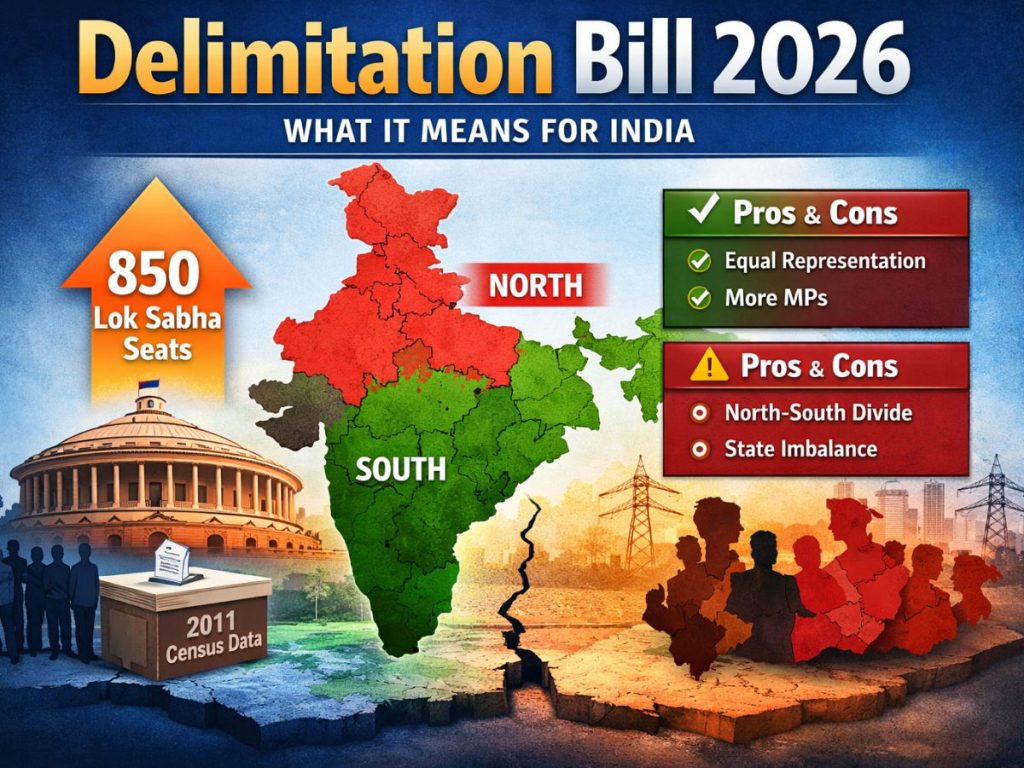
India stands at a defining moment in its democratic journey. In April 2026, the government has introduced the Constitution (131st Amendment) Bill alongside the Delimitation Bill, aiming to expand the Lok Sabha from its current 543 seats to approximately 850. This exercise, intended to implement the long-promised 33 percent reservation for women in Parliament and state assemblies before the 2029 elections, relies on 2011 Census data for reallocating seats among states. For decades, the distribution of seats has been frozen based on the 1971 Census population figures to protect states that successfully controlled their population growth. Now, that freeze is set to end. While proponents hail it as a step toward equitable representation, critics, particularly from southern India view it as a threat to the federal character of the nation. They fear it will tilt power decisively toward the northern states, potentially deepening regional divides and weakening national unity. We need to understand the implications of this to our democracy and not just carried away by the fact that God will get three MP seats. Maybe we have to begin with the context that some commentators draw parallels to narratives that portray external influences as forces seeking to fragment India. The central question is whether this delimitation exercise will ultimately strengthen Indian democracy or push the country toward internal rupture.
To understand the stakes, one must first grasp what delimitation truly means. Delimitation is the constitutional mechanism to redraw the boundaries of parliamentary and assembly constituencies based on population changes, ensuring that each vote carries roughly equal weight. The Indian Constitution, under Articles 82 and 170, requires this process after every decennial Census. India has conducted delimitation exercises in the past in 1952, 1963, 1973, and most recently in 2002 based on 2001 data but these were largely limited to adjusting boundaries within states. The inter-state allocation of seats, however, was deliberately frozen. The 42nd Constitutional Amendment in 1976, during the Emergency period, first imposed this freeze until 2001. Later, the 84th Amendment extended it until the first Census after 2026. The explicit purpose was noble: not to penalize southern states like Tamil Nadu, Kerala, Karnataka, Andhra Pradesh, and Telangana, which had implemented effective family planning programs and achieved lower fertility rates. Meanwhile, northern states such as Uttar Pradesh, Bihar, Rajasthan, and Madhya Pradesh continued to experience higher population growth.
This compromise preserved a delicate federal balance for nearly five decades. Southern states, proud of their achievements in education, healthcare, and economic productivity, felt reassured that their political influence would not diminish simply because they had responsibly managed demographic trends. Today, the total fertility rate in southern states hovers around 1.5 to 1.8 children per woman well below the replacement level of 2.1 while several northern states still record figures above 2.5. Economically, the southern region contributes disproportionately to India’s GDP, with states like Tamil Nadu, Karnataka, and Telangana driving innovation in information technology, automobiles, pharmaceuticals, and services. Their success in human development indicators such as higher literacy, better health outcomes, and lower poverty stands in contrast to challenges persisting in parts of the north.
The proposed delimitation using 2011 Census data dramatically alters this equation. Projections suggest Uttar Pradesh could see its Lok Sabha seats rise from 80 to nearly 140, Bihar from 40 to around 73, Rajasthan from 25 to 48, and Madhya Pradesh from 29 to over 50. In contrast, southern states might experience only marginal gains or even relative stagnation. Tamil Nadu, for instance, may increase modestly from 39 to about 42 seats, while Kerala’s share could remain nearly static. Collectively, the southern states’ proportion of seats in the Lok Sabha would decline significantly, even as the overall house expands. The government has assured that no state will lose seats in absolute terms and that all will gain. Yet the shift in relative power remains the core concern. Southern leaders argue this amounts to punishing states for their developmental successes and rewarding unchecked population growth. They worry that national policies on resource allocation, language, culture, and fiscal matters will increasingly reflect northern priorities, eroding the cooperative federalism envisioned by the Constitution’s framers.
This anxiety resonates strongly in southern India, where a sense of distinct cultural identity rooted in Dravidian heritage, linguistic pride, and progressive social policies has long coexisted with national loyalty. Narratives such as those explored in books highlighting how certain Western-funded foundations and ideological networks have historically amplified regional, caste, and linguistic faultlines find renewed attention here. Some perceive the delimitation not merely as administrative arithmetic but as part of a larger pattern that could be exploited to deepen divisions. Opposition parties have amplified these fears, labeling the move as favoring a “northern-centric” vision of India. They caution that diminished southern voice in Parliament could lead to policies that overlook regional aspirations, potentially fueling demands for greater state autonomy or even separatist sentiments in extreme scenarios.
However, fears of India “breaking” may be overstated when viewed against the nation’s remarkable resilience. India has navigated profound challenges since Independence: the trauma of Partition, linguistic reorganization of states in the 1950s, the Emergency, economic crises, multiple insurgencies, and coalition politics. Its federal structure, though often described as quasi-federal with a strong Centre, has proven flexible. The Constitution provides safeguards through the Rajya Sabha, where states enjoy equal representation irrespective of population. Finance Commissions continue to address fiscal imbalances, transferring substantial resources to states based on need and performance. Economic integration through GST, inter-state migration, cultural exchanges, and a shared democratic ethos bind the country more tightly than ever. Pan-Indian institutions like the judiciary, Election Commission, armed forces, and civil services transcend regional divides. Past delimitations did not lead to disintegration, and the current expansion of seats offers an opportunity to accommodate growing aspirations without absolute losses.
Critics of the southern position emphasize democratic fundamentals. The principle of “one person, one vote” lies at the heart of representative democracy. Perpetual freezing of seats would have perpetuated gross inequities, where a voter in a densely populated northern constituency exercises far less influence than one in the south. In an era when India aspires to become a developed nation by 2047, equitable political representation ensures that the voices of its youthful northern demographic crucial for future labor force and consumption find due space. Ignoring population realities indefinitely would undermine the legitimacy of Parliament itself.
The path forward demands statesmanship rather than confrontation. The government should engage chief ministers from all regions in transparent consultations, perhaps evolving a hybrid formula that balances population with factors like development indices, fiscal contributions, and population stabilization efforts. Strengthening institutions of cooperative federalism such as the GST Council and NITI Aayog could mitigate concerns. Linking future delimitation reviews to incentives for states achieving demographic goals might encourage balanced growth nationwide. Above all, political leaders must resist the temptation to mobilize regional sentiments for short-term gains. The South’s model of development offers valuable lessons for the North, just as the North’s demographic dividend can power national progress if harnessed inclusively.
In conclusion, the coming delimitation exercise is neither an inevitable harbinger of breakup nor a flawless democratic reset. It reflects India’s evolving realities demographic shifts, regional achievements, and the perennial tension between equality and equity. If managed with sensitivity, dialogue, and a long-term vision of unity, it can reinforce the federal compact that has held 1.4 billion diverse people together. India has repeatedly defied predictions of fragmentation by renewing its democratic foundations. The real test lies not in seat numbers but in the maturity with which its leaders and citizens navigate this transition. By choosing integration over division, India can emerge stronger, proving once again that its unity in diversity is not fragile but enduring. The coming years will determine whether this redrawing of the electoral map becomes a chapter of renewal or regret in the nation’s story.