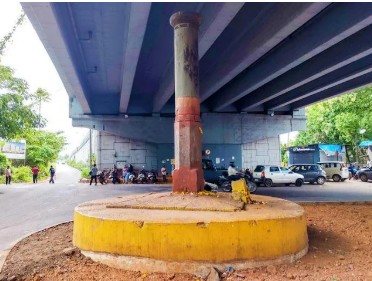
In the historic quarter of Old Goa, where ancient churches and convents stand as testaments to a layered colonial past, a solitary black basalt pillar rises at a prominent crossroads near the Basilica of Bom Jesus. This unassuming yet significant monument, known officially in Portuguese records for centuries as the Pilourinho Novoor New Pillory, has in recent times been referred to in government circles by a different name: Hath Katro Kambo or Hath Katro Khamb. Translated roughly from Konkani as “Hand-Cutting Pillar,” this local name has sparked considerable debate. Historians, heritage researchers, and concerned citizens have raised serious questions about adopting this name officially, arguing that it is rooted more in popular folklore than in verifiable historical evidence. The controversy highlights deeper challenges in interpreting Goa’s complex history, where colonial structures often carry multiple overlapping stories.
Pillories were common features across Portuguese territories from the medieval period through the age of exploration. These stone or wooden columns served as public symbols of civic authority. In towns and cities under Portuguese rule, they were places where local authorities announced royal decrees, municipal laws, and important notices. More visibly, they were sites for corporal punishments such as flogging or public shaming. Offenders would be tied to iron rings fixed on the pillar and subjected to lashes in full view of the community, serving both as deterrence and communal spectacle.
The Pilourinho Novo in Old Goa was one of two such structures in the former capital of Portuguese India. The older one, Pelourinho Velho, stood near the bustling market area. The newer pillar, which survives today, was likely established in the late 16th or early 17th century as the city expanded and administrative needs grew. Historical descriptions portray it as a sturdy basalt column with a cylindrical upper section, a decorative capital, and a lower octagonal base mounted on a square platform. At one time, it featured metal rings for securing those being punished. Over the centuries, the pillar was moved several times due to changes in road layouts and urban development, eventually finding its current position at a busy junction.
Some scholars believe the pillar may have even older origins. Parts of it could have been repurposed from a pre-Portuguese Hindu temple pillar, or stambh, dating back to the Kadamba dynasty that ruled the region in the 12th and 13th centuries. Such reuse of local materials was a practical colonial strategy, blending indigenous craftsmanship with new functions. This possibility adds another layer of cultural history to the monument, showing how structures often carried traces of multiple eras.
In local Konkani tradition, the pillar has long been referred to as Hath Katro Kambo. For many residents, especially in oral storytelling and community memory, the name evokes a darker association. Over the past few decades, particularly through social media, public discussions, and activism by certain groups, this pillar has been increasingly linked to the Goa Inquisition. Stories circulate claiming that individuals, particularly Hindus who resisted conversion to Christianity, were brought here and had their hands severed as punishment. Some versions describe it as a site of severe torture or even executions tied to religious persecution during the period from 1560 to 1820.
These narratives present the pillar as a grim reminder of colonial religious oppression. Hindu organisations and local activists have advocated for its recognition under this name, urging authorities to highlight its significance as a symbol of resistance and historical suffering. They argue that acknowledging Hath Katro Kambo helps preserve the memory of Goan ancestors who faced coercion during Portuguese rule. The name has appeared in official notifications when the Directorate of Archaeology and Archives considered protecting the monument under heritage laws. This formal adoption has intensified the debate.
However, many professional historians and Goan researchers have expressed strong reservations. They point out that after extensive examination of available records, there is no primary documentary evidence linking the pillar specifically to hand-severing punishments or to Inquisition practices. Accounts from the Inquisition period, including contemporary writings by observers and later scholarly studies, do not mention such amputations occurring at this location. Public punishments and executions associated with religious tribunals typically took place at other designated sites in Old Goa, such as open fields used for burnings at the stake.
Hand amputation as a standard penalty does not appear in the documented procedures of the Portuguese Inquisition in Goa. While the Inquisition undoubtedly involved harsh interrogations, property confiscations, and executions, the methods were regulated and recorded. Civic pillories like this one primarily handled secular municipal matters , minor crimes, tax defaults, or public order violations rather than religious offences. The “hand-cutting” association may stem from older local traditions of punishment in pre-colonial times or from general stories of harsh justice that became attached to the visible pillar over generations.
Critics of the new naming argue that transforming Pilourinho Novo into Hath Katro Kambo in official use risks turning a historically documented civic structure into a symbol based largely on legend. They worry this could politicise heritage management and make objective study more difficult. Several experts have suggested a balanced approach: retaining the Portuguese historical name while noting the popular local designation. For instance, referring to it as “Pelourinho Novo, also known locally as Hath Katro Khamb” would respect both documented history and living community memory without privileging one over the other.
This debate is part of larger conversations about how Goa remembers its past. The Portuguese era left behind magnificent churches that attract millions of tourists, yet it also included periods of cultural disruption, temple destructions, and social tensions. The Inquisition remains a sensitive chapter, one that caused real suffering to many Hindu, Muslim, and even Jewish communities in the region. Acknowledging that pain is important. At the same time, not every colonial remnant needs to be reframed as a site of extreme atrocity if evidence does not support it. Doing so can sometimes oversimplify a history that includes trade, cultural exchanges, intermarriages, and the emergence of a unique Luso-Indian identity.
The physical condition of the pillar also deserves attention. Standing near modern traffic and a developing urban landscape, it has faced weathering, pollution, and occasional neglect. Official protection is welcome, but the process should be guided by careful research rather than prevailing popular sentiment alone. Heritage conservation works best when it balances evidence, community feelings, and historical accuracy.
In conclusion, the pillar at Old Goa stands as more than just stone. It represents layers of governance, punishment, cultural adaptation, and memory. Its original Portuguese name Pilourinho Novo connects it clearly to the administrative systems of the empire. The local name Hath Katro Kambo reflects how communities reinterpret landmarks through their own experiences and stories. The ongoing questions raised by historians remind us of the responsibility to handle such symbols thoughtfully. As Goa continues to evolve, preserving this monument with intellectual honesty will ensure that future generations inherit a richer, more nuanced understanding of their shared history — one that honours both facts and feelings without letting one erase the other.