The Sao Joao festival in Goa, a vibrant celebration honoring St. John the Baptist, has often faced opposition from those who argue that its festive nature contradicts the saint’s well-known ascetic lifestyle. Critics point to St. John’s austere existence—living in the desert, eating locusts and wild honey, and wearing simple garments—as evidence that such celebrations are inappropriate.
However, this perspective represents a reductive view of both St. John’s mission and the Christian faith we uphold as disciples of Jesus Christ. Far from being a violation of St. John’s legacy, the Sao Joao festivities embody a theologically rich expression of joy, community, and inculturation, consistent with the life and teachings of Jesus, who came eating and drinking yet was rejected by the self-righteous.
This reflection contests the opposition to Sao Joao by exposing the theological shortcomings of their argument and affirming the festival’s place within Christian tradition.
St. John the Baptist: Beyond Asceticism to Joy
St. John the Baptist is undeniably a figure of asceticism in Christian tradition. His life of self-denial in the wilderness, preparing the way for the Messiah, is a powerful testament to repentance and humility. Yet, to define him solely by his ascetic practices is to miss the fuller significance of his role in salvation history. The Gospel of Luke recounts that St. John “leaped for joy” in his mother Elizabeth’s womb when Mary, carrying Jesus, approached (Luke 1:44). This prenatal expression of joy reveals that St. John’s life was not merely about austerity but also about anticipating the gladness of Christ’s coming.
Moreover, St. John’s ministry as the baptizer of Jesus in the Jordan River (Matthew 3:13-17) ties him to the sacrament of baptism, a moment of spiritual renewal and celebration in Christian life. The Sao Joao tradition of leaping into wells and water bodies in Goa echoes this baptismal act, symbolizing purification and the joy of new life in Christ. Rather than contradicting St. John’s asceticism, this practice honors his legacy by connecting participants to the transformative event he facilitated.
To dismiss such symbolism as unfaithful to St. John is to overlook the profound link between his mission and the joy it heralded.
Jesus Christ: Eating, Drinking, and the Rejection of Reductive Piety
As disciples of Jesus Christ, we look to Him as the fulfillment of St. John’s preparatory work. Unlike St. John, Jesus did not adopt an ascetic lifestyle in the same manner. He attended feasts, shared meals with sinners, and performed His first miracle at a wedding in Cana, turning water into wine (John 2:1-11). This act of divine generosity not only blessed a celebration but also revealed His glory, affirming that God enters into human experiences of joy.
Jesus Himself contrasted His approach with St. John’s, noting, “For John came neither eating nor drinking, and they say, ‘He has a demon.’ The Son of Man came eating and drinking, and they say, ‘Look, a glutton and a drunkard, a friend of tax collectors and sinners!’” (Matthew 11:18-19). Here, Jesus critiques the reductive thinking of His detractors, who rejected both St. John’s asceticism and His own conviviality.
The Pharisees’ condemnation of Jesus for eating and drinking mirrors the opposition to Sao Joao today. Just as they failed to grasp the divine purpose behind Jesus’ actions, critics of the festival fail to see how celebration can coexist with christian faith. Jesus’ ministry demonstrates that fellowship and joy are not antithetical to faith but are integral to it.
As His disciples, we are called to emulate this balance, recognizing that the Sao Joao festivities reflect the incarnational reality of a God who dines with humanity.
Inculturation and Community: Theological Foundations of Sao Joao
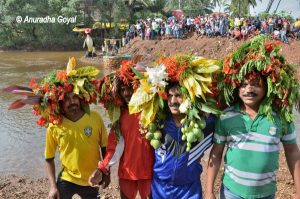
The Sao Joao festival is a beautiful example of inculturation, blending Christian devotion with Goan cultural traditions. Practices such as wearing floral crowns (kopels), participating in boat races, and sharing communal meals weave local identity into the worship of St. John. The Catholic Church has long embraced such adaptations, as seen in the diverse expressions of Christianity worldwide. Far from diluting the faith, these customs enrich it, making the Gospel accessible and relevant to the people of Goa.
The festival also fosters community, a core Christian value. By bringing people together in joyous celebration, Sao Joao mirrors the early Church’s practice of gathering for fellowship and the breaking of bread (Acts 2:42). The opposition’s focus on St. John’s solitary asceticism neglects this communal dimension, reducing Christian life to an individualistic pursuit. Yet, Jesus taught that love for one another is the hallmark of His disciples (John 13:35), and Sao Joao provides a vibrant opportunity to live out this command.
Asceticism and Celebration: A Harmonious Christian Tension
Christian tradition does not pit asceticism against celebration but holds them in tension as complementary expressions of faith. The liturgical year exemplifies this, with seasons of penance like Lent giving way to the exuberance of Easter. St. John’s asceticism prepared the way for the joy of Christ’s arrival, just as the monsoon rains of Goa—during which Sao Joao is celebrated—renew the land for a season of abundance.
The festival’s offerings of flowers and fruits in the kopels parallel the biblical practice of presenting firstfruits to God (Deuteronomy 26:1-11), transforming celebration into an act of gratitude.
To insist that St. John’s asceticism precludes festivity is to misunderstand its purpose. His self-denial was not an end but a means to draw near to God, just as the joy of Sao Joao is not mere indulgence but a way to honor Him.
The festival invites participants to engage fully—body, soul, and spirit—in praising the God who became flesh and dwelt among us.
Conclusion
The apparent opposition to Goa’s Sao Joao festivities, rooted in St. John the Baptist’s asceticism, seem to rest on a reductive and incomplete understanding of Christian theology. St. John’s life, while marked by austerity, was oriented toward the joy of Christ’s coming—a joy that Jesus Himself embodied by eating, drinking, and celebrating with His people.
As His disciples, we honor St. John not by rejecting festivity but by embracing it as a legitimate expression of faith, enriched by cultural resonance and communal love. Sao Joao is not a betrayal of St. John’s legacy but a celebration of it, inviting us to leap for joy as he did, in the presence of the Savior who redeems all human experience. Let us reject the narrow thinking that would silence this celebration and instead affirm its place in the vibrant tapestry of Christian life and at same time reject wrong practices if any that have creeped into Sao Joao celberations. It does not make sense to throw the baby with bath water. Besides market forces will take control over the festivities and comodify it. Celberationing it in true Christian spirit seems to only way to confront the market take-over of Soa Joao festival