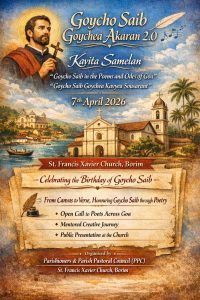
The paintings in our exhibition, “Goycho Saib,” are more than mere representations. They are vibrant objects, pulsating with their own being, transcending their role as human creations or historical tributes. Inspired by object-oriented ontology (OOO), we recognize these works as autonomous entities that speak, withdraw, and resonate in a network of relations with St. Francis Xavier, the land of Goa, and us, the fleeting spectators.
Each painting stands as an object in its own right, irreducible to the artist’s intent or the viewer’s gaze. The hues and shades of Goa are not just colors on a canvas; they are agents, whispering truths about a place, a saint, and a way of being that exists beyond our grasp. These canvases, layered with colors, are not passive surfaces awaiting interpretation. They hum with the weight of their own existence, their brushstrokes and textures forming a silent language.
A depiction of St. Francis Xavier preaching in a Goan setting is not merely a representation; it is an object that interacts with the air, light, and other objects around it, including us. The colors of Goa emerge as co-creators within these paintings, asserting Goa’s presence as a living entity that collaborates with the figure of St. Francis Xavier.
In the OOO framework, St. Francis Xavier appears not as a historical figure but as an object among objects. His autonomy lies in his refusal to be fully captured. The paintings capture him in moments, but these are not portraits of a man; they are encounters with a presence that resonates through time.
Goa itself is no passive setting. In OOO, places are entities with their own depth and agency. The Goa of these paintings withdraws from us, just as the real Goa eludes the tourist’s snapshot or the historian’s chronicle. Its beaches, churches, and monsoons are not accessories to St. Francis Xavier’s story but co-equal objects that assert their own reality.
The exhibition invites us to stand before the paintings as equals, to sense the friction and harmony between Xavier’s asceticism and Goa’s lushness. The paintings refuse to be tools of nostalgia or tourism; they are not here to sell us a postcard version of the state. Instead, they invite us to witness a conversation that began long before us and will continue long after we leave.
The paintings, in their quiet autonomy, remind us that Goa—and all it holds—is a world of objects, speaking in hues and shades that we can only begin to understand. As we walk through the exhibition, we are not the masters of this narrative. We are guests, overhearing a conversation that speaks to us indirectly, inviting us to resonate with the autonomous voices of the canvas. Let us walk with the paintings listening in the spirit of synodality