In the intricate tapestry of human civilization, art has long been celebrated as a medium of beauty, expression, and transcendence. However, philosophers like Boris Groys challenge conventional views of art as a passive or decorative object, instead positioning it as an active force that shapes ideologies, manipulates perceptions, and negotiates the tension between autonomy and control.
Groys’ seminal collection of essays, Art as Power, argues that art constructs the world, wielding influence on rival political and economic systems. At the heart of Groys’ philosophy lies a paradox of art’s claim to autonomy and innocence. Despite being elevated to a realm of “pure” creativity, art becomes a space where power is exercised subtly but decisively.
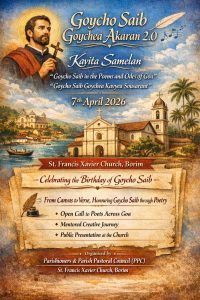
Our art exhibition, celebrating the birthday of St. Francis Xavier, embodies this idea. While acknowledging that no art is innocent, our aim is modest: to picture the intimacies of Goans’ relations with Goycho Saib. We remain aware of art’s entanglement with power and have carefully curated the exhibition to respect the dignity and works of the artists.
In the contemporary world, art’s power lies in its ability to infiltrate networks, shaping public consciousness under the guise of neutrality. However, we wish to unleash the power of art within human creative acumen. Groys’ analysis takes on new urgency in the context of modernity and postmodernity, where the proliferation of images and objects challenges traditional notions of artistic value.
Groys draws from Walter Benjamin’s insights on mechanical reproduction, examining how art’s aura has been eroded by mass production. Yet, rather than lamenting this loss, he sees it as a shift in art’s mode of power. In a world saturated with copies, art derives authority from its capacity to circulate, influence, and disrupt.
For Groys, art’s political potency lies in its ability to dismantle established norms, exposing the fragility of cultural and ideological frameworks. However, its revolutionary potential is double-edged, risking co-option by the very powers it opposes. We are interested in harnessing this power of art, acknowledging its potential as a tool for critique.
Groys’ portrayal of the museum as a battlefield is compelling, highlighting the power struggles between competing narratives. Our exhibition, however, is a table of conversation, inviting diverse perspectives and inclusivity.
In conclusion, Boris Groys invites us to reconsider art not as a refuge from power but as its most cunning expression. By appearing powerless, art secures a unique authority, one that operates beyond the reach of overt coercion. Our exhibition embodies this idea, harnessing the power of art to picture the intimacies of Goans’ relations with Goycho Saib.