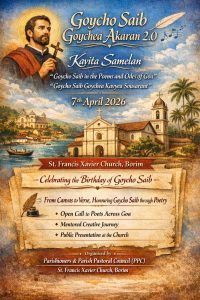
St. Francis Xavier was the first Jesuit to set foot on the land of Goa. He arrived on 7th April 1542 which happened to be his birthday. It is said that he had learnt Konkani. In the letters of the Jesuits we can find that Fr. Paulo writes to Simao Rodrigues in 1558 , ‘he gives so beautiful sermons in the language of the black people as if it was his mother tongue’. Fr Joseph Wicky says that the language of the backs was Konkani. It was called lingua indigena que Goae erat Konkani. It is also said that St. Francis tried to learn Tamil and even Japanese and tried writing catechisms in those languages. He was not a linguist and did not have any desire to write to build literature. He was simply a missionary.
St. Francis Xavier was followed by other brilliant Jesuits. The Jesuits transformed the College of Santa Fe established by Fr. Diogo de Borba into the College of St. Paul. Its purpose was to train young men from different places who were converted to Christianity and send them to their respective places to continue the work of evangelization initiated by the missionaries. Goa being the capital of the Eastern possessions of the Portuguese, it was but natural that an institution like The College of St. Paul was established. Santa Fe of Fr. Diogo Borba was to train only native clergy, hence its limited scope was expanded by the Jesuits.
At the College of St. Paul, the students were encouraged to practice their local language. It is said that there were also Konkani speaking students at St. Paul College. Fr. Antonio Pereira gives their number as 10 but it is not clear about the time when these students were studying. It is likely that they were studying after 1546 when the rules to promote the local language of the students were framed. By 1663 we can find an un-named local Goan scholastic who teaches the Jesuit students and the priests Konkani by means of a ‘ Arte’- grammar. This is why we may call St. Paul College as the first Konkani School of the Jesuits.
It is said that St. Francis Xavier had brought the Portuguese Catechism by Joao de Barros. Xavier is said to have made some adaptations, additions, and annotations and got it published in 1557 at the printing press set up in College of St. Paul in 1557. It became the first book printed in the whole of Asia. This Doutrina was the model for all others to follow from the Franciscans as well as the Jesuit order . Unfortunately, we cannot find the catechism of St. Francis Xavier. It was used in the parish schools of Goa. It seemed to have been lost in the pages of history. It is reported that this catechism was translated in various languages and one of them was in Tamil which become the first printed book in any Indian language.
There were many attempts in St. Paul’ s College to write the grammar in Konkani by the local teachers and many Jesuits who had mastered the language. We do not seem to have them . This learned Jesuits were modelling Konkani to the scholastic grammars of classical languages that they knew. Along with that work they were also collecting lexical items and were creating vocabularies in Konkani and Portuguese. By 1570 there were Konkani grammars and vocabularies to learn Konkani. The schools that were established in Rachol and Choddnem had more elaborate and develop curriculum of Konkani. These two schools produced scholars and men of erudition and brought glory to these centers.
The Rachol School of Konkani has a profoundly interesting history. The Jesuits had started the College of Salcete in Margao at the Holy Spirit Church in 1574. In 1610, this College was transferred to Rachol and later when St. Ignatius became the saint in the Catholic Church, it was called the College of St. Ignatius . The College of Rachol conducted a course in Moral Theology and had a School of Konkani. It was called Escola de Lingua Canarina.
Besides the College of Rachol, the Jesuits had small schools in their residences in Rachol, Verna, Cortalim and Mormugao where they educated the local boys. Fr. Thomas Stevens working at on earlier grammatical works of his predecessors produced Arte da Lingua Canarim. The text is written in Portuguese and follows the scheme of declensions and conjugations like the Latin grammar. He used Roman Script to write Konkani and makes use of diacritical marks.
He also gives examples to manifest the difference between Konkani and Marathi. He has given us the first Konkani Book, Doutrina Christam Em Lingoa Bramana Canarim in 1622 (although he had died in 1619 . It was published posthumously.
An enlarged and revised version of the same grammar was published by Diogo Ribeiro, Stevens disciple and successor in 1640. It is this version that has come to us. Thomas Stevens is immortalized for his work , Christao Purana where he enshrines history of salvation in the literary motifs of a Vaisnava Purana producing a dialogue with Vaisnavism and Catholicism of his time. It was composed in Marathi and was very popular among the people. This work produced inculturation even before, we had the idea and the term to describe. It is also said that he had influenced Roberto De Nobili to work with local cultures in his mission.
We also have other spiritual works composed by the Jesuits of the Rachol School of Konkani. Studying them we can understand the state of Konkani in those centuries. The comparative Grammar of Marathi (Decanni) and Konkani titled Janua indica is worth mentioning. It was written by Ignatio Archamone. It is said that Archamone is the one who gave Goan language the name Konkani.
Diogo Reibeiro is to be credited for producing bilingual vocabulary , Konkani -Portuguese tilled Vocabulario de Lingoa Canarym 1526 . Latter two Jesuits Antonio de Saldanha and Miguel Almeida ( The provincial of the India province of the Jesuit, Rector of St. Paul’s College and the Parish Priest of Chicalim. He wrote the famous five volumed Onvaleancho Mollo in 1558 ) did lexicographic work on Konkani in Rachol and the former wrote Vocabulario de Lingua Concanica.
The College of Salcete in Rachol had a printing press and it churned out 16 books in Konkani.
We still have the ruins of Jesuit College of Sam Jeronimo in the Parish of Graca in Chorao . It was a seminary built in 1560. It also promoted the study of Konkani language. The main Literary genres cultivated by the Jesuits in Konkani were Doutrinas, Puranas , Lives of Saints, Vocabularies and Grammars. It is said that the Jesuits disregarded the condemnation of Konkani of 1664 and helped Konkani to survive. Konkani bloomed and flowered even after the expulsion of the Jesuits in 1759 and that the expulsion of the Franciscans and other religious orders from Goa. Today the Jesuit School of Konkani continues with Father Thomas Stevens Kendre in Porvorim