When Portuguese ships carried missionaries to the Malabar coast in the sixteenth century, they brought a Church shaped by Trent, the Inquisition and the confidence of empire. Their theology made a quiet assumption: that the mission field was a tabula rasa, a blank slate on which European Christianity could be written. If the slate was not blank, as with ‘Hindu’(plural cults that will unite later) temples, festivals and kinship customs, it was to be scraped clean.
The Eurocentric Slate
In Goa this assumption became policy. The Inquisition was established in 1560 to bring doctrinal purity. Provincial councils, notably those of 1567 and 1575, prohibited indigenous rites, marriage customs and even the possession of with divine images. Temples in Salcete and Bardez had to go. Converts commonly had to take Portuguese names, wear western dress, and were catechised primarily in Portuguese or Latin (also to some extent Konkani). Faith was treated as a transplant from Europe, and the converts’ own language, symbols and thought-world counted as obstacles rather than resources.
The theological problem was deeper. This approach implied that God had been absent from India until Christians (Portuguese) arrived, and that the gospel could only be understood in European categories. It was a theology about Christ delivered to Indians, rather than a theology in Indian speech.
Thomas Stephens: The Englishman Who Became Indigenous
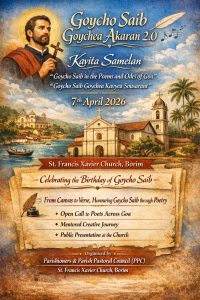
Thomas Stephens (1549–1619), an English Jesuit from Wiltshire, reached Goa in 1579 and spent his life in Salcete, chiefly at Rachol and Margao. His origins matter: an Englishman from a country then hostile to Rome, he was an outsider twice over, and he did what few Portuguese contemporaries did. He learned the people’s language to a level of mastery.
His major works show the shift
The Krishtapurana (1616), a Christian epic of roughly ten thousand verses, narrates salvation history from creation to the Resurrection. It is composed in a Marathi–Konkani idiom and uses the ovi metre, the same poetic form that carried the devotional literature of that time. It borrows the purana genre, the traditional Indian ( upper caste) vehicle for sacred story.
The Doutrina Christam (published 1622), a catechism in the local language ( Konkani). It became the second published in India in Indian language only after a similar one that was written in Tamil and published in Goa.
The Arte da Lingoa Canarim (published 1640), widely regarded as the first grammar of Konkani by a European. It treated Konkani as a language worthy of systematic study rather than a barrier to be overcome.
Stephens never denied the uniqueness of the Gospel, but he changed how it was communicated. He did not erase local forms; he used them as vehicles. This is theology on the pattern of the Incarnation: the Word becoming flesh in a particular place, tongue and culture. It anticipates what we now call inculturation, and it was a real disruption, because it contradicted the assumption that Christianity required Europeanisation. His contemporaries Matteo Ricci in China and Roberto de Nobili in Madurai pursued parallel paths and met comparable suspicion.
The disruption was not permanent in its time. Konkani was later restricted by official decree in 1684, and the Portuguese language was pressed on Goa’s Christians yet Konkani survived in the homes of simple folks. Stephens’s insight outlived the policy, though. The Krishtapurana continued to be read and sung, and today it is celebrated as a classic of Indian Christian literature.
The Syrian Church in India: Another Kind of Theology
The Christians of Kerala, the St Thomas Christians, offer a revealing contrast. At the time of Stephens, they were neither a mission field nor a blank slate. They were an ancient community, claiming apostolic origin in St Thomas, with their own liturgy, hierarchy and social standing.
Theology in the Syrian Church was largely liturgical, communal and oral rather than speculative. Several features stand out:
1. Ecclesial ties to Persia. For centuries the community received bishops from the East Syriac Church of the East. Its liturgical language was Syriac, and its theological heritage came through the Persian school, with figures such as Theodore of Mopsuestia and the tradition of Nisibis. Its formal doctrine was Antiochene in flavour, though practical knowledge of it among ordinary faithful was thin.
2. Local governance. The archdeacon, called Jathikku Karthavyan (“head of the community”), exercised wide authority alongside the bishop. The community’s life was organised around the Margam (“the Way”) of Thomas, a concept more lived than taught.
3. Deep social integration. The Thomas Christians held a respected place within Kerala’s social order and shared many customs with their ‘Hindu’ neighbours, including purity observances and ritual practices at weddings and festivals. Their theology was inculturated in practice long before the term existed, though rarely articulated as theory.
4. A limited scholarly tradition. Syriac learning was confined mainly to the clergy, the kathanars. Much religious memory lived in songs and folk forms such as the Margamkali and the Ramban Pattu, a narrative song attributed to Thomas Ramban that recounts the apostolic tradition.
The result was a living faith with strong identity but little systematic, written theology in the local language.
Collision with the Latin Model
This community’s encounter with the Portuguese was harsh. The Synod of Diamper in 1599, led by Archbishop Alexis de Menezes, brought the Thomas Christians under Latin jurisdiction. It condemned perceived “Nestorian” errors, revised Syriac books, and many manuscripts were destroyed. The Church’s long-standing ties to the East were severed. Here Stephens’s approach stands in sharp relief. Menezes treated the Syrian tradition as something to be corrected into Latin conformity, a version of the tabula rasa at the level of an ancient Church. Stephens, in Goa, honoured a largely unwritten culture by composing in its own language. One model said you must become like us; the other said the Word can speak in your tongue (Konkani). The Coonan Cross Oath of 1653 expressed the community’s resentment, and the Church fractured. Eventually it developed into the Syro-Malabar and, after 1930, Syro-Malankara Catholic Churches. Their long journey of recovering their own liturgical and theological heritage reflects the same lesson Stephens embodied: faith cannot take root by uprooting a people’s identity.
Why It Still Matters
Stephens’s disruption was modest in scale but profound in implication. It says that theology is not exported like a finished product; it is born again in each culture. This insight prefigures the Second Vatican Council’s affirmation of local Churches and the later work of Indian theologians who seek an authentically Indian expression of the faith.
The two stories, the Latin missionary who learned to sing the gospel in Konkani and the ancient Syrian community who lived it without a written theology, point to the same destination. The Word becomes flesh not on a blank slate but in a particular, already inhabited world.