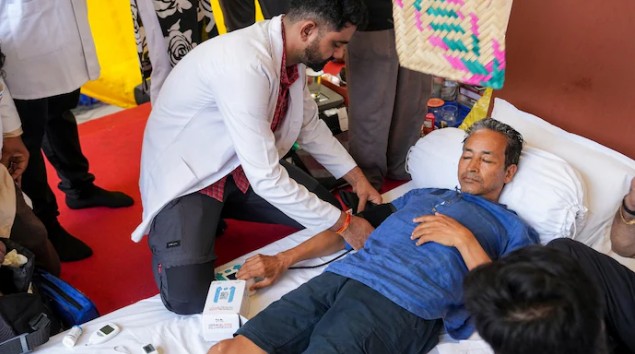
In the bustling yet indifferent heart of Delhi, at Jantar Mantar, a lone figure embodies the fading spirit of non-violent resistance that once defined India’s freedom struggle. Sonam Wangchuk, the visionary climate activist and educator from Ladakh, continues his indefinite fast, now pushing his body to the brink. As reports suggest his health deteriorates with each passing day, the nation faces a stark moral test: will India respond with the urgency this crisis demands, or will it allow another voice of conscience to fade into silence? This is not merely the story of one man’s protest; it is a reflection of how human life is increasingly treated as expendable in the pursuit of political calculations, particularly under the influence of the BJP-RSS combine, whose sensitivity to grassroots suffering appears dangerously diminished.
Sonam Wangchuk’s fast, which began in late June 2026, draws directly from Mahatma Gandhi’s legacy of Satyagraha. Wangchuk, celebrated for engineering artificial glaciers that combat water scarcity in the fragile Himalayan ecosystem, now stands as a symbol for two intertwined struggles. On one hand, he amplifies the anguish of students across India, whose dreams have been shattered by leaks and irregularities in competitive examinations for medical and other professional courses. On the other, he demands greater autonomy and constitutional safeguards for Ladakh under the Sixth Schedule, protection for its unique ecology, and recognition of its cultural identity following its reorganization as a Union Territory. By fasting after paying homage at Rajghat, Wangchuk reminds us that true leadership listens to the margins, not silences them. Yet, as his condition worsens, the response from authorities remains muted, raising alarms about a deeper erosion of empathy in governance.
Human life is precious. This fundamental truth, rooted in India’s civilizational ethos of ahimsa and dharma, seems lost in the current political climate. Wangchuk is not just an activist; he represents the hopes of countless young Indians and indigenous communities fighting for survival. His fast highlights how systemic failures in education are robbing an entire generation of their future. Students who have sacrificed years of preparation now face uncertainty, their aspirations crushed by scandals that demand accountability at the highest levels. By ignoring Wangchuk’s pleas, those in power are effectively sacrificing the future of our children. They prioritize narratives of development and majoritarian pride over the immediate human cost unfolding before them. In Ladakh, melting glaciers threaten water security for millions downstream. Ignoring Wangchuk means ignoring the rivers that sustain the nation. This is not governance; it is a callous gamble with lives.
The BJP-RSS combine, which positions itself as the guardian of Indian culture and values, reveals a troubling valuelessness when confronted with such protests. Promises made to Ladakh after its bifurcation remain unfulfilled, with dialogue processes stalling despite cycles of detentions and releases. In education, the ministry’s handling of examination leaks has been criticized for lacking swift, decisive action, leaving students in despair. This pattern extends beyond Ladakh. In Goa, local communities have protested for over a hundred days against mega-projects that threaten hills, rivers, farmlands, and traditional livelihoods. Their journey to Delhi for intervention underscores the disconnect between central policies and regional realities. Yet, engagement remains slow, coordination feeble. Even controversies surrounding the Ram Temple in Ayodhya, involving allegations of mismanagement of donations, have exposed gaps in transparency within institutions meant to symbolize cultural revival. Critics argue that an administration focused on economic growth, infrastructure, and security often frames protests as disruptions rather than legitimate cries for justice.
This valuelessness in the BJP-RSS approach is particularly sensitive because it strikes at the core of India’s democratic fabric. The combine’s emphasis on civilizational heritage and national integration is commendable in intent, but its execution appears selective. Infrastructure projects in remote areas are pushed vigorously, often clashing with environmental concerns and local aspirations. Examination reforms are acknowledged as challenging, yet the human toll on youth is downplayed. Development in sensitive regions like Goa is pursued for employment generation, but without adequate safeguards or community consultation, it breeds resentment. When sacred trusts face scrutiny, investigations proceed, but the broader perception of ethical lapses undermines public trust. In this framework, a fasting activist like Wangchuk becomes an inconvenience rather than a catalyst for introspection. The readiness to let him risk his life signals a dangerous normalization of sacrifice not of the powerful, but of those who dare to question.
The urgency of India’s response cannot be overstated. As Wangchuk’s health declines, joined by students and supporters enduring harsh conditions at Jantar Mantar, the window for meaningful action narrows. Immediate medical intervention and empathetic dialogue are essential. The government must address the root causes: bolstering examination integrity with robust technological and systemic safeguards, resuming sincere negotiations with Ladakh’s representatives for autonomy and ecological protection, and ensuring sustainable development models that incorporate local voices rather than overriding them. Civil society, too, has a role to sustain protests constructively, proposing solutions that bridge divides instead of deepening them.
India’s youth are its greatest asset. They carry the burden of educational uncertainties, environmental degradation, and uncertain futures. Allowing Wangchuk to weaken further is not just a failure of policy; it is an assault on the aspirations of millions. The BJP-RSS combine, with its vast organizational reach and ideological influence, has the capacity to lead with compassion. Yet, its perceived detachment fosters cynicism. Protests are filtered through partisan lenses, genuine grievances dismissed as opposition ploys. This polarization risks alienating the very demographic young, educated Indians who will shape the nation’s tomorrow. Human life is precious, and sacrificing it, even indirectly, for political expediency kills not just one individual but the collective hope of a generation.
The spirit of Satyagraha succeeded because it appealed to the conscience of rulers, compelling them to confront injustice. Gandhi’s methods worked because they humanized the struggle, forcing recognition of shared humanity. In today’s India, where rapid modernization clashes with traditional values and ecological limits, reviving this spirit requires more than rhetoric. It demands leaders across the spectrum to rise above electoral arithmetic. For the BJP-RSS, this means demonstrating that cultural pride includes protecting the vulnerable, that development includes environmental stewardship, and that governance includes listening to fasting voices before they fall silent.
Broader challenges compound the crisis. Climate change disproportionately affects regions like Ladakh, where Wangchuk’s work on artificial glaciers has offered practical solutions. Ignoring his warnings endangers national water security and biodiversity. In Goa, the tension between tourism-driven growth and preservation of unique identity mirrors national dilemmas. The education scandals expose deeper rot in institutional trust, where the future of children is bartered for administrative complacency. These issues are not isolated; they reflect a governance model that values headlines of progress over the quiet suffering of citizens.
As India aspires to global leadership as an economic powerhouse, it must not lose its soul. The response to Wangchuk’s fast will define whether the nation honors its moral inheritance or drifts toward a utilitarian calculus where lives are collateral. Urgent intervention medical care, policy dialogues, accountability measures is the least that conscience demands. Students, environmentalists, and regional voices must be heard not as adversaries but as partners in nation-building.
The clock ticks. Sonam Wangchuk’s body weakens, but his message resonates: human life is precious, and the future of our children is not negotiable. The BJP-RSS combine, sensitive to its self-proclaimed role as custodian of Indian ethos, faces a pivotal moment. Will it act with the urgency required, reaffirming the value of every life, or will history record another chapter of indifference? India must choose empathy over expediency, dialogue over dismissal. Only then can the echoes of Satyagraha inspire a truly inclusive democracy, where development serves people, and power serves justice. The time for response is now before another voice of reason is lost, and with it, a piece of India’s conscience.