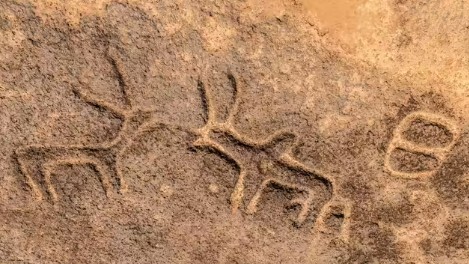
The Usgalimal rock engravings, also known as Pansaimol petroglyphs, represent one of the most important prehistoric artistic achievements in Goa and the broader Western Indian region. Situated along the banks of the Kushavati River in South Goa, these ancient carvings date back to the Mesolithic and Neolithic periods, spanning roughly 4,000 to 10,000 years ago or possibly earlier. Carved into laterite rock surfaces, the site features over a hundred figures including animals, human forms, symbolic patterns, and geometric designs. Together with similar rock art sites from the same era across Goa, they reveal a rich philosophical worldview centered on nature, spirituality, fertility, cosmic cycles, and human interconnectedness with the environment.
The Usgalimal site occupies a unique semicircular rocky platform, naturally enclosed by water channels, creating a liminal sacred space that feels almost like an island. This physical setting itself embodies a philosophy of thresholds between the material world and spiritual realms. The river, with its life-sustaining flow, likely symbolized vitality, renewal, and the underworld. Ancient communities probably used the location for rituals, initiations, storytelling, and communal ceremonies. In this context, art was far more than decoration; it served as a bridge to higher powers, ancestors, and the forces of nature, reflecting a deep belief in the sacredness of the landscape.
One of the most striking elements is the prominent labyrinth carving, a single-path design resembling a coiled serpent with multiple circuits. Unlike mazes offering false turns, this unicursal pattern symbolizes the continuous journey of life, cosmic cycles, rebirth, and spiritual enlightenment. Serpents in such prehistoric art often represented renewal through shedding skin, mirroring seasonal changes and personal transformation. Small cupules or depressions within the design may have held offerings or rainwater, tying the symbol to fertility rites and the regenerative powers of the earth. This motif underscores a cyclical philosophy of existence, where death and life are intertwined, and humans must navigate a sacred, winding path toward harmony with the universe.
Fertility themes and reverence for the mother goddess appear prominently. Sequences depicting human birth from sperm-like forms to placenta and postpartum female figures highlight the sacredness of procreation and the nurturing Earth Mother. Vulva symbols and goddess-like representations emphasize creation, sustenance, and the feminine divine. Footprints carved into the rock suggest journeys to the afterlife or transitions between worlds, pointing to beliefs in the soul’s passage and ancestral veneration. Human figures shown in dancing or dynamic poses evoke ritual ecstasy, communal celebration, and the vitality of life, possibly foreshadowing later cultural traditions of dance and performance.
Animal imagery dominates the engravings, featuring bison, bulls, deer, peacocks, dogs, and snakes rendered with remarkable anatomical detail. This reflects an intimate knowledge of the local environment and a philosophy of respect for fellow creatures. Bulls may symbolize strength, fertility, or ritual sacrifice, while deer could represent sustenance and adaptability. Such depictions suggest totemic beliefs and shamanistic connections, where humans drew spiritual power from animal spirits for hunting success, healing, or guidance. The art conveys a sense of interdependence: humans are not dominant over nature but participants within its balanced rhythms.
Geometric symbols add further depth. Cross-like figures aligned with cardinal directions indicate astronomical awareness and cosmic orientation. Triskelions and other patterns explore ideas of motion, balance, and universal order. These elements point to an emerging proto-scientific understanding integrated seamlessly with spiritual insight, where observation of the stars, seasons, and land informed a holistic worldview.
Overall, Usgalimal embodies an animistic philosophy fused with early shamanistic practices. The natural world is alive with spiritual energy, and rituals expressed through art helped maintain harmony between humans, animals, land, and cosmos. The labor-intensive creation of these enduring carvings likely guided by elders or ritual specialists highlights values of community cooperation, cultural continuity, and the intergenerational transmission of knowledge. In a pre-literate society, the rock art functioned as a visual archive, preserving cosmology, daily life, myths, and collective memory.
Similar prehistoric rock art sites from the same broad era reinforce and expand these philosophical ideas across Goa. In the Curdi area near the Selaulim reservoir, a relocated megalith featuring a mother goddess figure displays strong fertility symbols alongside animal motifs. This artifact, tied to riverine contexts, echoes Usgalimal’s emphasis on regeneration and the sacred feminine. Sites around Mhaus village near Valpoi and in Kajur also contain petroglyphs of animals and abstract symbols, suggesting a regional network of sacred spaces shared by ancient communities in the Konkan region.
These interconnected sites illustrate a common philosophical framework among early Goan inhabitants. They emphasized harmony with the surrounding landscape rivers as arteries of life, rocks as permanent canvases for expression. Fertility cults addressed practical concerns of survival, reproduction, and abundance in a fertile yet sometimes unpredictable tropical environment. Labyrinths and footprints spoke to existential concerns: the soul’s journey, moral navigation, and the search for transcendence. Shamanistic elements imply practices of spirit communication for guidance, healing, and ensuring seasonal prosperity.
Unlike the structured doctrines of later organized religions, this prehistoric spirituality was fluid and experiential. It grew directly from close observation of nature’s cycles, community bonds, and awe at the mysteries of creation. In a period of transition from hunter-gatherer lifestyles toward early agriculture, the art captures both hopes for sustenance and anxieties about change. It promoted resilience by etching cultural knowledge into stone, ensuring that future generations could connect with their origins and purpose.
The philosophy emerging from Usgalimal and related sites is ultimately one of profound interconnectedness. Humans, animals, the land, and the cosmos form an intricate web sustained through respect, ritual, and mindful living. These ancient creators marked the rocks not only to record their world but to express wonder, fear, gratitude, and a quest for meaning beyond immediate survival. Though precise interpretations remain open due to the absence of written records, the power of these images endures in their universal resonance with core human experiences—birth, life’s winding journey, reverence for the wild, and the enduring search for connection.
In the broader cultural heritage of Goa, these prehistoric artworks provide a foundational layer. They remind us that philosophical inquiry is not limited to texts or urban centers but begins in humanity’s earliest creative acts. As modern observers, we find in these carvings timeless wisdom: the importance of living in balance with the earth, honoring life’s cycles, and walking our paths with awareness and humility. Protecting and studying such sites preserves not just artifacts but a deep philosophical legacy that continues to inspire reflection on our place in the natural world.