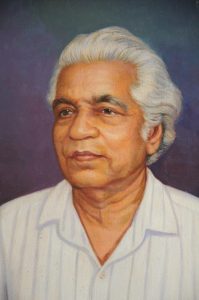
Manohar Rai Sardessai’s Zaiat Zage (Arise, Awake), published in 1964, is far more than a collection of Konkani verses from a newly liberated Goa. It is a poetic intervention against resignation, a demand for collective consciousness at the precise historical moment when formal political freedom threatened to freeze into new forms of domination. Viewed through the lens of Frankfurt School Critical Theory, Sardessai’s work emerges not as regional folklore but as a powerful instance of dialectical critique. Its central imperative to awaken resonates powerfully today, when advanced capitalism has refined its techniques of integration and pacification to an unprecedented degree.
The Frankfurt School, emerging from the Institute for Social Research in the interwar period, developed a radical critique of modern society that refused to separate culture from economics or aesthetics from politics. Thinkers such as Max Horkheimer, Theodor W. Adorno, Herbert Marcuse, and later Jürgen Habermas diagnosed how Enlightenment reason had turned into its opposite: an instrumental rationality that organizes human beings as objects within self-perpetuating systems of administration. Where traditional Marxism emphasized economic base, the Frankfurt theorists foregrounded the cultural superstructure, ideology, and the psychic structures that reproduce domination even after apparent revolutions.
Sardesai’s poetry performs a similar move in the Goan context. Goa’s liberation from Portuguese colonial rule in 1961 did not automatically usher in genuine human emancipation. New elites, bureaucratic structures, and emerging market forces threatened to replace overt colonial masters with subtler mechanisms of control. The poem/song “Zaiat Zage” functions as what Marcuse might call a “Great Refusal” , a rejection of one-dimensional thought that accepts the given order as natural or inevitable. It calls upon farmers, fishers, workers, and the dispossessed to recognize their own potentiality against the false harmony offered by the status quo.
Central to Frankfurt critique is the concept of the “culture industry,” elaborated by Adorno and Horkheimer in Dialectic of Enlightenment. They argued that mass culture, far from being democratizing, standardizes consciousness, turning art into commodity and leisure into another sphere of labor. In this light, Sardessai’s decision to write in Konkani the language of the people rather than the colonizer’s Portuguese or the emerging national lingua franca constitutes a subversive act. It refuses the homogenizing tendencies of dominant cultural forms. The poem’s rhythmic urgency, its oral-musical afterlife through performers like Ulhas Buyao, resists easy commodification. It is art that seeks to awaken rather than soothe.
Today, this critique bites even deeper. The digital culture industry social media platforms, streaming services, algorithmic recommendation systems has achieved what Adorno could scarcely have imagined: the colonization of free time and interior life on a planetary scale. Attention itself has become the new raw material. In Goa and across India, the explosion of tourism, real estate speculation, and extractive industries has transformed landscapes and communities into picturesque backdrops for capital accumulation. The same fisherfolk and tillers Sardessai addressed now face gentrification, environmental degradation, and precarious gig labor in the hospitality sector. The dominant narrative presents this as inevitable “development.” Zaiat Zage disrupts this narrative by insisting on the gap between formal progress and real human flourishing , a classic Frankfurt move.
Herbert Marcuse’s One-Dimensional Man (1964, the same year as Sardessai’s collection) provides another striking parallel. Marcuse described how advanced industrial society flattens oppositional thinking through the satisfaction of false needs and the closing of conceptual space. When critique becomes impossible because the system appears to deliver the goods, transcendence is repressed. Sardessai’s poetry fights this closure. It keeps alive the memory of suffering and the promise of something better. In an era of smartphone-enabled spectacle, where political mobilization often dissolves into performative outrage or managed dissent, the poem’s raw demand to “wake up” retains explosive potential. It reminds us that genuine awakening requires more than clicking “like” on injustice; it demands a transformation of material conditions and consciousness alike.
The Frankfurt School’s emphasis on negative dialectics, particularly in Adorno’s work, further illuminates the poem’s strength. Negative dialectics refuses to resolve contradictions into premature syntheses or happy endings. It dwells in the tension, the non-identity between concept and reality. Sardessai does not offer simplistic nationalist euphoria after liberation. Instead, he highlights the persistent suffering, the unfinished character of freedom. This refusal of affirmative culture is crucial. Contemporary discourses of “Incredible India,” “Smart Cities,” or Goa as a global tourism paradise function as ideological veils. They paper over class contradictions, caste realities, ecological destruction, and the alienation of labor. Zaiat Zage embodies negative dialectics by holding open the wound of unfulfilled emancipation, forcing confrontation with what remains unreconciled.
Jürgen Habermas’s later work on communicative action and the colonization of the lifeworld adds another layer. Systems of money and power, he argues, increasingly invade spheres that should be governed by undistorted communication family, community, culture. In Goa, traditional village institutions, ecological knowledge systems, and local economies have been steadily eroded by external capital and bureaucratic rationality. Sardessai’s call to awakening can be read as a defense of the lifeworld: an insistence that ordinary people reclaim their voice and agency. In the age of climate crisis, this is profoundly relevant. The environmental degradation of rivers, coasts, and hills in Goa is not merely technical but the result of systemic imperatives that prioritize profit over communicative reason and ecological rationality. The poem’s message urges a reawakening of collective will capable of challenging these imperatives.
Critics might object that applying European Critical Theory to a Konkani poet risks cultural imperialism. Yet this objection misses the universalist thrust of the Frankfurt project itself. The School’s thinkers, many of them exiles, always sought to illuminate particular struggles through universal categories while remaining sensitive to context. Sardessai’s Marxism-inflected humanism finds natural resonance with their thought. Both traditions reject positivist resignation and affirm the possibility however fragile of human emancipation through critical self-reflection.
In our present conjuncture, marked by rising inequality, authoritarian populism, technological surveillance, and ecological collapse, Zaiat Zage speaks with renewed urgency. The neoliberal consensus that promised endless growth has delivered precarity for the many and obscene wealth for the few. Digital capitalism has created new forms of false consciousness through personalized echo chambers and dopamine-driven distraction. Yet cracks appear everywhere: farmers’ protests, ecological movements, youth disillusionment with hollow development models. These constitute potential sites for the kind of awakening Sardessai demanded.
The poem does not offer easy solutions, and neither did the Frankfurt theorists. Their strength lay in relentless critique that prevents thought from becoming an accomplice to domination. Similarly, Zaiat Zage functions as a persistent thorn in the side of complacency. It rejects both nostalgic traditionalism and uncritical modernism, seeking instead a dialectical third path , one rooted in the people’s lived reality yet oriented toward genuine freedom.
Ultimately, the enduring power of Sardessai’s work lies in its refusal to let poetry become mere decoration. Like the best products of Critical Theory, it insists that theory and art must serve emancipation or they serve nothing. In a world that increasingly demands we sleepwalk through ecological and social catastrophe, “Zaiat Zage” remains a vital injunction: Arise. Recognize the contradictions. Refuse the administered life. Only through such awakening can humanity move beyond the perpetual reproduction of its own chains.
The poem’s relevance is not historical but dialectical. It illuminates our present precisely because the structures of domination it contested have mutated rather than disappeared. Reading Sardessai with Adorno, Marcuse, and Horkheimer does not exoticize a Goan voice; it reveals the universal human stakes in every particular struggle for dignity. In this sense, Zaiat Zageis not merely relevant today , it is indispensable.