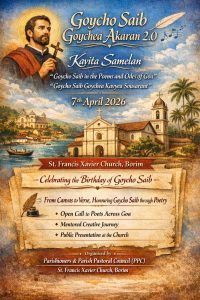
In Goa, the bells of St. Francis Xavier Church in Borim ring for Sunday Mass, for funerals, for feasts. They do not ring for the Inquisition. Yet the Inquisition happened. From 1560 to 1812, tribunals judged faith, punished dissent, and left scars on families who are now dust. Today, most Goan Catholics do not carry that pain in their daily speech. They carry the mando, the ros, the baptism of a grandchild, the funeral mass of a neighbor joyfully. Visitors sometimes ask, with suspicion or with genuine wonder: Why have Goan Catholics forgotten the pain of the Inquisition? The question deserves an answer that is neither denial nor accusation. It deserves the quiet tools of Human Sciences and the deeper light of faith. Forgetting is not simple. It has reasons, and those reasons tell us much about how persons and peoples survive.
The first reason is as old as the psalms: the mind protects itself. Sigmund Freud called it repression. When an event is too large for the soul to hold, the mind places it in a locked room and tries to live in the rest of the house. This is not a lie. It is mercy. A child who sees his father taken away does not rehearse the scene every morning, or he could not eat. He locks it away so that his hands can still fish and his mouth can still sing. After many generations, the lock rusts and the key is lost. The story becomes a shiver without a name. In many Goan Catholic homes, there are such shivers. An old aunt may say, “We don’t talk about that time,” and no one knows what that means anymore. The detail is gone, but the body remembers caution. Repression explains why trauma can disappear from conversation while still shaping habits. It explains why a community can be devout and yet uneasy when certain histories are named. The forgetting is not betrayal; it is the scar left by a wound that was once too deep to touch.
A second reason comes from moments of extreme pressure. Psychologists speak of dissociation. When pain arrives suddenly and there is no escape, the person sometimes leaves himself. He watches from above. The event is not stored as a clean story with beginning and end. It is stored as pieces: a smell of burning, the sound of a Latin sentence, the cold of a stone floor. Later, the person cannot tell what happened, because it was never held together in the first place. Whole communities can dissociate when the world changes too fast. In the 1500s, many Goans faced a choice that was not a choice: change faith , loss of land, family, and safety. Some left. Some resisted and suffered. Some converted and tried to believe. In that chaos, memory could not take minutes. It took fragments. Over four centuries, the fragments were not sewn into a public history because there was no safe table on which to spread them. So they faded. Dissociation helps us understand why descendants may feel a vague grief at certain prayers or places, yet have no words for it. The trauma was real, but the narrative was never born.
The third reason moves from the individual to the village. The sociologist Maurice Halbwachs taught that memory is social. We remember together, or we forget together. A people selects the stories that let it eat at one table. After 1961, Goa had to live with itself. Hindus, Catholics, Muslims, and new migrants from other states had to share buses, panchayats, and markets. To name the Inquisition every day would have been to name a neighbour’s ancestor as persecutor who complained and another neighbour’s ancestor as victim. It would have made tea bitter. So a quiet agreement, never written, settled over the land: we will remember the saints, the festas, the rice harvest, and we will let the rest lie. This is collective amnesia, but it is not a conspiracy. It is susegad as diplomacy. Every society does it. Europe does not begin each morning with the Thirty Years’ War. Japan and America trade goods without reciting Hiroshima at breakfast. Forgetting, in this sense, is the price of a shared future. Goa paid it, and gained decades of relative peace between communities who might otherwise have lived as plaintiff and defendant.
There is a fourth reason, harder to say, but necessary. Psychologist Jennifer Freyd speaks of betrayal trauma. When the one who hurts you is also the one you depend on, the mind often chooses attachment over accuracy. A child beaten by a father who also feeds him may forget the beatings, because to remember would mean losing the only father he has. For centuries in Goa, the Church was both the power that enforced uniformity and the mother that baptized babies, gave last rites, ran schools, and fed the poor. For a convert’s family, to hold only the memory of Inquisition would be to cut oneself from the sacraments that gave life meaning. So the family remembered the mother and forgot the judge. Over time, that choice became culture. The feast of St. Francis Xavier healed what the auto-da-fé had broken, because people needed healing more than they needed a perfect historical ledger. Betrayal trauma does not excuse what was done. It explains why those who lived after chose to love the Church they had. Their love was real, and it covered a multitude of unspoken things. Church to changed . The same locals now run the Church.
A fifth reason is simpler: memory needs a container. If there is no ritual, no day, no monument, no song, the memory has nowhere to sit. Jewish people remember the Holocaust because there is Yad Vashem and there is Passover and there are names read aloud. African Americans remember slavery because there are spirituals, and Juneteenth, and books in schools. Goan Catholics were never given, and never made, a public liturgy of lament for the Inquisition. The Church, after the 1800s, was embarrassed and silent. The state, after 1961, wanted integration, not division. Families, wanting peace, did not build private altars to grief. So the memory, having no chair, left the room. This is socially constructed silence. It is not a plot. It is the absence of a structure. Without structures, even great pain becomes private, and private pain dies with the last grandparent who knew how to cry it.
Finally, the body itself forgets. Neuroscience now shows that memory is not a video file. It is a living path in the brain, and paths not walked grow over. Every time we recall something, we re-save it, and it changes a little. If a community stops recalling a trauma, the neural paths weaken. If the community builds new, safe experiences weddings, tiatrs, football, interfaith help during floods those new paths grow strong and compete with the old fear. After fifteen generations of Masses, rosaries, and neighbourly help, the brain of a Goan Catholic is literally wired more for the Pieta than for the prison. This is not denial. It is healing. God made the brain to prune, or no one could live past childhood.
So why have the Catholics of Goa forgotten the pain of the Inquisition? Because time is merciful, because the mind protects, because the village chose peace, because the Church became mother more than judge, because there was no cup to hold the sorrow, and because new life wrote over old death. None of this means the Inquisition did not happen. It did. It was against the Gospel. The Church has said so. None of this means descendants of victims should be told to “just move on.” Their memory, where it lives, is sacred. But it does mean that the forgetting we see is human, not malicious. It is the same forgetting that lets a widow laugh again, that lets a nation trade after war.
For Borim, and for Goa, the way forward is not to excavate every wound or to cement every silence. It is to do what Christ did at the tomb of Lazarus: weep, tell the truth, and then say, “Come out.” We can tell the truth about 1560 without asking a child born in 2026 to wear it. We can forget in the way God forgets which means: we release the debt, but we still remember the person. We remember that our
ancestors were Konkne / Hindu and Christian and both, that some came to the font in joy and some in fear, and that all are now ours. We remember so we do not repeat. We forget so we can still break bread together.
In the end, the Catholics of Goa have not forgotten because they are faithless. They have forgotten because they are faithful to life. The Cross stands at the center of our churches not as a museum of nails, but as a tree of life. It remembers pain, and it transforms it. That is the only forgetting worth having: the kind that makes room for resurrection. If Goa can show India, and the angry age we live in, that dignity does not need an enemy, then the silence of these centuries will have been a long, patient prayer. And the bells of the church of Borim will ring for that, too.