The world has seen politics over dead bodies. Katrine Verdery’s book, the Political life of dead-bodies: Reburial and Postsocialist Change has deep insight for us on dead-body politics. As recently as 1961, we saw the removal of Stalin’s body originally kept on the side of Lenin in Russia in 1953. This deStalinization campaign took off when a female comrade got up to report that Lenin had appeared to her in a dream and said ‘it is unpleasant to me to be besides Stalin, who brought much misfortune to the party’. Lenin’s body continues to be preserved in a mausoleum and is a place of pilgrimage today. Often a dead person acquires a post-death socio-political life and it is being retrieved to derive political capital by several players. Socialists and anthropologists also see statues of dead people cast in metal or stone as ‘dead bodies’. Hence, to them desecration of the statues also belong to the politics of the dead bodies. The situation becomes complex when it comes relics of saints as the socio-political life of the relic enters the spiritual domain and acquires a cult force of its own. When it comes to Goa, it appears that there is a concerted effort to forget that the cultic realm of the sacred relics of St. Francis Xavier and treat is simply as a dead body and do what is called the politics of dead-body that is studies by Verdery. It seems that politics centered around the sacred relics of the Saint hitherto is a politics of provincializing St. Francis Xavier.
Politics of dead-bodies make use of dead bodies of the political leaders as symbols of political order. We have the famous beheading of the king in France or the dismantling to the statue of Saddam Hussein after the Gulf war declaring an end of an era. The dead-body enters multivocality or polysemy and hence can be politically used as a sign of the end or continuation of an era. This appears to be the politics that is employed by the obnoxious discourse unleased on Goans By Subhas Velinkar. While the colonizer and the colonial rule has reached it closure in 1961, Velinkar unjustifiably sees the continuation of colonial legacy in the legacy of the Saint of Goa. He thus, conveniently also forgets how St. Francis Xavier reached greatness not just in his life but most in his death. The Saint is said to have hardly lived six to seven months in Goa. This too with three interruptions. But became very important to Goa and Goans only in his death when his Body was declared as miraculous after it was subjected to sufficient medical tests by the then religious and civic authorities. After that his body has undergone several medical examinations. This also indicates that it cannot be a body of any other person other than the saint himself. All these studies are available for study and scrutiny. This means the great legacy of the Saint grew after his death and further crystallized and flowered with him being declared as saint in the Catholic Church. It is only from that time the Saint acquired great importance and value in the Catholic world.
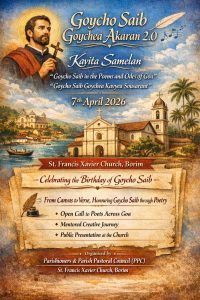
In Goa, St. Francis Xavier is regarded as Goycho Saib. This high regard that Goans give him and believe that he is the protector of Goa produces self-referentiality because of which the highly regrettable rant of Velikar has hurt the sentiments of several right thinking Goans and not just Catholics. This shows how Goans keep St. Francis Xavier in great esteem. There is a sacred dimension to the cult or devotion of St. Francis Xavier. This sacrality cannot be desacralized and simplified by reducing it to colonial times. He belongs to the living tradition of everyday life of the people who come to him to pray for his intervention in their ordinary lives. Therefore, we cannot view his sacred relics as a body alone. It is not simply a corpse. He is more to Goan society and the world over. It is impossible to desacradize St. Francis Xavier. The negative discourse of Velinker and his ilk is trying to desacradize him. His authority does not merely come from colonial legacy. It flows from his holiness of life and deep love for God and humanity. St. Francis Xavier who is looked upon as Goycho Saib does not belong to his space and time but he belongs to our space and time . He was certainly man of his time but he is saint for our times. We cannot look at him in our post-colonial times with a colonial lens. He has risen above the colonial lens and as a living Saint is very much part of our life. Perhaps, the sacred relics of St. Francis Xavier are no longer a dead-body and hence a dead-body politics is deeply disgusting and distasteful for right thinking Goans.