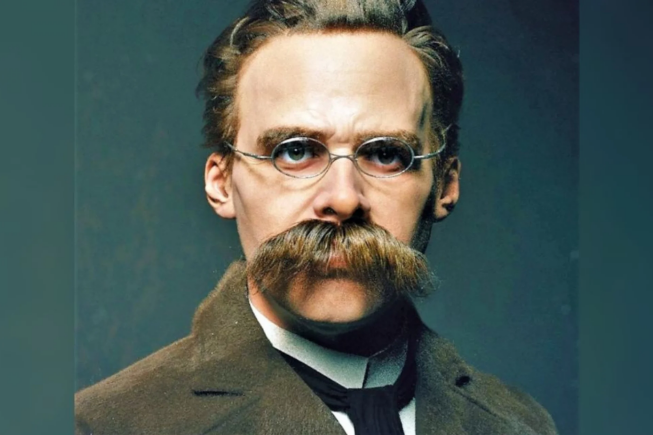
Nietzsche’s God did not die because He was denied. He died because He was praised until nothing was left inside the praise. That is my claim here: the death of God names the hollowing of cataphatic theism. The words stay in place, and their kernel drains away.
1. Starting from the residue
I begin, as I always do, with what is ordinary. It is a Sunday in Goa. The church is full and the litany is long: God is good, God is almighty, God is just, God is love. Nobody doubts the words. Yet I keep asking myself whether anyone still leans their weight on them. Do the attributes still carry us, or do we carry the attributes, the way a procession carries a statue?
Cataphatic theology is the theology of affirmation. It speaks of God by naming Him: Creator, Father, Judge, Truth. Nietzsche’s madman runs into the marketplace with a lantern in daylight and says this naming has already lost its ground. My question is how that happens without anyone noticing.
2. Shell and kernel
The psychoanalyst Nicolas Abraham taught us that a word has two layers. The shell is the meaning everyone agrees on. The kernel is the buried source that first gave the word its life. An anasemic reading goes past the shell to recover what the word once carried.
The decisive point is simple: a shell can outlive its kernel. Form remains, seme departs. A phrase can be recited every week while its substance has quietly gone. This is what I call hollowing. It is not destruction. Destruction is loud, and hollowing is polite. It keeps the façade so well that the emptiness becomes invisible.
So I read the death of God in three moves:
1. Name the shell: the attributes cataphatic theology affirms.
2. Recover the kernel: what those attributes once did for the people who spoke them.
3. Trace the hollowing: how the kernel left while the shell stayed.
3. The madman’s horizon
The shell is clear. In The Gay Science (§125), God is the One of whom much is said: maker, judge, guarantor of good and evil. But listen to the madman’s images. He does not describe the loss of a being. He asks who wiped away the horizon. He asks what happened when the earth was unchained from its sun. He asks whether we are now falling in every direction, with no up or down left.
These are not images of a missing person. They are images of a missing frame. Here is the kernel. “God” in cataphatic speech did more than name a supreme object. It held predication itself together. It made it possible to say firmly that something is good, true or real. In Twilight of the Idols Nietzsche says we will not be rid of God while we still believe in grammar. The kernel of the word was the ground of all our affirming.
Read anasemically, then, “God is dead” does not report that a being has ceased to exist. It reports that our affirmations go on speaking without their ground. The shell talks; the kernel is gone.
4. Apophasis, kenosis, hollowing
Someone will object: is this not simply negative theology? It is not, and the difference is the heart of the matter.
Apophatic theology, from Pseudo-Dionysius onward, removes the predicates in order to protect God. God is not good as we are good, not even being as we are being. The names are emptied so the Named may stand beyond them. Hollowing does the reverse. The names are kept and the Named is lost. Apophasis empties the word to save the reality. Hollowing empties the reality and saves the word.
Kenosis gives us a sharper test. In Philippians, Christ empties himself so that others may be filled. That emptying is a gift. Hollowing is an emptying imposed so that something else stays full. So I ask my usual question: who became empty, and who became full?
In the death of God, the attributes became full. Goodness, truth and justice kept circulating as values, with all their authority intact. What emptied was their warrant. Morality kept its throne and lost its King.
5. The crypt and the phantom
Abraham and Maria Torok describe two ways of living with a loss. In introjection the loss is mourned and worked through. In incorporation it is sealed away, unmourned, in a crypt, and kept as if it were still alive.
The madman ends by asking what the churches are now, if not the tombs and sepulchres of God. That is a crypt. The ceremony continues so that the grief need not begin. The madman also says he has come too early. The deed has been done, but it is still farther from people than the farthest stars. The loss has been incorporated, not introjected.
A crypt in one generation becomes a phantom in the next. Nietzsche tracks it carefully. God’s shadow will be shown in caves for thousands of years (§108). Our will to truth turns out to be the last form of the old faith (§344). The ascetic ideal survives inside science itself, as the Genealogy argues. Secular modernity carries God’s predicates without knowing whose they are.
I must be fair to the other side where i belong. A believer may say the kernel was never ours to lose, because God is not a function of our grammar. A living faith that prays, serves and suffers is no shell. I grant this. The anasemic reading does not judge God. It judges speech that goes on affirming after it has stopped leaning on what it affirms.
6. Putting the kernel back
What would it mean to leave the crypt? Not to stop saying “God is good,” but to stop saying it from habit. The task Nietzsche calls the revaluation of all values is, read anasemically, a work of mourning. It is the hard labour of introjecting a loss we have only buried.
For believers this can be a grace. A faith that has been through the death of God may find its way back to kenosis, an emptying that gives instead of a hollowing that hides. Less litany, and more leaning. The lantern in daylight is still burning. The question is whether we will let it show us the empty shrine.
Sources
* Friedrich Nietzsche, The Gay Science (1882), §§108, 125, 344.
* Friedrich Nietzsche, Twilight of the Idols (1889), “Reason in Philosophy.”
* Friedrich Nietzsche, On the Genealogy of Morals (1887), Third Essay.
* Nicolas Abraham and Maria Torok, The Shell and the Kernel, vol. 1 (University of Chicago Press, 1994).
* Pseudo-Dionysius, The Mystical Theology.
* Victor Ferrao, Garlands for an Empty Shrine: An Anasemic Reading of India’s Constitution, Jnanamrit, 26 November 2026.
* Victor Ferrao, Chronopower: An Anasemic Analysis of Emptying the Present to Rule It, Jnanamrit, 22 November 2026.