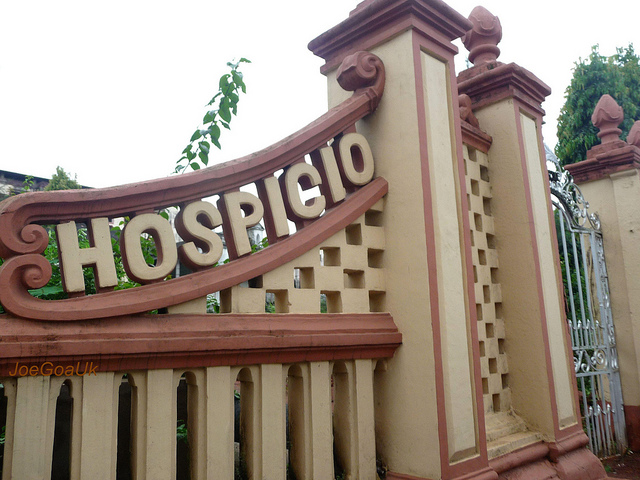
Hospicio is the most Goan word for a hospital. It is not the English hospital, and it is not the Marathi davakhana. It comes from the Latin hospitium: hospitality, the guest-house that receives a stranger.
On 13 December 1867, Fr. António João de Miranda founded the Hospicio do Sagrado Coração de Maria on Monte Hill in Margao. He had seen the poor and sick dying on the streets, and he did something about it: he published an appeal for donations in March of that year, and then went from house to house, begging bowl in hand. People responded from across Salcete and Mormugao, and the Margao community gave the land. The hospital began small, a few beds, one hall and a corridor, and was meant to serve the poor without regard to caste or religion.
Today Margao has two Hospicios, and both have been hollowed.
The Old Hospicio is the heritage building at the foot of the hill. It is mostly vacant now. It still holds a blood bank, a small paediatric palliative care unit and a chapel where Fr. Miranda’s remains rest. The New Hospicio is the 500-bed South Goa District Hospital (SGDH) at Fatorda, commissioned in September 2020 in the middle of the pandemic. It now works largely as a busy hub from which complicated cases are sent on to Bambolim.
Both keep the name. Neither quite does what the name once promised. Anasemic analysis asks: what did the word have to stop meaning for this to happen?
1. What Hospicio originally meant: hospitality
In 1867, the stranger was the old, the destitute, the sick and the dying. Nobody asked whether you were Bamonn or Chardó, Hindu or Catholic, from Margao or from Cuncolim. Hospitality meant one thing: you are sick, so you come in.
The begging bowl matters most here. Ordinarily, begging carries shame. For Fr. Miranda it had to become trust. The rich of Margao gave because they believed the priest would not keep the money. To last, that trust had to be organised, and the Hospicio formed two committees, one to plan and build, another to raise funds and sustain it. Under Fr. Miranda the managing committee stayed in his hands until his death on 20 January 1891. The main building we see today largely dates from a major expansion in the early twentieth century.
So the first hollowing was charity. It stopped meaning only alms and began to mean an institution, with wards, accounts and committees. Charity became competence.
The next change was larger, and I would call it a gentle one. In 1977 the State Government took over the hospital. Private charity became public hospital, and a priest’s begging bowl became a government file. There is nothing sinister in that, because a public hospital is the proper home for public health. The question is what happens to hospitality once it lives inside a file.
2. Second hollowing: from hospital to referral point
The new SGDH was meant to decongest the Goa Medical College in Bambolim and to serve South Goa as a full district hospital. The government’s own figures show what it carries. In the year to March 2025, SGDH admitted 42,755 patients, and 4,683 of them were referred on to GMC. In 2025 it also received nearly 7,000 referrals from primary health centres, more than any other hospital.
The Health Minister has acknowledged some of the strain. He told the Assembly that admissions can exceed the beds available, that patients in emergencies are treated on stretchers until a bed frees up, and that the hospital was short of 187 staff across categories, including nurses and multi-tasking staff. In August 2026 the hospital reported all 500 beds occupied, with the outpatient department touching 1,500 patients a day, and some patients managed on trolleys and wheelchairs in the corridors. In September 2026 the Health Minister conceded the hospital was at full capacity, and opposition leaders said patients were lying on chairs, stretchers and even the floor. In June 2026 a family found an elderly patient assigned a blood-stained, foul-smelling bed.
The government’s response deserves a fair hearing. It has added beds, going from 350 to 500 in 2025. It has signed an arrangement with Apollo Victor Hospital for specialist services. It runs a nine-bed ICU, a STEMI programme for heart attacks, and says posts for a cardiologist, nephrologists and a neurologist have been filled. Yet the same replies describe a cardiologist deputed from GMC once a week and a visiting nephrologist. A critical care unit is still “in the pipeline.”
What got hollowed? Three ordinary words.
Hospital. A hospital is where you are treated. For a referral hub, treatment gives way to transit. The patient arrives, receives a slip and travels thirty kilometres to Bambolim. The slip can stand in for treatment, a kind of new begging bowl in which the patient now begs for a bed elsewhere.
Doctor. A doctor is a healer. When the tools are missing, the doctor becomes the person who signs the referral. This is not the doctor’s failing. It is what a hollowed system makes of a good doctor.
Bed. A bed is a place to lie down and be healed. When the bed count rises without staff, it becomes a number. The Government can honestly say it increased beds. A patient on a stretcher can honestly say that no bed was available. Both are true, because the bed in one sentence is a number and the bed in the other is care. As the hospital’s own staff said at the time, adding 150 beds without additional manpower could compromise care.
This is what I mean by kakistocracy in health: a system that rewards its easiest metric, the number of beds, over its hardest result, the number healed.
3. Third hollowing: from Old Hospicio to “space”
When services moved to the new building around 2021, the old one was left largely empty. By late 2022 reports described bushes and vegetation growing over a heritage complex that had not been maintained, with the blood bank as the only major facility left. The Archdiocese asked the Director of Health Services to hand over a portion for a health care centre, to continue Fr. Miranda’s work. I could not find a record of the outcome in what I read, so I leave it as a question to confirm.
What I can say is how the building is now being talked about. In October 2026 the proposal under discussion is to move the nursing college from the fourth floor of SGDH to the Old Hospicio, which would free that floor for patients. Officials call it preliminary, and a stop-gap. The old hospital, meanwhile, is described as partly dilapidated.
Here the word hospital is hollowed into space: empty square metres waiting to be filled. A nursing college is a good thing and Goa needs nurses, but the chain is worth noticing. The nursing college pushes into the old building, the old building ceases to be a hospital, and the patients are pushed into corridors and on to Bambolim.
Heritage is hollowed too. It stops meaning the memory of healing and starts meaning a structure to be repaired when funds appear. If the funds do not appear, the building decays, and decay can then be cited as the reason it cannot serve as a hospital. That is a self-fulfilling hollowing.
Residue. The chapel still holds Mass and Fr. Miranda’s remains. The blood bank still works. A paediatric palliative care unit still occupies part of the old hospital. Hospicio began as care for people who were suffering and often dying, and today part of it is palliative care for a building. The origin returns as residue.
4. Fourth hollowing: from health to announcement
I want to be careful here, because this one is an argument, not a statistic. In public life a hospital is often most visible when something is being announced: a proposal, a memorandum, a new unit “in the pipeline.” Health, in its ordinary sense, is a body healed. In its hollowed sense it becomes a programme launched. A ribbon needs no doctor.
What gets hollowed is time. The patient needs care now. The announcement is about tomorrow. If the announcement keeps replacing the now, the patient waits in a corridor for a future that is always being promised.
The Chimbel parallel
In my earlier note on the Chimbel Carmelites I traced a convent hollowed from prayer into asylum and then into ruin. Hospicio shows a similar pattern: hospitality hollowed into referral and then into real estate. At Chimbel, priests excluded elsewhere built a house of their own. At Margao, a priest moved by the excluded sick built a house for them. In both cases the state later took the place over, and it is fair to ask whether the people it was built for are still at its centre.
The name survives, and that is the clearest sign of anasemia. The word stays on the new building, the old building waits, and the announcements continue. The name remains and the meaning drifts away.
If Fr. Miranda came back with his begging bowl, he would find a locked and weathered old building with an open chapel, and a new one where patients lie in corridors and a doctor writes a referral because the machine, the ward or the nurse is missing. I think he would see that hospitality had been hollowed into management.
Hospitality says: stranger, come in, I will look after you.
Management says: patient, please wait; I will refer you, renovate, and announce.
Management is not wicked. It is hollow. It has files, but no hands.
What remains
The residue that returns is the visit. The Sisters of Charity, who came to serve at Hospicio in the twentieth century, did what Fr. Miranda did: they went to the sick and stayed with them. That visiting is the least hollowed part of Hospicio.
When Goans say “Hospicio”, they rarely mean a building. They mean the place where a mother delivered her child or a father died with dignity. Indeed , I was born in the then Hodpisio. That memory is the anasemic residue, and no nursing college or administrative reshuffle will erase it.
To restore Hospicio we do not need another building. We need to un-hollow a word: Hospicio must stop meaning a building and mean hospitality again. Hospitality takes a bed, a doctor, a toilet that works, and a hand that cares and heals