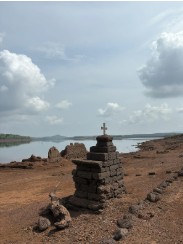
In the verdant folds of the Western Ghats in Sattari taluka, North Goa, the Anjunem Dam rises as a modern engineering feat. Completed in the late 1980s, this medium irrigation project was designed to harness the waters of the region, providing reliable water for agriculture and drinking needs across Sattari and neighboring Bicholim areas. For many residents in the surrounding hills, the dam represented progress, a promise of development in a region long plagued by seasonal water shortages. Yet, this advancement came at a profound cost. Beneath the reservoir’s shimmering surface lie the remnants of four entire villages: Gullem, Pansuli, Kelawade, and Anjune. Their submergence displaced hundreds of families, erasing homes, farmlands, and a way of life deeply intertwined with the land and its rhythms.
The construction of the dam, inaugurated with much fanfare, submerged vast tracts of fertile valley land. Around 344 families found their ancestral villages flooded, forcing a painful relocation to new settlements such as Morlem, Onda, Poriem, and Ravona. Compensation packages included agricultural plots, house sites, and some monetary aid, but no amount of planning could fully cushion the emotional and cultural upheaval. What was lost was not merely physical structures but an entire ecosystem of memory, community bonds, and spiritual connection that had sustained generations.
Before the waters rose, life in these villages unfolded in quiet harmony with nature. Nestled amid dense forests and rolling hills like Vagheri, the communities thrived on rain-fed agriculture, cashew groves, and small-scale farming. Villagers cultivated traditional crops, relying on the seasonal monsoons that transformed the landscape into a lush green paradise. Wells served as the primary source of water, lanterns and oil lamps illuminated evenings, and travel often meant long walks along forest paths to nearby markets or schools. In some hamlets, education stopped at the primary level, with students trekking miles to places like Keri for further studies. Electricity was absent, and modern transport was a distant dream. Yet, this simplicity fostered a profound resilience and closeness among people.
Daily routines were governed by the land’s demands. Men and women worked side by side in the fields, tending to banana plantations in areas like Kelawade whose very name echoes its historical association with these fruits. Children played in the streams and gathered wild fruits from the forests. Evenings brought families together around stories of local folklore, where ancient tribal roots blended with later migrations, such as those of the June Marathe community. Two prominent groups shaped the social fabric: the Saterkars, devoted to the goddess Sateri often depicted in forms reminiscent of protective deities, and the Kelmekars, who revered Gajalaxmi. Village governance once revolved around traditional Gaunkari systems, community assemblies that managed shared resources and disputes with a blend of customary law and mutual consensus.
The cultural life was rich with festivals and rituals that celebrated the cycle of seasons and the bounty of the earth. Temple festivals drew entire villages together, reinforcing bonds through music, dance, and shared feasts. One particularly vibrant tradition was Shigmo, the Goan spring festival, which in these parts featured unique performances like ‘Bharnool’, a man attired as an elderly woman delivering humorous social commentary and entertainment that lightened the hardships of rural existence. These celebrations were not mere events but affirmations of identity, linking people to their deities and to one another in the shadow of the Ghats.
Faith stood at the heart of this existence. Temples dedicated to local deities were more than places of worship; they were anchors of community identity and moral guidance. When the dam’s reservoir began to fill, these sacred sites faced the same fate as the homes. Yet, faith proved remarkably resilient. Villagers carefully relocated idols, sculptures, and sacred artifacts to the new colonies. In Gullem, for instance, temples were rebuilt sometimes duplicating structures so that both old and new traditions could find expression. Major rituals continued in larger rebuilt shrines, while smaller ones preserved intimate connections. Even today, during summer when water levels drop, glimpses of old foundations and temple ruins emerge from the reservoir, drawing former residents and curious visitors alike. These submerged relics serve as silent witnesses to a vanished era, evoking a mix of nostalgia and reverence.
The process of displacement was fraught with difficult choices. Community meetings, such as those held at places like Baravansh, became arenas for debate. Some families resisted, deeply attached to their ancestral lands and fearful of losing their way of life. Others, acknowledging the region’s chronic water scarcity, accepted the inevitability of change for the greater good. Elders bore the heaviest emotional burden. Many recounted tearful departures from homes where generations had lived, leaving behind fruit trees, wells, and pathways etched with childhood memories. One former resident recalled returning years later to the reservoir’s edge, where companions pointed out the approximate location of his family’s old hut and a beloved jackfruit tree now lost underwater. Such visits stir a quiet sorrow, a recognition that the physical landscape had been irrevocably altered.
In the new settlements, life gradually took on new contours. Government-allotted houses and plots provided a foundation, though adjusting to unfamiliar surroundings was challenging. The younger generation benefited from improved access to education, healthcare, and employment opportunities, including government jobs that were previously unimaginable. Reliable irrigation transformed agriculture, allowing for more consistent yields and economic stability. Many acknowledge that material conditions have improved: better roads, electricity, schools, and connections to the wider world. Yet, the transition also brought subtle losses. The intimate forest connection weakened, and the tight-knit rhythms of the old villages sometimes felt diluted amid the new layouts.
Despite these changes, cultural and spiritual traditions endure as lifelines. Festivals continue with the same enthusiasm, temples host regular gatherings, and oral histories keep the past alive. Elders gather to share tales of the old days, passing on knowledge of medicinal plants from the submerged forests or the specific ways deities were honored in hillside shrines. Descendants who never saw the original villages still feel a pull toward the reservoir, visiting during low water seasons or participating in commemorative rituals. Environmental enthusiasts and local historians have documented these stories, highlighting how the villages’ heritage was intertwined with the biodiversity of the Western Ghats that is home to unique flora, fauna, and ecological balance now partially altered by the dam.
The story of Anjunem’s submerged villages echoes similar tales across India, where development projects often pit progress against preservation. Like the more widely known case of Curdi village submerged by another dam, these communities illustrate the human dimension behind infrastructure statistics. The dam today irrigates thousands of hectares, supports local economies, and even attracts tourists who admire the scenic reservoir sometimes called a “Mini Kashmir of Goa” for its misty hills and tranquil waters. Yet, for those displaced, the beauty carries an undercurrent of melancholy.
Ultimately, the submerged memories of Gullem, Pansuli, Kelawade, and Anjune reveal a deeper truth about resilience. A village is more than its buildings or fields; it lives in the people, their faith, and the stories they carry forward. The waters may cover the physical remnants, but they cannot extinguish the spirit that once animated those communities. In rebuilt homes and revived rituals, in the laughter during Shigmo performances and the quiet prayers at relocated temples, the displaced villagers have forged continuity amid change.
As Goa continues its journey of balancing tradition with modernity, the legacy of Anjunem serves as a poignant reminder. Progress demands sacrifices, but honoring the memories—through documentation, cultural preservation, and empathetic storytelling ensures that the submerged past remains a living part of the present. The faith that sustained generations in the hills now strengthens them in new settlements. The village life once defined by simplicity and nature’s rhythms persists in adapted forms, a testament to human adaptability and the enduring power of memory.
In the end, standing by the reservoir on a misty morning, one senses both loss and renewal. The gentle lapping of waters over forgotten thresholds whispers of homes gone by, while the surrounding greenery and thriving communities speak of lives reborn. These submerged echoes invite reflection: in the pursuit of a better future, how do we safeguard the soul of what came before? The answer lies in the hearts of those who remember and in the quiet determination to keep those memories afloat, even as the dam waters rise and fall with the seasons.