The swift advance of artificial intelligence has transformed how we understand human action. Agency no longer belongs only to isolated individuals making independent choices. Instead, AI weaves us into complex networks involving designers who shape algorithms, developers who train models with vast data, users who apply these systems in everyday life, and the technologies that influence results through ongoing interactions. This form of distributed agency resembles an interconnected web where people and machines together create outcomes. It raises tough questions about moral responsibility. When an AI system causes harm, who is accountable for the coder behind the software, the company releasing it, the person using its suggestions, or the system’s own unpredictable behaviors?
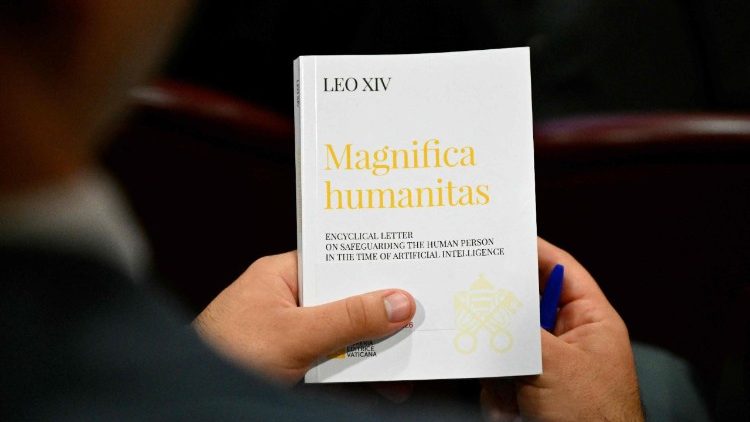
Catholic Social Teaching provides a strong foundation for tackling these issues. It centers on the human person as worthy of respect and deeply connected to others. Its key ideas the primacy of the human person, the common good, subsidiarity, and solidarity offer reliable guidance for handling distributed agency in AI. Pope Leo XIV’s encyclical Magnifica Humanitas, issued on 15th May 2026, builds on this heritage by addressing AI’s challenges head-on. It stresses the need to protect human dignity amid technological change and insists that AI should promote true human growth instead of controlling or weakening it. The letter calls for “disarming” AI, freeing it from forces of dominance, rivalry, and division so it can truly serve humanity’s grandeur.
The principle of the primacy of the human person forms the core of this vision. Each individual holds unique worth, reflecting divine creation, and cannot be reduced to mere data or tools. Magnifica Humanitas highlights that while AI can mimic thinking and tasks, it lacks true conscience, compassion, or spiritual insight. In AI environments, this principle requires that no technology treat people simply as resources. Networks of distributed agency make this harder, as models built on collective data may spread prejudices, invade privacy, or steer decisions subtly. The encyclical reminds us that no amount of technological capability justifies overriding personal dignity.
This focus on the person does not ignore networked realities. Moral judgment must always consider real effects on individuals. Those who design systems carry a duty to build in respect for worthiness, using clear methods and careful checks for unfairness. Developers should value understanding over pure speed, knowing their work carries ethical weight. Users also share in this responsibility; by choosing, modifying, or refusing AI applications, they help direct the network’s path. Magnifica Humanitas affirms that AI remains a human creation, and its ethical quality flows from the intentions and actions of its makers and users. This approach maps accountability throughout the web of connections, ensuring every participant from tech professionals to everyday operators as well as effects of their use on humans and nature helps protect human dignity and the created order.
The principle of the common good complements this by emphasizing conditions that allow everyone to thrive fully. It envisions a collective setting of fairness, harmony, and complete human development, not just adding up personal gains. In relation to AI, this idea challenges setups where gains go to a small group while difficulties spread widely, such as lost livelihoods, false information, or constant monitoring as well as military use. Magnifica Humanitas critiques how AI can gather influence among elites and urges that choices about data and programs benefit everyone, particularly those most at risk.
Accountability in these networks spreads across many parts. A biased hiring program, for example, implicates not just its builders but all who sustain it through data or use. The common good, as presented by Pope Leo XIV, encourages shared watchfulness and broad involvement in oversight. Creators of AI should aim for fair results that include diverse voices. Builders of systems need reasons to match progress with societal well-being. Those who apply the tools must think carefully and choose wisely. This leads to wider changes, including global agreements, shared development efforts, and rules that help AI strengthen communities instead of splitting them. The encyclical links this to care for coming generations, making us responsible for maintaining healthy digital surroundings.
Subsidiarity guides how decisions happen at different levels in these networks. It teaches that larger groups should aid smaller ones without taking over their roles, honouring the abilities of individuals and close-knit circles. Magnifica Humanitas brings this to the digital realm, promoting openness, answerability, and active involvement over hidden centralized power. It cautions against too much control by big organizations or governments, as well as uncontrolled spreading without protections.
This idea reshapes distributed agency in helpful ways. It recognizes responsibility at every scale. A single programmer making code holds meaningful duty. Nearby groups using AI for farming or healing bring valuable local insight. Broader institutions must provide support through standards and remedies. Such a structure allows tracking of duties without causing inaction. The Pope stresses that subsidiarity involves real participation, external review, and fair opportunities, stopping a tiny number from controlling AI’s direction. Each person in the chain acts within their sphere while aiding the larger effort.
The principle of solidarity highlights our mutual reliance. It sees all people as part of one family, sharing duties across backgrounds and times. Magnifica Humanitas deepens this in the AI era, where information crosses borders and effects reach everywhere. It advocates building a culture of care instead of control, addressing dangers like false narratives or weaponized tools. It asks those with advantages in technology to support those facing disruptions, from displaced workers to overlooked regions.
Solidarity means treating designers, developers, and users as members of one ethical community. It drives thoughtful planning, conversations that include many perspectives, and steady responsibility. People using AI show it by seeking clarity and better options. Those building it demonstrate it through honest handling of risks. Creators weave it in by making tools that connect rather than separate.
These elements, enriched by Magnifica Humanitas, create a solid ethics for distributed agency. The encyclical moves past views that blame technology alone or pretend individuals act alone. It presents humans as part of living networks yet invited to ethical growth within them. Duty stays connected and layered—visible across links but not lost in them. The call to disarm AI removes it from exclusionary patterns, directing it toward human excellence.
This outlook suggests practical steps. Approaches that place ethics in the design process, centered on personal worth, could become normal. Groups involving various parties might put the common good and subsidiarity into action. Learning programs could nurture a sense of shared bonds. In the end, Catholic Social Teaching, extended in this letter, recalls that technology expresses human creativity and our calling to build wisely.
Today’s human situation urges us to reconsider agency, as our inventions have become so influential they can hide it. Drawing from these teachings, we can build an ethics suited to connected systems, one that places the person first, seeks joint well-being, honours every fitting role in the chain , and unites us in concern. Designers, developers, users and those impacted form the center of moral consideration, not as separate actors but as contributors to something bigger. Their decisions will shape whether AI aids genuine human advancement , flourishing or lessens our common value. The way ahead involves accepting our networked technological world while holding to the lasting understandings of human dignity.