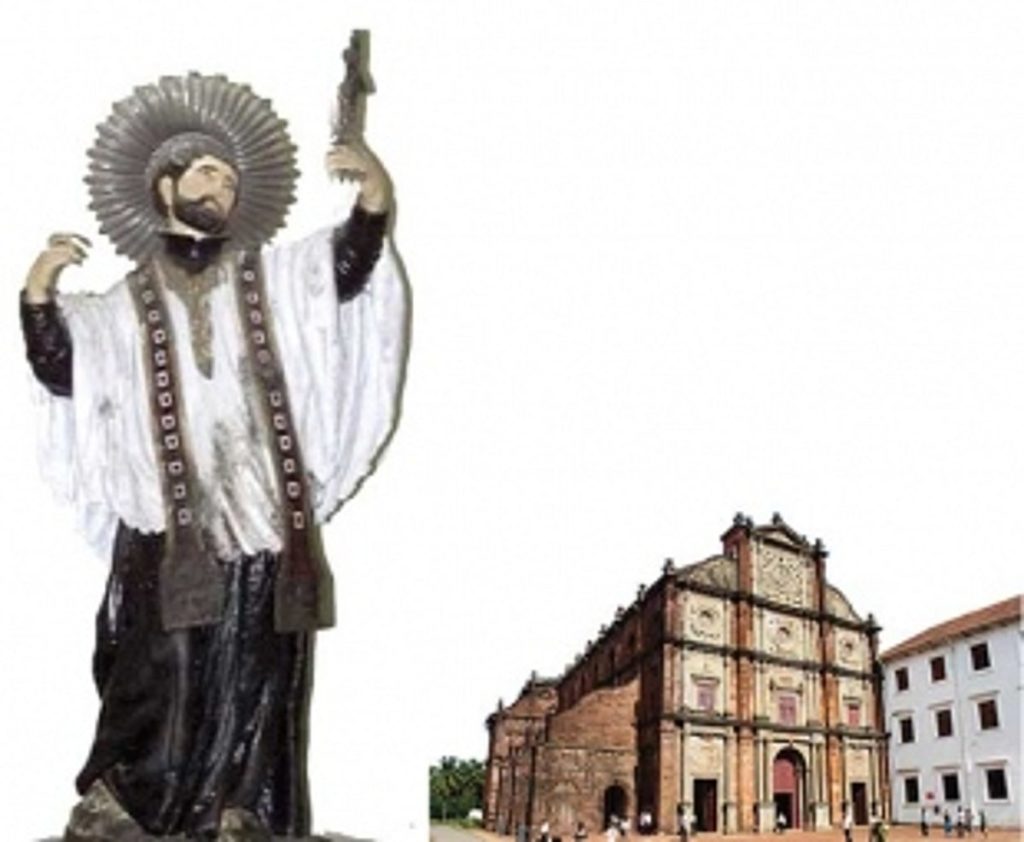
In the sun-kissed streets of Goa, where the Arabian Sea wave whispers ancient lullabies amidst the dancing coconut palms, the name Goycho Saib rises like the gentle tide at Colva. It is not merely a phrase; it is a living invocation, a collective heartbeat that binds every Goan whether in the red laterite villages of Salcete or the bustling lanes of Panjim. To call Goycho Saib a “terrorist,” as some voices did in Vasco yesterday, is not just an error of fact. It is an act of symbolic violence that strikes at the very core of what it means to be Goan. It wounds the shared soul of a people whose DNA, as the saying goes, carries the salt of the same sea and the soil of the same earth. We Goans are one family. Our unity is not fragile political rhetoric; it is the quiet, enduring truth of centuries.
To understand the depth of this wound, we must turn to the French psychoanalyst Jacques Lacan and his concept of the point de capiton, the quilting point. Lacan taught that certain signifiers do not merely describe reality; they stitch together the chaotic fabric of human experience, anchoring meaning where it would otherwise unravel. Goycho Saib functions precisely as such a quilting point for the Goan psyche. It gathers into itself layers of history, faith, memory, and longing. The title evokes the gentle yet unyielding presence of a saintly figure, Saint Francis Xavier, the “Apostle of the Indies”, whose arrival in 1542 marked the beginning of a unique Goan identity that fused Konkani,indigenous traditions with western threads into a tapestry unlike any other in India. But Lacan would remind us that the signifier is never static. Goycho Saib is not a closed historical fact; it is a dynamic force that continues to shape the imaginary and symbolic orders of Goan life. It carries the devotion of fisherfolk who light candles at Basilica of Bom Jesus, the quiet pride of the elderly aunt in Margao who still sings the Sam Francis Xaviera with deep devotion, the sense of belonging felt by the young engineer in Duler, Mapusa who returns home in the evening to hear the church bells ring . In Lacan’s terms, it is the master signifier that organizes the Goan subject’s desire not for domination, but for rootedness, that makes us at home. Hence derogatory insults hackled at the Saint becomes a painful unhoming experience.
Yet this signifier remains, in the Derridean sense, unclosed. Jacques Derrida spoke of différance, the endless deferral of final meaning, the way every text, every name, carries within it the trace of what it is in the coming. Goycho Saib is precisely such an open signifier. It does not belong exclusively to any one community, any one era, or any one interpretation. It belongs to the Hindu who respects the relic at Old Goa as part of the shared cultural heritage; to the Muslim who sees in its humility a reflection of universal compassion; to the Christian who kneels in prayer and feels the saint’s intercession as a living presence. Its meaning is never exhausted. It spills beyond catechism or history book. It lives in the laughter of children playing football near the Basilica, in the aroma of sorpotel and bebinca shared across tables during the feast, in the silent tears of a Goan working in Dubai or London who feel safe outside Goa To attempt to close this signifier to fix it with a crude label like “terrorist” is to perform an act of metaphysical tyranny. It tries to nail down what refuses to be nailed down. It is, in Derrida’s language, a violent attempt to arrest the play of meaning, and in doing so, it fractures the very community it claims to speak for.
Yesterday’s remarks in Vasco crossed the delicate line between freedom of speech and hate speech. Freedom of speech is the oxygen of democracy; it allows the influencer, the activist, the ordinary citizen to voice dissent, to question power, to provoke thought. But when speech weaponizes a sacred symbol to sow division, when it reduces a centuries-old emblem of love,peace and unity to a caricature of fear, it ceases to be speech and becomes incitement. The Constitution of India, in its wisdom, draws this line not to stifle debate but to protect the fragile ecology of our plural society. Communal harmony is not a slogan; it is the first value, the ground upon which every other freedom stands. To attack Goycho Saib is to attack the Goan self. It is to tell every son and daughter of this land that their deepest sense of belonging is illegitimate, that their shared history is tainted, that their common DNA is somehow divisible.
We Goans have always known how to hold complexity without collapsing into conflict. Our villages have churches beside temples beside mosques, and the same monsoon rain falls on all their roofs. Our festivals whether the Feast of St. Francis Xavier or the Shigmo processions or Eid celebrations have never been zero-sum games. They are expressions of a single, multifaceted Goan identity. The social media “influencer” who seeks personal impact without grasping the local context performs what Lacan would call an imaginary misrecognition. He sees only his own reflection, his follower count, his trending hashtag while failing to recognize the Real of Goan life: the interconnected web of relationships, memories, and affections that Goycho Saib holds and quilts together. Such misrecognition breeds disruption. It produces terror not through bombs but through the slow poison of hate, the erosion of trust, the planting of suspicion where once there was only the easy camaraderie of the tinto or bolcao bench.
Let us, therefore, respond not with anger but with the deeper force of love and clarity. Let us reaffirm that Goycho Saib remains an open invitation to belonging. It calls every Goan Catholic, Hindu, Muslim, of whatever caste or creed to recognize the other as part of the same family. It reminds us that our strength lies in our refusal to be divided. Divisive forces, whether from within or without, whether cloaked in the language of “truth-telling” or “exposure,” thrive only when we forget who we are. We are the people of the khazan lands and the mandovi waters, the people whose ancestors survived colonial oppression and rose to liberation, whose grandparents rebuilt lives after floods and whose children dream of a Goa that remains green, gracious, and united.
In this moment of tension, let communal harmony be our guiding star. Let us speak with the sensitivity that Goycho Saib himself embodies, the sensitivity of a saint who walked among the poorest, who listened more than he preached, who healed through presence rather than condemnation. Let us extend the same grace to those who err. Let correction, not cancellation, dialogue, not denunciation prevail . For in the Lacanian frame, true subjectivity emerges not through mastery but through the humble recognition of our interdependence. And in the Derridean horizon, the meaning of our shared life will always remain open rich with possibility, resistant to final closure.
God be with us all. May the spirit that Goycho Saib represents continue to quilt our hearts together, even when voices seek to tear them apart. We Goans are united. Our DNA is common. We cannot allow ourselves be divided. Let this truth echo from the ramparts of Tiracal Fort to the beaches of Palolem, from the spice gardens of Ponda to the silent church of Borim of . Goycho Saib is not a slogan to be debated; it is the very name we give to the love that makes us Goan.