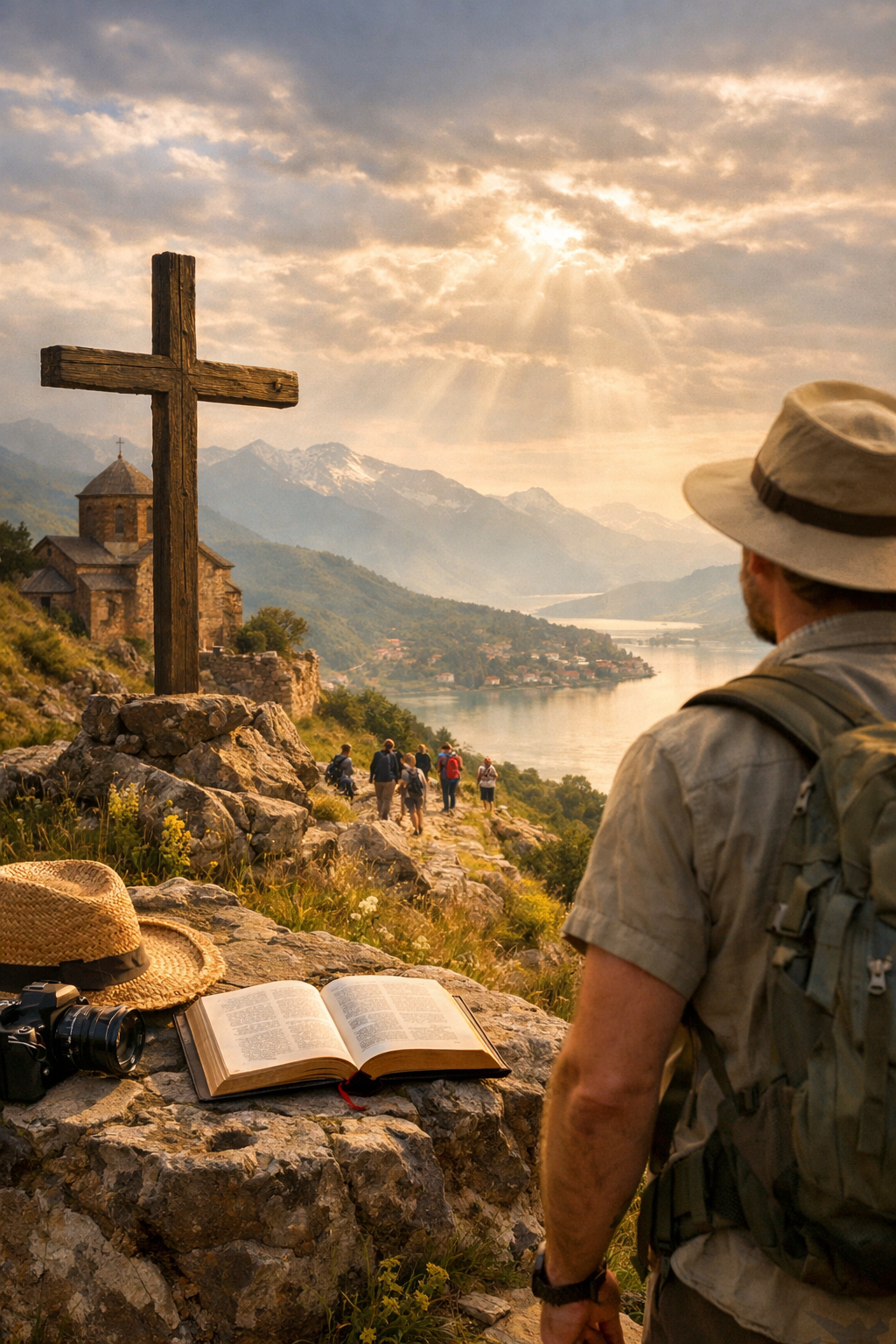
Opening to the Unconditional Call
Tourism is far more than an escape or an industry. It is an opening to a call that comes from the place itself, an unconditional summons that places a demand upon every visitor and every host. This demand refuses calculation. It cannot be measured in tourist arrivals, revenue statistics, or occupancy rates. Instead, it belongs to the realm of abundance, an overflowing reality that exceeds every human attempt to contain or commodify it. In the sun-bathed landscapes of Goa, this call takes the form of justice in its deepest, most restless sense: a justice that remains forever in the impossible, challenging both those who welcome and those who arrive to open themselves to the infinite. This infinite has been revealed in Jesus Christ, whose life, death, and resurrection invite us into a continuous fidelity within the living symbiosis of human beings and the land.
Goa’s Living Symbiosis
Goa’s identity is rooted in a profound interdependence between people and nature. The ancient khazan ecosystems, reclaimed wetlands where rice cultivation, aquaculture, and mangrove forests coexist in delicate balance tell a story of centuries-old partnership. Tidal waters flow through sluice gates managed by local communities, nourishing fields while protecting villages from the sea. Coconut palms sway above red laterite soil, and fishing communities launch their boats at first light, reading the currents and the behaviour of crabs and fish as signs of the sea’s generosity. Churches built during the colonial era stand beside temples and mosques, their bells and chants mingling with the rhythms of village life. This is not a static heritage but a breathing, evolving symbiosis that has sustained generations. Yet the very arrival of tourists, drawn by golden beaches, vibrant nightlife, and cultural richness, puts this symbiosis under pressure. Tourism thus becomes the arena where the demand of justice is felt most acutely.
The Undeconstructible Call of Justice
Justice here is not a set of rules or policies that can be fully satisfied. It is the undeconstructible call of the singular Other, the particular mangrove creek, the specific fishing family, the unique olive-ridley turtle nesting on a moonlit beach. Any attempt to reduce this call to checklists of “eco-friendly” practices or economic benefits falls short. The place itself demands a response that is infinite in its scope because each encounter is utterly unique. A visitor photographing a sunset is not merely capturing beauty; the landscape is addressing them, asking for reverence rather than consumption. A host opening their home is not simply providing a service; they are offering part of their life-world, exposing their community’s fragile balance to outsiders. This mutual exposure creates an ethical tension that cannot be resolved once and for all.
The Aporias of Hospitality
The paradoxes are many. Hospitality must be unconditional welcome to the stranger without reservation and yet it operates within limits of capacity, ecology, and livelihood. Hosts face the pressure to expand, to build more rooms, to cater to every whim, often at the cost of their own traditions and environment. Visitors arrive with expectations shaped by marketing images: pristine shores, endless parties, authentic experiences available at a price. Both sides stand before an impossible decision. One must act immediately, book the ticket, approve the resort, serve the meal yet the demand requires infinite consideration of consequences that stretch across generations. Justice does not wait, yet it can never be fully calculated. This tension does not paralyse but instead calls forth a deeper responsibility, a willingness to live in the gap between what is possible and what is demanded.
The Prophetic Mission of Jesus Christ
Into this tension steps the figure of Jesus Christ, whose prophetic mission illuminates the path. Jesus did not come as a distant philosopher or a detached lawgiver. He entered the particularity of a specific land, a specific people, at a specific time. As prophet, he announced the kingdom of God not as a future escape but as a present reality breaking into history. He proclaimed good news to the poor, freedom for captives, sight for the blind, and release for the oppressed. His mission was deeply ecological and social: he fed multitudes with loaves and fishes, calmed storms on the sea, and spoke of the lilies of the field that neither toil nor spin yet are clothed in glory. Jesus revealed the infinite within the finite. In him, God emptied himself, taking the form of a servant, dwelling among us in vulnerability and love.
The prophetic mission of Jesus challenges every form of exploitation and calls for the renewal of creation’s groaning order. He overturned tables in the temple, confronting religious and economic systems that turned sacred space into a marketplace. He ate with tax collectors and sinners, crossed boundaries of purity and ethnicity, and insisted that love of God and love of neighbour are inseparable. In Goa’s context, this prophetic voice echoes in the cry of the khazan lands threatened by concrete development, in the struggles of fisherfolk displaced by luxury resorts, and in the silent suffering of mangroves choked by plastic waste as well as in the threat of Goa becoming a coal handling hub. Jesus does not offer easy solutions or distant spiritual comfort. He stands in the midst of the symbiosis, calling hosts and visitors alike to conversion to a turning of heart and practice that honours the abundance already given.
Incarnation and Abundance in Goan Landscapes
Consider the Incarnation: the Word became flesh and pitched his tent among us. In Goa, this means the divine is not an abstract ideal hovering above the beaches but is encountered in the salt-stained hands of a fisherman, the laughter of children playing in village lanes, the patient labour of women transplanting rice in the khazans. The same Christ who multiplied fish and bread invites us to receive the sea’s gifts without greed. The same prophet who wept over Jerusalem weeps over landscapes scarred by unchecked tourism. His resurrection promises not escape from the material world but its renewal. The infinite revealed in Jesus is therefore not a distant horizon but a presence that disturbs every comfortable arrangement and calls us to fidelity.
This fidelity is continuous precisely because justice remains impossible. No single policy, no amount of responsible tourism certification, no personal commitment to “leave no trace” can ever exhaust the demand. Every season brings new failures: overcrowded beaches, polluted estuaries, cultural performances reduced to entertainment for outsiders. Yet these failures do not cancel the call; they intensify it. The justice that is always “to come” keeps the present open, restless, alive with possibility.
Continuous Fidelity Amid Impossibility
Hosts are invited to resist the total commodification of their home, choosing instead community-led initiatives that protect the khazans and share benefits equitably. Visitors are called to move beyond passive consumption and are invited to listen to local stories, support small-scale enterprises, participate in conservation efforts, and allow the place to change them rather than merely using it as backdrop.
Imagine arriving in Goa not as a consumer but as a pilgrim of sorts. You walk the mangrove laden opposite river banks at dawn, feeling the intricate web of roots that hold soil and life together. You share a meal of fresh fish and coconut curry in a family home, hearing stories of how the tides have shaped generations. You witness the release of turtle hatchlings and sense the fragile miracle of their journey back to the sea. In these moments, the prophetic mission of Jesus becomes tangible. He who said “I was a stranger and you welcomed me” addresses both the tourist and the host. The visitor is the stranger who must learn humility and gratitude. The host is the one called to offer a generous welcome even when resources are stretched. Both are drawn into the abundance that flows from God’s own self-giving.
Practical Paths of Response
The symbiosis of human and land life in Goa thus becomes a living parable. Just as Jesus taught that the kingdom is like a mustard seed or yeast working silently, the small acts of care refusing single-use plastic, supporting organic farming, joining village efforts to clean estuaries carry disproportionate significance. They testify to a justice that cannot be measured yet is already breaking in. The churches of Goa, with their whitewashed walls and colourful festivals, remind believers and seekers alike that faith is not private devotion but public witness. The same Christ present in the Eucharist is present in the broken body of the earth and its people. To receive communion is to commit to the healing of creation’s wounds. We can find the susegad Christ of Goa in green fields , lush mountain, white. sands and blue waters of Goa.
Challenges and Resurrection Hope
Challenges remain formidable. Economic pressures push for more hotels, more flights, more entertainment zones. Climate change raises sea levels that threaten the very khazans that have sustained life. Cultural erosion occurs when traditions and culture become spectacles sold for a price. Yet within these difficulties lies the invitation. The impossible demand does not lead to despair but to hope an active, engaged hope rooted in the resurrection. Jesus’ prophetic mission culminates in victory over death, declaring that the forces that destroy life are greed, indifference, exploitationbut they do not have the final word. New creation is already underway for those with eyes to see.
A Liturgical Invitation
In the end, tourism in Goa is no ordinary leisure activity. It is a liturgical invitation into the heart of reality. The place calls us unconditionally, placing upon us a demand that belongs to abundance. In responding, however imperfectly, we open ourselves to the infinite revealed in Jesus Christ. His prophetic mission announcing justice, healing the broken, renewing the earth becomes our own. We are left in continuous fidelity, walking the beaches, tending the fields, welcoming the stranger, knowing that every act matters in the grand symbiosis of life. Though the demand can never be fully met, it is already being answered in every small turning of the heart. In that paradox lies profound grace.
Goa does not merely host tourists. It summons all who come into a deeper belonging to the land, to one another, to the God who became flesh in history and continues to call through creation’s voices. In opening to this call, we discover that justice, though impossible, is the very ground of abundant life. May both hosts and visitors have the courage to live within its restless, life-giving tension.