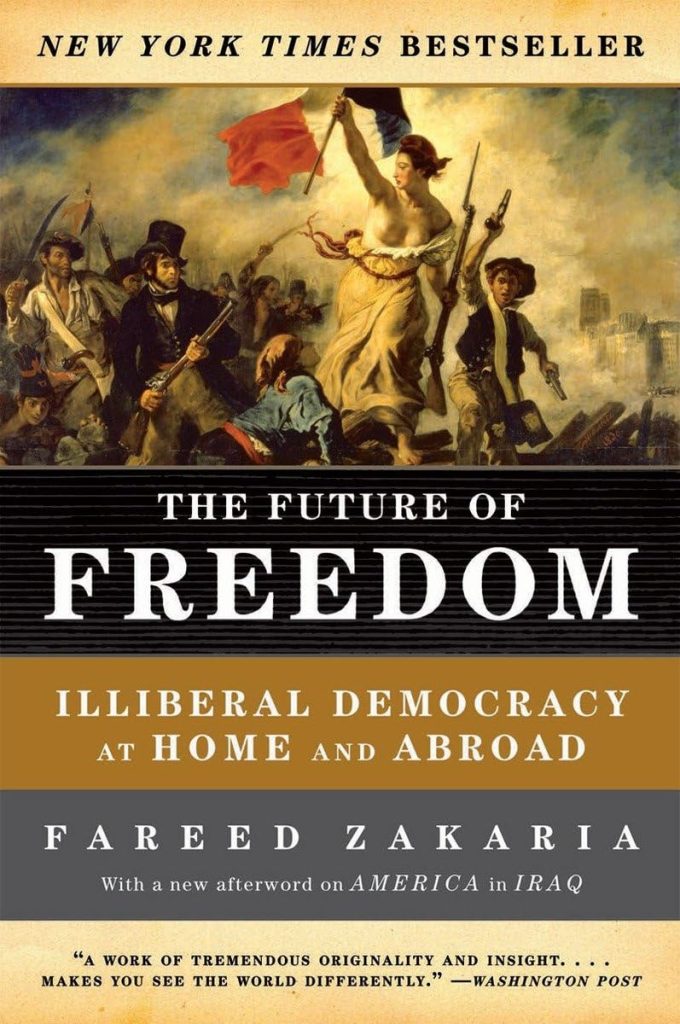
Illiberal democracy manufactures fear to control the narrative that leads people to vote mindlessly. At its core, this form of governance preserves the outward rituals of democracy and elections, campaigns, voter lists while hollowing out the liberal safeguards that once protected individual rights, minority voices, and institutional independence. Coined by political scientist Fareed Zakaria in the late 1990s, the term describes regimes where majority rule overrides constitutional limits. In India, the world’s largest democracy by population, illiberal democracy has not arrived through a sudden coup but through a gradual, populist recalibration of power. It survives not by abolishing elections but by weaponizing them, turning fear into electoral fuel and populism into a self-reinforcing cycle.
Liberal democracy, in its ideal form, balances popular sovereignty with restraints on power. It enshrines free speech, an independent judiciary, a free press, and protections for minorities. Illiberal democracy discards these restraints. Leaders win mandates at the ballot box but then bend rules to favor the dominant group, silence dissent, and centralize authority. The result is a system that feels democratic because people vote, yet functions autocratically because the choices presented are narrowed by manufactured threats. Populism provides the oxygen. It frames politics as a cosmic battle between “the pure people” and a corrupt elite, often redefining the elite to include not just the wealthy but also intellectuals, journalists, opposition parties, and religious minorities. In India, this populist surge has fused with cultural majoritarianism, creating a potent hybrid that thrives on anxiety rather than aspiration.
India’s tryst with illiberal democracy traces back to the gradual erosion of Nehruvian secularism, but it accelerated dramatically after 2014. The Bharatiya Janata Party’s rise was built on a narrative of Hindu pride and national revival. This was not mere ideology; it was strategic populism. The party positioned itself as the authentic voice of the Hindu majority, long sidelined by a supposedly Westernized, English-speaking establishment. Promises of economic transformation, jobs, infrastructure, digital India, were paired with cultural assertions: building a Ram temple in Ayodhya, abrogating Article 370 in Jammu and Kashmir, and enacting the Citizenship Amendment Act. These moves resonated because they tapped into a reservoir of historical grievance. Yet beneath the development rhetoric lay a deeper mechanism: the deliberate amplification of fear.
Populism in this context survives by converting complex problems into simple existential threats. Economic distress, unemployment among youth, agrarian crises, and regional inequalities are real. But rather than addressing them through evidence-based policy alone, the system redirects attention toward imagined enemies. Narratives around “love jihad,” “urban Naxals,” and “anti-national” elements create a siege mentality. Every protest whether by students at Jawaharlal Nehru University, farmers at Delhi’s borders, or Muslims opposing the National Register of Citizens gets painted as part of a larger conspiracy funded by foreign forces or opposition parties. This fear is not abstract. It is personalized through relentless media amplification, social media echo chambers, and WhatsApp forwards that circulate images of violence or demographic change. The average voter, bombarded daily, begins to see the ballot not as a tool for policy choice but as a weapon of self-defense.
The manufacturing of fear follows a repeatable pattern. First, identify a fault line religion, caste, language, or border security. Second, exaggerate the threat through selective storytelling. A single incident of communal violence becomes proof of a nationwide conspiracy. Third, position the ruling dispensation as the sole protector. The leader is elevated from politician to savior, his image omnipresent on billboards and television screens. In India, this has manifested in the careful choreography of national security discourse. Surgical strikes across the Line of Control or standoffs with China are framed not merely as military operations but as vindication of a muscular new India. Dissent on these matters is equated with disloyalty. Laws like the Unlawful Activities (Prevention) Act and sedition provisions, once used sparingly, expand in scope. Journalists, activists, and even comedians find themselves under investigation. The message is clear: question the narrative at your peril.
This fear-driven populism reshapes voting behavior in subtle yet profound ways. Elections in India remain fiercely contested and boast impressive turnout. Yet the quality of deliberation declines. Voters are nudged toward identity consolidation rather than issue-based reasoning. In 2019, for instance, the Pulwama attack and subsequent Balakot airstrikes dominated the campaign discourse, sidelining questions of job creation or farm income. The 2024 general elections, held amid economic recovery from the pandemic, still saw polarization around temple inaugurations and welfare schemes framed as gifts from a benevolent leader. Caste arithmetic and regional alliances persist, but the overarching meta-narrative of Hindu consolidation under threat has proven remarkably effective in stitching together a pan-Indian majoritarian coalition. Mindless voting here does not mean illiterate or uninformed voters; it means voters whose rational faculties are overwhelmed by emotional mobilization. Fear short-circuits analysis. When survival feels at stake, nuance feels like luxury.
Illiberal democracy’s resilience also stems from its control of the public square. Traditional media outlets, once diverse, increasingly align with the dominant narrative, driven by commercial pressures or regulatory intimidation. Digital platforms, meanwhile, become battlegrounds where algorithms reward outrage. Coordinated campaigns, often described as “IT cell” operations, flood timelines with trending hashtags that reinforce the fear cycle. The opposition, fragmented and often defensive, struggles to offer a competing vision that matches the emotional intensity. When it does criticize, it is accused of being elitist or dynastic another populist trope that resonates with voters tired of old political families.
Yet this system is not invincible. Its dependence on perpetual crisis creates vulnerabilities. Economic underperformance cannot be hidden forever behind cultural victories. Youth unemployment, inflation in food prices, and regional discontent in states like Punjab or Tamil Nadu occasionally puncture the narrative. The judiciary, though under pressure, has occasionally pushed back striking down aspects of electoral bonds or questioning arbitrary detentions. Civil society organizations and independent journalists continue to document discrepancies between rhetoric and reality. Most importantly, India’s federal structure allows pockets of resistance; state elections sometimes deliver verdicts that defy the national trend, as seen in recent southern and eastern results where welfare-focused governance outperformed cultural appeals.
The deeper danger lies in normalization. When fear becomes the default operating system of politics, democratic habits atrophy. Citizens grow accustomed to majoritarian comfort, accepting curbs on press freedom or minority rights as necessary trade-offs for “stability.” Institutions lose their legitimacy when perceived as partisan. Over time, the line between the state and the ruling party blurs. This is populism’s ultimate paradox: it claims to empower the people while concentrating power in fewer hands. In India, the cult of personality around the Prime Minister illustrates this shift. Every achievement is personalized; every failure is externalized to “vested interests.”
Looking ahead, illiberal democracy in India faces a test of sustainability. Demographic changes, a young, aspirational population connected globally via the internet may demand more than symbolic victories. Climate change, technological disruption, and geopolitical uncertainties will require pragmatic governance rather than perpetual mobilization. If populism fails to deliver tangible progress, the fear narrative may lose potency. Conversely, if global trends toward authoritarian nationalism persist, India’s model could inspire imitators elsewhere.
Ultimately, the survival of illiberal democracy rests on a simple bargain: voters trade liberal freedoms for a sense of belonging and protection. In India, this bargain has delivered electoral success by fusing cultural identity with welfare delivery and nationalist fervor. Yet history shows that fear-based systems are brittle. They thrive on division but crumble when citizens rediscover the power of deliberation over demagoguery. The challenge for India’s democracy is not to reject populism entirely after all, it reflects genuine aspirations but to ensure that populism does not devour the liberal guardrails that make democracy worth preserving. Only then can elections become instruments of mindful choice rather than vehicles of manufactured panic. The stakes are nothing less than the soul of the world’s largest experiment in self-rule.