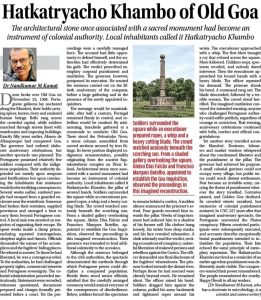
Dr Nandkumar Kamat’s recent article on the so-called Hatkatryacho Khambo of Old Goa makes a noteworthy contribution to public discussion of colonial memory in Goa. It draws attention to a surviving material remnant of Portuguese rule and situates that remnant within a broader narrative of violence, authority, and local suffering. Such efforts to keep difficult histories visible deserve recognition.
Yet the framing of the pillar raises deeper questions about how colonial experience is remembered and represented. Portuguese colonisation in Goa was never solely a war on religion. It was a dense and interlocking project that had political, economic, and religious dimensions all at once. The Crown sought strategic control of the Indian Ocean, the extraction of revenue, the management of diverse populations, and the imposition of a juridical order. Religion functioned as a powerful instrument within that larger apparatus, not as its exclusive engine. To view the entire colonial enterprise through a single prism of religious aggression risks flattening a complex historical process. In the present climate such reduction can also become politically hazardous, encouraging communal readings of the past that obscure the shared structures of power under which multiple communities lived.
There is no denial of the violence of the Goa Inquisition. The corporeal suffering it produced was real. That suffering fell with particular force upon those closest to the fault lines of conversion and orthodoxy: the Kristanvos de terra, the Novo Kristãos, and the crypto-Christians whose faith and bodies were subjected to scrutiny, discipline, and punishment. Public penances, imprisonment, confiscation of property, and the rarer but still devastating autos-da-fé left deep marks. Any honest account of Portuguese Goa must confront this violence without minimisation.
The specific claim that the pillar known as the Pelourinho Novo served as an instrument of the Inquisition, however, does not withstand historical scrutiny. The structure was a civic marker of the kind erected throughout the Portuguese world, a pelourinho used for the announcement of decrees, the administration of ordinary justice, and the public enforcement of municipal authority. Surviving administrative records and the work of historians who have examined both Portuguese municipal sources and the fragmentary documentation of the Inquisition offer no evidence that this particular column was employed for the systematic amputation of hands by the then ‘Holy Office’. The popular designation Hatkatryacho Khambo remains a folk attribution that scholarly consensus has consistently rejected.
An anasemic reading helps clarify what has occurred. In the framework developed by Nicolas Abraham and Maria Torok, anasemia names the process by which a signifier is emptied of its original meaning and then refilled, cryptically, with unassimilated trauma. The Pelourinho Novo, the New Pillory, originally carried a precise civic and juridical sense. It marked the presence of municipal power and the visibility of legal authority. Over time that original meaning was progressively hollowed out. What remained was an empty pillar standing in the landscape of Old Goa.
Into that emptied signifier, the collective memory of colonial trauma has poured itself. The column is reoccupied by the phantom of mutilated bodies and public terror. It becomes Hatkatryacho Khambo not because the archival record documents such use by the Inquisition, but because unprocessed historical suffering required a concrete, visible site upon which to deposit its encrypted pain. The administrative meaning is evacuated; the pillar is transformed into a crypt of colonial trauma.
This displacement is intelligible . Trauma seeks materialisation. It attaches itself to stones and place-names when the available historical languages prove incomplete or silent. Yet when the emptied signifier is presented as straightforward historical fact, folklore is elevated to documentation, and the complex political-economic-religious matrix of Portuguese power is reduced to a single spectacular image of religious cruelty.
The task of historical reflection is therefore double. It must refuse any denial of the violence of the Inquisition and the corporeal suffering it inflicted, particularly upon local Catholics and New Christians. At the same time it must resist the reduction of colonial history to a single prism and the conversion of an emptied civic marker into unexamined evidence. Only by holding both the density of the past and the integrity of the documentary record can memory serve understanding rather than distortion. perhaps, we need to deal with the haunting of the colonial pain and seek healing through harmony and forgiving love.