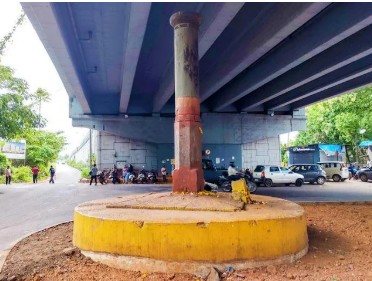
In the sun-warmed streets of Old Goa, the weathered basalt pillar known officially as the Pelourinho Novo stands quietly near the Basilica of Bom Jesus. To some, it is familiar as the “Hat Katro Khamb” or hand-cutting pillar. In recent years, this modest civic monument has been transformed in public discourse into a potent symbol of Hindu suffering under Portuguese colonial rule, supposedly linked to the Goa Inquisition as a site where Hindus resisting conversion allegedly had their hands severed. While the impulse to remember ancestral pain is deeply human and worthy of respect, the elevation of this particular narrative demands careful reflection. When oral history and social memory are used in a selective, unverified manner to construct such a singular symbol, we risk oversimplifying a complex shared past and deepening divisions among Goans today.
I write these words with genuine sensitivity and love to all Goans. The Portuguese arrival in Goa in 1510 and the subsequent centuries of colonial administration brought profound changes, including the destruction of temples, pressures to convert, and periods of religious enforcement that caused real grief for many Hindu families and communities. That suffering deserves honest acknowledgment, not dismissal. At the same time, many Goan Catholic families trace their roots to local Konkani people who navigated conversion, adaptation, and sometimes coercion themselves. Their ancestors also lived through fear, loss of old traditions and brotherhood as well as internal hierarchies within the colonial system. Pain was not the exclusive preserve of any single community. Framing the entire colonial encounter as a straightforward religious war waged solely against Hindus overlooks the layered realities of empire like trade ambitions, geopolitical rivalries, local agency, resistance, collaboration, and cultural mixing that shaped Goa’s unique colonial experience and Goan identity.
Central to the current controversy is the reliance on oral tradition and collective social memory. The claim that the Pelourinho Novo was specifically a site of systematic hand amputation for Hindus refusing baptism. The claim that this memory was faithfully preserved for nearly five hundred years sounds unreal . Yet turning local lore into concrete historical assertion requires more than repetition across generations. Historians have long recognized both the value and the limitations of oral history and social memory when weaving them into written accounts.
Oral history, when practiced rigorously, involves systematic interviews with individuals who experienced events or heard direct testimony from participants. It can recover voices often missing from elite archives making space for everyday experiences of fear, resilience, family stories, and cultural adaptation. Social or collective memory refers to the shared narratives, folklore, rituals, and stories that communities pass down to maintain identity and a sense of continuity. These forms of memory are powerful because they carry emotional truth: they reveal how people felt events, how trauma was processed, and why certain symbols endure in the collective imagination.
However, several well-established principles guide the responsible use of such sources in professional history writing. First, memory is not static. It is socially framed and evolves over time in response to present needs, political contexts, and changing group identities. What feels like an unbroken chain of transmission is often reshaped with details added, emphasis shifted, or stories moralized to serve contemporary purposes and goals . Second, reliability diminishes with generational distance. Eyewitness testimony carries more weight than accounts passed through multiple intermediaries over centuries. Third, all memory must be cross-verified against independent evidence: contemporary documents, physical archaeology, maps, administrative records, or multiple unrelated testimonies. A single thread of oral tradition, no matter how sincerely held, does not by itself establish specific factual claims about events, locations, or scale.
Repeating a statement across families or community gatherings, however heartfelt, does not automatically qualify as robust historical evidence. Historians insist on corroboration precisely because human memory is vulnerable to telescoping (compressing timelines), conflation of events, and the natural human tendency to craft coherent moral stories from fragmented experiences. In the case of the Pelourinho Novo, archival references consistently describe it as a standard European-style pillorywhich was a civic structure used for public humiliation, whipping, or other non-lethal punishments against lawbreakers such as thieves, debtors, or corrupt officials. This was a common feature in Portuguese towns and colonies, rooted in secular justice rather than exclusively religious persecution. While harsh colonial punishments undoubtedly occurred, and while the Inquisition did enforce Catholic orthodoxy with severity (often targeting recent converts suspected of secretly retaining older practices), linking this specific pillar to systematic amputation of hands of unconverted Hindus resisting baptism relies heavily on later interpretations of local lore rather than contemporary records.
The maverick or selective use of social memory here becomes problematic when it singles out one community’s suffering while downplaying or erasing others. Goan Catholics today are largely descendants of those who converted during the Portuguese period. Many of their forebears faced scrutiny under the Inquisition themselves, navigating suspicion of “crypto-Hinduism,” social stigma, or restrictions on native clergy. Painting today’s Catholic community as collective inheritors of perpetrator guilt ignores this complexity and risks new forms of exclusion. Colonization was never a pure religious crusade. It was entangled with commercial ambitions to control spice routes, strategic competition with other powers, and the internal dynamics of Goan society under shifting rulers which included pre-Portuguese periods marked by their own conflicts and temple politics. Reducing 450 years of history to a simple story of Hindu victimhood versus Catholic/Portuguese aggression flattens the rich syncretism visible in Goan cuisine, festivals, architecture, language, and family histories.
Pankaj Mishra, in works such as Age of Anger, offers a useful lens for understanding why certain historical narratives gain intense emotional power in our times. Modernity tends to atomize individuals, weakening traditional community bonds while promising personal success and equality that often remain out of reach. This breeds deep resentment and a sense of humiliation. Isolated personal anger seeks release by merging into larger tribal identities that offer belonging, moral clarity, and a sense of restored dignity. In such an “age of anger,” complex colonial histories can be reshaped into stark victim-perpetrator frames that feel cathartic. A civic pillar becomes a visceral symbol of unique communal trauma. While this response is profoundly human, it can also hinder the difficult work of honest reckoning. Social memory, when mobilized primarily for present-day identity assertion rather than careful dialogue with other evidence, risks becoming propaganda rather than history.
From another angle, Mishra’s From the Ruins of Empire reminds us that postcolonial societies often grapple with the lingering humiliation of conquest. The desire to reclaim narrative control by highlighting ancestral suffering is understandable. Yet true engagement with the “ruins” of empire requires acknowledging ambiguity: the genuine disruptions and losses alongside moments of adaptation, intermarriage, economic opportunity, and cultural creativity that emerged. Goa’s UNESCO-listed churches stand alongside its ancient roots not as monuments to conquest alone, but as testaments to a living, blended heritage that belongs to all Goans.
Responsible history does not demand forgetting pain. It asks us to remember with greater fullness. The suffering of Hindu families who lost temples or faced conversion pressures was real. So too was the dislocation experienced by those who converted and their descendants, who sometimes found themselves caught between worlds or facing discrimination even within colonial structures. Pre-colonial and intra-Indian power struggles also left scars. By singularizing only Hindu victimhood, we inadvertently diminish the shared humanity of the past and present. We forget that Catholic Goans today are not Portuguese colonizers; they are fellow citizens whose families have called these shores home for generations, contributing richly to the state’s culture.
A wiser path forward lies in methodological humility. Oral traditions and social memory should be treasured as windows into emotional and cultural realities. They deserve respectful collection and study. But when they are used to make precise claims about specific sites, events, or scales of atrocity especially claims unverifiable through contemporary records historians rightly pause. Five hundred years is a vast distance. Memory chains stretch and transform. What may have begun as recollections of general harsh justice under any ruler can, over centuries and amid modern pressures, crystallize into a focused symbol of religious terror. This evolution tells us something important about the present as much as the past.
Goa’s beauty has always emerged from its layered identity consisting of the Kadamba temples and Portuguese churches, Konkani rhythms and Luso-Indian customs, Hindu, Catholic, and other threads woven together. Protecting this syncretism requires resisting the temptation to weaponize memory for tribal solidarity. Instead of contesting monuments through competing claims of exclusive victimhood, Goans of all backgrounds can advocate for transparent scholarship, preservation of sites under their documented names where evidence supports it, and public education that presents multiple perspectives with evidence-based care.
Acknowledging pain across communities does not dilute justice; it deepens it. It allows descendants to honour ancestors without inheriting enmity. The Pelourinho Novo can serve as a reminder of the harshness of pre-modern justice in many societies, including colonial ones, without needing to bear the full symbolic weight of a singular religious war. By applying consistent principles to oral history and social memory verification, contextualization, and openness to complexity, we move closer to a history that heals rather than one that divides.
In an era when atomized individuals increasingly seek belonging through intensified group narratives, choosing nuance is an act of courage. Itconsiders the real wounds of the past while refusing to let them dictate perpetual grievance in the present. Goa’s future, like its richest heritage, depends on this shared, truthful remembering.