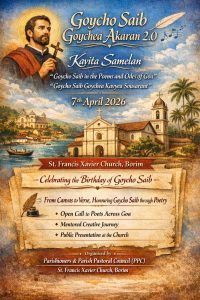
In the sun-kissed streets of Goa, where the scent of jasmine mingles with the salt of the Arabian Sea, St. Francis Xavier is not merely another Saint. He is revered as Goycho Saib by Goans of all walks of this. This affectionate Konkani title, among other things is evoking a protective father figure, and captures a profound truth about the saint’s legacy. The historical Francis Xavier, the 16th-century Jesuit missionary who set foot in Goa for only fleeting periods, achieved far less tangible impact in Goa during his lifetime than in the distant shores of southern India, Malacca, or the Moluccas. Yet, in death, he has grown immeasurably larger. His sacred relics , housed in the Basilica of Bom Jesus in Old Goa, has become a beacon of faith for generations. This transformation speaks to the mysterious ways in which sanctity often reveals itself not in the clamour of earthly labours and spectacle but in the quiet endurance of memory and devotion. To those who love him, Goycho Saib is not a distant European figure but a living guardian whose intercession has shielded Goa and Goans through ravages of the centuries.
The historical record paints a picture of a man whose time in Goa was remarkably brief. Xavier arrived on May 6, 1542, after a perilous sea voyage from Portugal. For the first five months, he immersed himself in the hospitals and streets of the Portuguese enclave, preaching to the sick, ringing a small bell to gather children for catechism, and tending to the spiritual needs of the fledgling Christian community. He would later return briefly in 1548 for administrative duties as superior of the Jesuits, before departing again in 1549. In total, his physical presence in Goa spanned mere months across a decade of tireless travel. His true apostolic fire burned brightest elsewhere: among the pearl-fishing Parava communities of southern India, where he baptized thousands using a simple Tamil catechism; in the Spice Islands, where he evangelized amid headhunters and traders; and in the ports of Malacca, laying groundwork for missions that would reach Japan. Goa served more as a base and administrative hub than a primary field of labour. Compared to the tens of thousands he instructed and confirmed in faith across Asia, his direct work in Goa remained modest, focused on consolidating existing Portuguese Christian settlements rather than mass conversions of the local populace.
Xavier’s own writings reveal a deep disappointment with the Portuguese community in Goa. In letters to King John III of Portugal, he lamented the moral laxity of the fidalgos, the noblemen and soldiers who had come to the East seeking fortune rather than fidelity to Christ. He described a colonial society rife with scandal, where greed overshadowed piety, and where the Christian life was often reduced to outward appearances. Xavier urged the king to enforce stricter , even suggesting severe punishments for negligent governors to ensure that settlers lived as true believers. These epistles were not calls for conquest but cries from a pastor’s heart, pained by the gap between professed faith and lived virtue. Far from the triumphant conqueror some imagine, Xavier emerges here as a compassionate reformer, frustrated by the very empire he finds himself thrown within.
A shadow often cast over Xavier’s memory concerns his 1546 letter to the Portuguese king John III, written while he was in Malacca, advocating for the establishment of an Inquisition in the Indies. Critics sometimes portray this as a blanket call for persecution of non-Christians, fueling narratives of cultural erasure. Yet a careful reading of the letter reveals a far narrower intent. Xavier expressed concern specifically about “new Christians”, those recently converted from Judaism or Islam who continued to practice their former faiths in secret, living “according to the law of Moses or the law of Muhammad without any fear of God or shame before men.” His plea was for a tribunal to address crypto-Judaism and crypto-Islam among those who had outwardly embraced Christianity, a problem familiar from the Iberian Inquisitions. There is no mention of Hindus, Muslims outside the converted community, or any non-Christians as targets. Xavier wrote not from Goa itself but from a Portuguese fort in the East, and the formal Goa Inquisition was not established until 1560, eight years after his death in 1552 on the island of Sancian while awaiting entry to China. He neither witnessed nor directed its operations. The historical Xavier sought pastoral discipline for the faithful, not a campaign against Goa’s indigenous traditions or faiths if we can say that finally Inquisition was established.
Tragically, ignorance of Xavier’s actual life persists even among many devotees and his nay sayers In Goa today, Goycho Saib is invoked in prayers, processions, and the grand decennial Exposition of his relics, where thousands flock to venerate the sacred relics that has drawn pilgrims for centuries. Yet how many know of his exhausting journeys, his struggles with language barriers, diet issues etc., assisted only by interpreters and sheer conviction, or his letters of frustration with colonial complacency? The saint’s life story marked by humility, relentless travel, and a death far from home often fades behind the glow of legend. This gap is not mere oversight; it reflects how devotion can sometimes eclipse history, allowing ‘myths’ to take root.
Nowhere is this distortion more evident than in discussions of the Goa Inquisition itself. Popular accounts, appear to be influenced heavily by A.K. Priolkar’s 1961 book The Goa Inquisition, have linked the tribunal to widespread temple destructions, forced conversions of Hindus, and systemic terror. Priolkar’s work, while ambitious, has faced significant scholarly scrutiny for its reliance on secondary and anecdotal sources rather than primary archival records. The Inquisition’s own trial documents were largely destroyed by Portuguese authorities baring a few in the 19th century, leaving historians to piece together inventories, correspondence, and surviving fragments from Lisbon and elsewhere. Priolkar did not consult these emerging archives effectively; instead, he drew from traveler accounts like those of Charles Dellon( who suffered inquisition) and Protestant critics, which often amplified the “Black Legend” of Iberian ‘cruelty’. Modern researchers, accessing digitized Portuguese records, have clarified that the Inquisition primarily targeted lapsed Christians crypto-Hindus among converts or those blending earlier practices rather than launching a direct assault on non-Christians. Temple demolitions, where they occurred, belonged mainly to an earlier phase of Portuguese conquest in the 1510s–1540s, driven by military and administrative policies, not the religious tribunal Xavier envisioned. They were also related to the conversion of the Ganvkaria which lead to the conversion of the entire village. There was no idea of self . ‘Hanv’ was ‘Ganv’ . To conflate these events misrepresents both the Inquisition’s scope and Xavier’s role. Such distortions, born perhaps from the genuine wounds of colonial history, risk reducing a complex legend to a caricature. With deep sensitivity to those who have inherited pain from that era, one must affirm that acknowledging historical complexities does not diminish the suffering of the past, but neither should it obscure the saint’s sincere, although imperfect, zeal for God and humanity.
In death, Francis Xavier’s presence in Goa has eclipsed his limited earthly stay. His body, returned in 1554 and found remarkably preserved, became a symbol of divine favour. Housed since 1624 in the Basilica of Bom Jesus, it has withstood the ravages of time and climate, drawing the faithful across faiths and generations. As Goycho Saib, he is credited with miracles of protection interceding-tradition holds, even against invasions. The annual feast and decennial expositions transform Old Goa into a sea of prayer, where the saint’s legacy lives not in conquest but in compassion, healing, and unity. Devotees who know little of his travels still experience his spiritual fatherhood.
This is the paradox and the beauty: the man who spent so little time in Goa and whose direct labours there were overshadowed by his Asian missions has become, through death and devotion, infinitely greater. Goycho Saib endures because faith magnifies what history alone cannot contain. In an age quick to judge the past through modern lenses, Xavier’s story invites us to approach it with humility and honour the missionary’s love for Christ and humanity while recognizing the human frailties of his time. For those who distort his life, whether through exaggeration or dismissal, the saint’s true greatness lies in the quiet witness of his sacred relics and the enduring prayers of a people who call him their own. In Goa, Francis Xavier did not build an empire; he planted a seed that death alone could make flourish. And in that flourishing, he remains, forever, Goycho Saib.