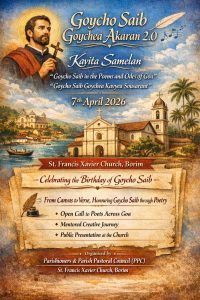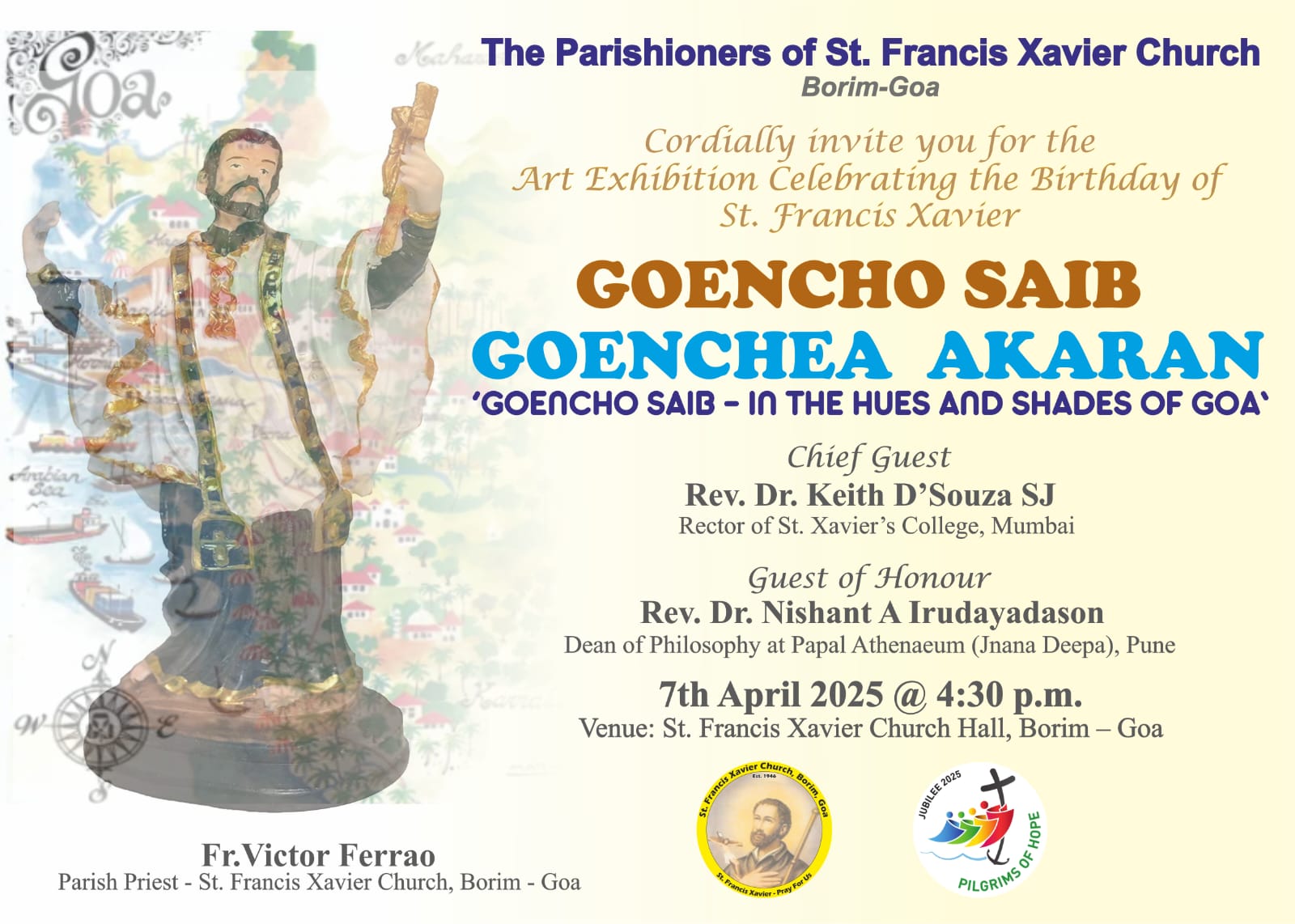
In the heart of Goa, where the vibrant hues of culture blend seamlessly with the sacred shades of faith, a unique art exhibition titled Goycho Saib Goychea Akaran: Goycho Saib in the Hues and Shades of Goa has emerged to celebrate the birthday of St. Francis Xavier, affectionately known as Goycho Saib.
Organized as part of the rich tapestry of devotion surrounding this beloved saint, the exhibition features the works of 21 established artists and 13 budding talents, each contributing to a vivid portrayal of how St. Francis Xavier has woven himself into the intimacies of Goan life.
More than a mere historical figure, Goycho Saib stands as a living presence, a source of inspiration and identity for Goans across generations and distances. Through this artistic endeavor, the exhibition illuminates the profound connection between the saint and the essence of Goan existence, a relationship that resonates with the philosophical insights of Canadian thinker Charles Taylor on the “sources of the self.
St. Francis Xavier, who arrived in Goa in 1542 as a missionary under Portuguese rule, quickly transcended his role as a foreign evangelist to become an indelible part of the Goan life. Known as Goycho Saib, his legacy is not confined to the Basilica of Bom Jesus, where his sacred relics rest, nor to the decennial exposition that draws millions. Instead, Goans have broken the barriers of distance—geographical, temporal, and emotional—to bring him into the intimacies of their daily lives.
From prayers whispered during times of calamity to the joyous celebrations of his feast on December 3rd, St. Francis Xavier is a constant companion, a figure who belongs to the very sources of Goan life.
This deep integration is reflected in the art exhibition, where 34 artists—21 seasoned and 13 emerging—use their brushes, palettes, and imaginations to depict Goycho Saib not as a distant saint but as a vibrant thread in the fabric of Goan identity.
.The theme, Goycho Saib Goychea Akaran (“Goycho Saib in the Hues and Shades of Goa”), captures this intimacy, portraying the saint through the colors, textures, and rhythms of Goa’s landscapes, traditions, and people.
The artworks range from bold acrylics to delicate sketches, each piece a testament to how St. Francis Xavier shapes the moral and spiritual horizons of Goans.
To understand the significance of this exhibition, we can turn to the work of Charles Taylor, a prominent Canadian catholic philosopher whose book Sources of the Self explores how individuals and communities derive their sense of identity and meaning.
Taylor argues that human life is oriented by “constitutive goods”—fundamental values or sources that provide a framework for understanding who we are and how we live. These sources, often rooted in history, culture, and spirituality, are not static; they evolve and are reinterpreted through collective expressions like art.
For Goans, Goycho Saib is one such constitutive good. He is not merely a relic of colonial history but a dynamic source of life that informs their sense of self. Taylor’s framework suggests that identity emerges from a dialogue with these sources, a process of articulation and rearticulation.
The art exhibition in Borim becomes a space for this dialogue, where artists—both established and budding—engage with Goycho Saib as a living presence. Through their works, they depict him as a companion in fishing villages, a guardian amid paddy fields, and a beacon of hope in the face of challenges of life.
In doing so, they affirm Taylor’s notion that our deepest values are expressed through creative acts that connect us to our past and present.
The 21 established artists bring a wealth of experience, their works reflecting a mature understanding of Goa’s cultural and spiritual landscape. Their paintings might portray Goycho These pieces speak to a Goa where faith and daily life intertwine, where the saint’s miracles—real or symbolic—continue to inspire. Meanwhile, the 13 budding artists inject fresh perspectives, often blending traditional motifs with contemporary styles.
.Together, the 34 artists create a kaleidoscope of interpretations, each hue and shade revealing a facet of Goycho Saib’s presence in Goa.
Some works emphasize his compassion, recalling his ministry to the poor and sick, while others highlight his unifying power, bridging communities across faith and caste.
This diversity mirrors Taylor’s idea of a “moral space,” where individuals and societies navigate their values through shared narratives.
The exhibition, in this sense, is not just a celebration of St. Francis Xavier’s birthday but a collective act of meaning-making, situating him as a source of Goan resilience, creativity, and unity.
What sets this exhibition apart is its portrayal of Goycho Saib as an intimate figure, not a distant icon. Goans, whether in their ancestral villages or scattered across the diaspora, carry him in their hearts, a bond unbroken by miles or time.
The artworks reflect this closeness: a fisherman’ boat painted with the name of St. Francis, a child’s prayer captured in soft pastels, a family procession glowing with candlelight. These images evoke the ways St. Francis Xavier has become part of Goan life—through stories told by grandmothers, hymns sung in Konkani, and rituals that mark the seasons.
In Taylor’s terms, this intimacy with Goycho Saib reveals a “horizon of significance” for Goans—a shared backdrop against which they define their lives.
The exhibition becomes a canvas for this horizon, showing how the saint’s legacy transcends his historical mission to become a wellspring of identity. The participation of both established and budding artists underscores this continuity, linking past reverence with future aspirations.
The art exhibition is more than a tribute to St. Francis Xavier’s birthday; it is a celebration of his enduring place in the sources of Goan life. Through the works of 21 artists and 13 budding talents, Goycho Saib emerges not as a relic of the past but as a vibrant presence in the hues and shades of Goa.
Drawing on Charles Taylor’s insights, we see how this artistic endeavor reflects a deeper truth: that identity is forged in dialogue with the sources that sustain us. For Goans, Goycho Saib is such a source—a saint who belongs to their land, their stories, and their souls, forever painted in the colors of their lives.