A poem is not a riddle. It hides no secret meaning waiting to be unlocked by the clever few. Instead, a poem is dialogical. It speaks directly to our world, inviting us into a living conversation where we bring our own lives, our doubts, our joys, and our everyday realities. Its role is evocative, not merely indicative. It does not point like a signpost to some fixed truth, nor does it prescribe how we must live. Rather, it stirs, awakens, and opens. In the sense Paul Ricoeur understood, a poem makes us think by disclosing new possibilities within the familiar. It does not dictate; it calls forth. It enlarges our imagination so that we see our own existence with fresh eyes, deeper feeling, and renewed wonder.
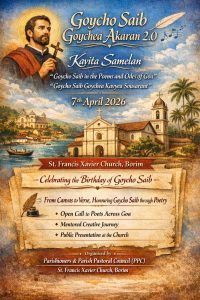
Nowhere does this evocative power shine more brightly than in the upcoming Konkani Kovi Somellon of Goycho Saib Goychea Akaran 2.0, to be held on 7 April 2026 at St Francis Xavier Church in Borim. This marks the second consecutive celebration of the birthday of St Francis Xavier, the beloved Goycho Saib whose life has become woven into the very fabric of Goan identity. What began last year as an artistic journey now deepens into verse. Poets from across Goa will gather in the church compound, their words rising under the evening sky, to offer poems in Konkani,some in the flowing Nagri script that carries the ancient rhythm of Devanagari, others in the familiar Romi script that has long been the everyday alphabet of Goan homes, schools, and prayers. These poems do not merely describe the saint. They evoke him. They bring him close, not as a distant historical figure but as an intimate presence in Goan life, calling us into dialogue with our own land, our own stories, and our own hearts.
Consider how a poem works its magic. It begins with a single image, a crab returning a crucifix from the sea, the scent of wet laterite after monsoon rain, or the sound of a mother humming a lullaby in Konkani. These are not clues to solve. They are doors flung open. The poet speaks of Goycho Saib not to prescribe devotion but to evoke the quiet moments when faith feels most real: a grandmother lighting a lamp before his picture at dusk, a fisherman whispering a prayer before casting his net, a young student in Margao feeling the weight of leaving home for distant shores yet carrying the saint’s courage like an unseen companion. In Nagri script, the verses may carry the classical elegance of literary tradition, their curves and dots evoking the old manuscripts preserved in village temples and churches. In Romi, the same lines feel immediate, conversational, the way Konkani is spoken on the bus from Panjim to Ponda or in the market square of Mapusa or Siroda. Both scripts, side by side in the same gathering, remind us that Konkani is one living language, rich enough to hold the saint’s story in every Goan accent and every Goan heart.
The evocative role of these poems lies in their refusal to preach. They do not say, “You must believe this.” They say, “Remember how it feels.” A verse might describe the saint’s bare feet on Goan soil, and suddenly the listener feels the coolness of the same earth beneath their own sandals during the annual feast procession. Another poem may speak of his letters written by lamplight, and we are reminded of our own late-night worries about crops failing, about children studying abroad, about preserving our culture amid rapid change. The dialogue begins. The poem addresses our world, and we answer with our memories. In Ricoeur’s terms, the text becomes a world in front of the text: not a code to crack, but a horizon that expands our own. We think not because the poem forces thought, but because it invites us to dwell in its images until our ordinary lives feel strangely luminous.
Goan life itself is evoked in these verses with rare tenderness. The poets will draw from the red laterite hills of Salcete, the swaying coconut groves of Bardez, the quiet rivers that mirror the Borim church spire. They will speak of the intimacy Goycho Saib has claimed in our daily rhythms. He is not confined to the grand basilica in Old Goa; he lives in the small wayside chapels, in the family altars where his statue stands beside photographs of ancestors, in the prayers recited before exams or before a safe journey. A poem in Romi might capture the laughter of children running through the church compound on his feast day, their bare feet kicking up the same dust their grandparents once did. A Nagri composition might linger on the silence after the bells ring, when the heart feels the saint’s presence as a gentle pressure, urging us toward compassion in a world that often rewards speed over kindness.
This intimacy is profoundly dialogical. The poem speaks, and Goan life answers back. When a poet evokes the saint’s love for the poorest fisherfolk, a listener from a coastal village may recall how her father, a simple boatman, always kept a small medal of Goycho Saib in his wallet. The verse does not prescribe charity; it evokes the memory of charity already lived. When another poet describes the incorrupt body of the saint, preserved as if still breathing, we are not given a theological lecture. We are invited to feel the miracle in our own fragile bodies to think about mortality, about legacy, about what it means to leave something incorruptible in the hearts of those who come after us. The Kovi Somellon becomes a shared space where these dialogues unfold in real time: poets offering lines, audience responding with nods, sighs, or the soft murmur of recognition that only happens when words touch the exact shape of lived experience.
Because the celebration is the second consecutive one under Goycho Saib Goychea Akaran, there is a growing sense of continuity. Last year’s gathering planted seeds; this year the verses harvest deeper roots. The theme of moving deeper into the saint’s story through poetry feels natural, almost inevitable. Konkani, whether written in Nagri or Romi, carries the flavour of our soil and sea. It is the language in which mothers first sang to us, in which tiatrists made us laugh and cry, in which elders told stories of miracles by the fire. When poets use it to sing of Goycho Saib, they are not importing a foreign saint into our culture. They are revealing how thoroughly he already belongs here and how his spirit has shaped our festivals, our songs, our very way of being together.
In the warm April evening at Borim, as the sun sets behind the Western Ghats and the church lamps begin to glow, the Kovi Somellon will not be a performance to watch from a distance. It will be a conversation to enter. Families will sit together on the grass, children leaning against parents, elders closing their eyes to listen better. A line in Nagri may rise like incense, formal and reverent; a line in Romi may follow, warm and familiar, like a neighbour calling across the fence. Together they evoke the full spectrum of Goan life: its Catholic devotion intertwined with its Konkani soul, its history of migration balanced by its deep sense of home, its struggles and its simple joys.
The poems will not solve the riddles of existence. They will do something far more powerful. They will make the familiar strange and the strange familiar. They will remind us that Goycho Saib is not a figure in a painting or a name in a history book. He is the quiet companion in our most intimate moments, the strength we draw when we face illness, the hope we cling to when the future seems uncertain, the love that teaches us to see Christ in the face of the stranger. Through the evocative power of Konkani verse, we enter into dialogue with him once more. We think, we feel, we remember, and in that living exchange, our Goan identity grows richer, our faith more personal, our community more tightly bound.
As the final poet steps forward and the last lines fade into the twilight air, the gathering will disperse not with answers but with questions gently awakened. What does it mean to live with such intimacy toward a saint who walked our shores centuries ago? How do we carry his spirit into tomorrow’s Goa? The poems will not prescribe the reply. They will simply have evoked the possibility of one. In that open space between verse and listener, between saint and soul, between past and present, the true celebration will have taken place not in grand declarations, but in the quiet, dialogical stirring of hearts that have been addressed, awakened, and invited to think anew.
On 7 April 2026, at St Francis Xavier Church in Borim, Goycho Saib Goychea Akaran 2.0 invites every Goan to this evocative encounter. Bring your whole self, your memories, your questions, your everyday faith. The poems await. They do not hide secrets. They open doors. And through them, Goycho Saib speaks once more, intimately, to the world we know , love and abide.