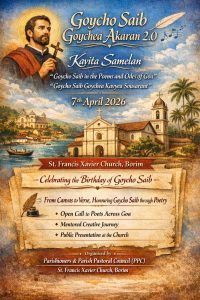
In the sun-kissed landscapes of Goa, where the Arabian Sea whispers ancient prayers and the red laterite soil cradles centuries of faith, the Kavi Somellon emerges as a vibrant confluence of poetic voices. On 7 April 2026, poets from across Konkani-speaking realms gather under the banner Goycho Saib Goychea Akaran 2.0, the second consecutive year of this celebration to honour the birthday of St. Francis Xavier, revered as Goycho Saib, the protector saint of Goa. This Kavi Sammelan, or poets’ assembly, transforms the occasion into a living network of odes and verses, where words do not merely describe but invoke the saint’s enduring presence. Far from being ornamental recitations, these poems can be heard and experienced through the profound lens of Indian aesthetic theories: the Dhvani (suggestion) of Anandavardhana, the Sphota (holistic revelation) of Bhartrhari, and the Rasa (aesthetic emotion) of Bharata’s Natyashastra. Together, they elevate simple tributes into transcendent experiences, allowing the saint’s “Goycho akar” resonate as both historical legacy and contemporary spiritual summons.
The theme Goycho Saib Goychea Akaran in the hands of Konkani poets, does not become prose-like narration but reach a height of poetic voice that can be intuitively grasped by these classical frameworks. Poets approach their craft as sadhakas spiritual practitioners
intending each verse to mirror Xavier’s zeal love for Jesus and the people: crossing oceans, healing souls, and kindling faith amid tempests. The process is deliberate yet intuitive. A poet might start with a personal anecdote of pilgrimage to the Basilica of Bom Jesus, but immediately layers it with suggestion, revelation, and emotional relish. This is no modern free-verse indulgence; it is rooted in India’s millennia-old poetics, adapted seamlessly to Konkani’s melodic rhythms, where the language itself carries the cadence of mandos and dekhnis.
At the heart of Indian Aesthetics lies Rasa theory, the science of evoking a dominant emotional flavour that transports the listener beyond the literal. Bharata’s Natyashastra identifies eight (or nine, with shanta) permanent emotions (sthayi bhavas) that, when properly stimulated through vibhavas (determinants), anubhavas (consequents), and vyabhicharins (transitory states), culminate in rasa, the relishable aesthetic joy. In the poems of Goycho Saib Goychea Akaran 2.0, the predominant rasa is Bhakti Rasa, the flavour of devotional surrender, often blended with Adbhuta (wonder) at the saint’s life and Shanta (peace) born of his protective grace. Composition here thus demands precision. The poet does not state “Xavier healed the sick”; instead, he constructs determinants such as the stormy seas of the saint’s voyages or the silent vigil of relics in Old Goa. These trigger anubhava like the tears of gratitude, folded hands in prayer, leading the audience into a collective relish of devotion.
Consider how a typical ode might unfold. The poet opens with vibhavas drawn from Xavier’s life: the Basque missionary arriving in 1542, his bare feet treading Goan shores, his voice preaching in local tongues. But rasa emerges not from biography alone. The poet infuses vyabhicharins fleeting emotions of awe at raising the dead, or compassion for the fisherfolk until the sthayi bhava of bhakti crystallises. The listener does not merely hear; they taste the rasa, their hearts swelling with the same fervent love that draws lakhs to the saint’s feast. In the second year of the theme, poets build on the previous iteration’s artistic echoes (once visual, now verbal), heightening the rasa through repetition and variation. One poet might evoke the saint as a flame that never extinguishes, stirring shanta rasa amid Goa’s rapid modernisation; another channels adbhuta by suggesting Xavier’s intercession during cyclones or pandemics. The Kavi Somellon thus becomes a rasa-utpatti birthplace of aesthetic emotion where the audience, seated in communal harmony, experiences catharsis akin to ancient temple performances. This is composition as sacred alchemy: the poet transmutes personal reverence into universal relish, ensuring every syllable serves the dominant flavour without dilution.
Complementing rasa is Dhvani theory, the cornerstone of suggestion expounded in Anandavardhana’s Dhvanyaloka. Dhvani posits that poetry’s soul resides not in the expressed (vachya) meaning but in the suggested (vyangya) the unspoken resonance that dawns like moonlight on a still lake . Literal words form the vehicle; dhvani is the luminous cargo. In composing poems for Goycho Saib, poets master this art with exquisite subtlety. The expressed might recount Xavier’s miracles the calming of seas, the gift of tongues, the incorrupt relics. Yet the suggested dhvani whispers deeper truths: the saint’s ongoing Goycho akar, his call to Goans to preserve cultural roots amid globalisation; or the unity of faiths, as his legacy bridges Hindu, Christian, and other traditions in Goa’s syncretic soil.
The composition process is rigorous. A poet selects abhidha (primary meaning) carefully simple Konkani words evoking the saint’s staff or crucifix but deploys lakshana (secondary) and vyanjana (suggestive) powers. Alliteration in Konkani, with its soft nasals and rolling ‘r’s, mimics the sea’s rhythm, suggesting the saint’s oceanic journeys and inviting listeners to feel the pull of distant shores. Metaphors abound: Xavier as the “eternal lamp of Borim” (nodding to local churches) carries dhvani of illumination against darkness of doubt. In Goychea Akaran 2.0, this suggestion gains urgency. The first year’s artistic expressions planted seeds of visual dhvani; now poets amplify it verbally, suggesting that the saint’s birthday is not mere chronology but a perennial invitation to renewal. A verse might literally describe pilgrims at the exposition of relics, yet dhvani evokes the inner pilgrimage every Goan must undertake towards compassion, justice, and ecological harmony. Anandavardhana’s hierarchy of dhvani types finds full expression: vastu-dhvani (suggesting facts of faith), alamkara-dhvani (ornamental beauty), and the supreme rasa-dhvani, where suggestion merges with emotional flavour. Poets avoid over-explicitness, trusting the listener’s sensitivity (sahridaya) to uncover layers. Thus, a single couplet can suggest Xavier’s protection during Goa’s turbulent history from Portuguese era to liberation while implying his role in contemporary challenges like environmental degradation or youth migration. Composition becomes an act of restraint: the poet suggests, never imposes, allowing the dhvani to bloom organically in the hearer’s mind, much as the saint’s quiet presence continues to guide without fanfare.
Sphota theory, articulated by the grammarian-philosopher Bhartrhari in his Vakyapadiya , adds the final, explosive dimension. Sphota is the indivisible, instantaneous “burst” of meaning the sentence or poem as a holistic entity that reveals truth beyond sequential phonemes. Individual sounds (dhvani here in phonetic sense) are mere catalysts; the sphota is the lightning flash of comprehension. In the Kavi Somellon’s oral tradition, this theory is palpably alive. Poems are not read silently but recited aloud, their rhythm building tension until the sphota erupts, illuminating the saint’s divine essence in a single, unified insight.
Composition under sphota demands architects of unity. The poet crafts the entire poem as one organic whole, where metre, rhyme, and imagery coalesce into a singular revelation. A fragmented verse fails; only a seamless vakya (sentence-poem) can manifest sphota. For Goycho Saib, this might manifest as a poem beginning with the saint’s arrival, traversing his labours in distant lands, and culminating in his eternal vigil over Goa, each segment a note in a raga that resolves in the final sphota: “He is here, calling still.” The burst reveals not facts but the living presence Xavier not as historical figure but as living saib, whose akar echoes in every Goan heart. Bhartrhari’s levels of sphota vaikhari (gross speech), madhyama (mental), and pashyanti (visionary) guide the poet: starting with audible recitation (vaikhari), stirring inner reflection (madhyama), and culminating in intuitive vision (pashyanti) of sanctity.
In the second year, sphota gains collective power. As poets perform sequentially, each ode’s sphota interlinks, creating a meta-sphota for the assembly: the realisation that Goycho Saib’s legacy is Goa’s collective soul. A poet might employ anvaya (syntactic flow) so that disparate images fishermen’s nets, basilica bells, monsoon rains fuse into one luminous truth: the saint’s call to stewardship. The oral delivery enhances this; pauses, intonations, and audience murmurs act as phonetic sparks igniting the burst. Unlike written poetry, the Kavi Somellon’s live sphota is communal, democratic every listener co-creates the revelation. Composition thus requires foresight: the poet anticipates the assembly’s mood, calibrating language so that the final line detonates the sphota like Xavier’s own miracles sudden, transformative, indelible.
These theories do not operate in isolation; they interweave in a harmonious triad during composition. Rasa provides the emotional core, dhvani the suggestive depth, and sphota the revelatory climax. A poet begins by intuiting the rasa to be evoked bhakti tinged with shanta. Then dhvani layers unspoken calls: the saint urging ecological care or cultural preservation. Finally, sphota ensures the whole crystallises into a deep insight. This synthesis mirrors Indian philosophy’s holistic vision where emotion, suggestion, and revelation form the indicness of poetic experience. In Goycho Saib Goychea Akaran 2.0, it manifests as poems that are at once local (rooted in Konkani idioms of mangroves and mandos) and universal (echoing Vedic suggestion and Buddhist compassion). The Jesuit saint, a 16th-century , becomes an archetype through these lenses: his life’s dhvani suggests eternal mission; his presence evokes rasa of wonder; his invocation triggers sphota of unity.
The Kavi Somellon itself enacts this integration. Poets, hailing from villages and cities, share not competition but communion. One may compose in free-flowing prose-poetry, relying on dhvani’s subtlety; another in traditional ovi or abhang like forms, harnessing sphota’s rhythmic burst. The audience: devotees, scholars, youth may respond with sighs, claps, or silent tears, validating the rasa. This second iteration builds continuity: where the inaugural year perhaps leaned visual , 2.0 foregrounds verbal precision, proving poetry’s primacy in sustaining faith. Challenges arise modernity’s cynicism, linguistic shifts but the theories equip poets to transcend: dhvani suggests resilience, rasa fosters belonging, sphota affirms timelessness.
Ultimately, these poems on Goycho Saib transcend tribute; they become vehicles of living dharma. Through rasa, they heal souls; via dhvani, they invite introspection; with sphota, they ignite epiphany. As the Kavi Somellon unfolds on 7 April 2026 marking the 520th birth anniversary, the verses will not merely celebrate a saint but rekindle his akar for a new generation. In an era of fleeting distractions, these odes, forged in India’s aesthetic crucible, remind us that true poetry is darshan: a visionary encounter. Goycho Saib lives not in relics alone but in the suggested, revealed, and relished words of his poets. The call resounds: come, taste the rasa; hear the dhvani; witness the sphota. Goa listens, and the universe echoes.