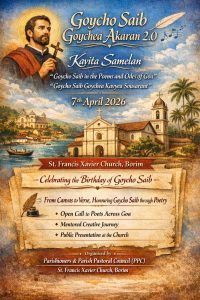
We are people who are addressed, called, interpellated. Every day the world hails us through traffic horns and phone notifications, through the glance of a child or the silence of an empty church pew. Yet within this constant summons, poetry alone addresses us as fully human. It does not settle for fragments of our being. It speaks at once to intellect and emotion, to intuition and memory, and even to the very pulse of our embodied life the way breath catches, the way feet shift on cool stone floors, the way a single Konkani syllable can make the skin remember childhood rains.
Nowhere does this truth unfold more tenderly than in the upcoming celebration at St. Francis Xavier Church, Borim, under the banner of Goycho Saib Goychea Akaran 2.0. On 7 April 2026, the celebration of the saint’s birth, the parish will move deliberately from canvas to verse. What began as an artistic exploration of colour, form and sacred imagery now finds its completion in the living word. A Konkani Kovi Somellon gathering of poets will fill the church compound with rhythm, rhyme and recollection. In that shaded space beside the whitewashed walls and the ancient cross, Goans will witness poetry doing what it does best: calling us home to ourselves.
Goycho Saib Goychea Akaran is more than an event series; it is a cultural pilgrimage. The name itself carries the sweet weight of Goan identity. “Goycho Saib” is the affectionate title given to St Francis Xavier, the Basque missionary whose arrival in 1542 changed the spiritual geography of our coast forever. “Goychea Akaran” evokes the very canvas of Goa, its red laterite earth, its swaying palms, its rivers that mirror both sky and soul. The first edition invited painters to interpret the saint’s life through brush and pigment. Now the 2.0 edition invites poets to take the same themes and set them singing in the mother tongue. The transition is deliberate and profound. A painting may move the eye; a verse enters the ear, lodges in the chest, and refuses to leave.
Why poetry, and why now? Borim with the great Bak Bab Borkar is a land of poetry and because in an age of fleeting images and hurried scrolls, the Konkani Kovi Somellon restores the ancient human practice of listening together. On the evening of 7 April, as the sun slips behind the Western Ghats and the church bells ring the Angelus, poets from across Goa and Mangalore elder bards from Salcete, fiery young voices from Bardez, women whose lullabies have shaped entire villages will stand before the assembly. Their verses will not be abstract. They will be rooted in the very soil of Borim. Some will recall the saint’s legendary miracles: the crab that returned his crucifix, the body that remained incorrupt. Others will speak of quieter graces the courage required to leave one’s homeland, the compassion that made him sit with the poorest fisherfolk. Still others will turn the gaze inward, asking what “Goycho Saib” means to a generation negotiating between tradition and tomorrow.
Here the full addressability of poetry reveals itself. Intellect is engaged when a poet traces the theological threads of Xavier’s letters, showing how Ignatian spirituality still shapes Goan Catholicism. Emotion surges when another recites a lament for the Konkani language itself, once threatened yet now vibrant again, much like the saint who learned local tongues to reach hearts. Intuition awakens in metaphorical leaps: Xavier compared to the monsoon that arrives unannounced and transforms the parched land. Memory stirs as grandparents nod in recognition, hearing lines that echo the mandos and dulpods of their youth. And embodied life? That is perhaps the most beautiful part. When the poets perform, the audience will not merely hear; they will feel the cadence in their bones. A line delivered with a sudden hush will make listeners lean forward. A rhythmic refrain will set feet tapping softly on the laterite laterite courtyard. Poetry, spoken aloud in the open air of a Goan evening, becomes a bodily sacrament.
The venue itself deepens the experience. St Francis Xavier Church in Borim is no grand basilica; it is a village church, intimate and alive. Its simple altar has witnessed baptisms, weddings and funerals for generations. Its walls have absorbed the prayers of farmers, teachers, migrant workers and returning sons and daughters. To hold a Kovi Somellon here is to place poetry where it belongs within the sacred ordinary. The saint whose birthday we mark was himself a man of movement and encounter. He walked dusty paths, sailed stormy seas, and met people in the flesh. By gathering under his patronage to listen to living poets, we continue that same spirit of encounter. We do not merely remember Xavier; we allow him to address us afresh through the voices of our own poets.
Organisers have kept the evening accessible and inclusive. There will be no entry fee, no elitist barriers. Families are encouraged to come together—children perched on laps, elders leaning on walking sticks, teenagers recording verses on their phones to share later. Between recitations, gentle hymns in Konkani will rise, blending seamlessly with the poetry so that the boundary between prayer and verse dissolves. Some poets will offer original compositions written specially for the occasion; others will revive classics from the rich treasury of Konkani literature, reminding us that our poetic heritage stretches back centuries. A few may even experiment with spoken-word forms, blending rap rhythms with traditional tiatr cadences, proving that poetry evolves without ever losing its soul.
In the larger story of Goan culture, this event matters deeply. Konkani is not just a language; it is the heartbeat of our identity. For too long it was sidelined in schools and offices. Yet here, in a church compound on a saint’s birthday, it regains its rightful place as the tongue of devotion, of protest, of joy and of grief. The Kovi Somellon becomes an act of cultural affirmation. When a poet speaks of Xavier’s love for the “miserable” and the “abandoned,” the words resonate with contemporary realities of migrant labourers building high-rises in distant cities, farmers battling climate change, young people torn between Goan roots and global dreams. Poetry does not offer easy answers. It offers addressability. It calls us by name and asks us to respond with our full humanity.
As the evening draws to a close, the final poet will likely step forward under the soft glow of lanterns. The crowd, now bound by shared listening, will fall into a profound silence. In that silence, one feels the saint’s presence not as a distant historical figure but as a living interpellation. He who once cried out to the people of Goa still calls through these verses. And we, addressed in intellect, emotion, intuition, memory and body, will answer in the only way possible: by carrying the poems home in our hearts, by speaking them to our children, by letting them shape the way we walk the red earth of our villages.
Goycho Saib Goychea Akaran 2.0 is therefore far more than a cultural programme. It is a reminder that art and faith, canvas and verse, are not separate compartments but successive movements in the same sacred dance. From the visual to the verbal, from the seen to the spoken, we move deeper into the mystery of what it means to be fully human and fully Goan. On 7 April 2026, at St Francis Xavier Church in Borim, the poets will not merely entertain. They will interpellate. They will call our body, mind and spirit to remember who we are and whose we are.
Come, then. Bring your whole self. The canvas has prepared the eye; now the verse will claim the ear and the heart. In the warm Konkani evening, under the patronage of Goycho Saib, poetry will do what it has always done: turn strangers into a listening community, and a community into a living poem of love and belonging.