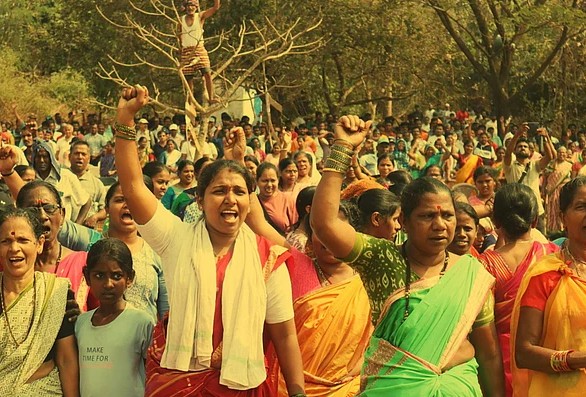
In the sun-drenched landscapes of Goa, where azure beaches meet lush hills, a new wave of resistance is reshaping the political and cultural narrative. The recent protests in Chimbel and Palem-Siridao, spearheaded by the Scheduled Tribe (ST) communities, have not only challenged the BJP-led government’s development policies but also disrupted the hegemonic grip of Hindutva ideology. These movements, which gained momentum in February 2026, mark a shift from manufactured consent or even manufactured dissent to authentic, grassroots mobilization that prioritizes local identity, ecology, and cultural heritage over top-down agendas.
The Spark: Chimbel and the Unity Mall Saga
The unrest began in Chimbel, a village on the outskirts of Panaji, where residents, including a significant ST population, launched a 40-day agitation against the proposed Unity Mall and Prashasan Stambh projects. Villagers protested the environmental toll, including the planned felling of nearly 100 trees and the risk of displacing tribal families for developments widely seen as favoring builder-politician interests. Hunger strikes, marches to the Goa Assembly, and demonstrations at Azad Maidan drew widespread support from opposition parties and environmental groups. The government’s eventual written assurance to relocate the projects marked a rare victory, underscoring the power of persistent community action.
This triumph in Chimbel set the stage for broader solidarity, proving that sustained local voices could halt mega-projects perceived as eroding Goa’s unique character.
Escalation in Palem-Siridao: A Fiery Stand Against Land Conversions
Building on Chimbel’s momentum, the protests shifted to Palem-Siridao, where villagers rallied against land conversions under Section 39A of the Town and Country Planning Act. This provision has enabled the rezoning of eco-sensitive hill slopes and no-development zones into settlement areas, allegedly to benefit private developers. Large tracts of land including sacred groves, prehistoric caves, and sites associated with traditional deities such as Shree Sateri Devi face transformation into housing complexes, threatening landslides, biodiversity loss, and the destruction of cultural heritage.
The agitation intensified around mid-February 2026, with innovative tactics that blended tradition and defiance. Torchlight rallies symbolized a fiery warning to the government, drawing participants from neighboring villages. Protesters performed traditional fugdi dances outside government offices, chanted invocations to local deities, and staged overnight sit-ins—actions that sometimes led to police intervention. By late February, the movement had relocated to Azad Maidan, where locals demanded the complete scrapping of Section 39A, citing recent court rulings that struck down similar provisions as contrary to public interest.
These actions have garnered opposition backing and transformed a local dispute into a statewide people’s movement. Villagers have stood firm, invoking cultural and spiritual resolve in the face of pressure.
Reimagining Resistance: ST Leadership and the Challenge to Hindutva Hegemony
At the heart of these protests is the leadership of the Hindu ST community, which has forged a new form of universal identity that directly contests the Hindutva narrative. In a state governed by a BJP administration, where policies often blend nationalism with development, these movements emphasize ST identity as a distinct, inclusive force. By focusing on ancestral lands, traditional practices, and ecological preservation, protesters are dismantling the notion of a monolithic Hindu identity imposed from above.
This resistance reimagines protest not as mere opposition but as a creative reclamation of space. Traditional elements fugdi performances, deity invocations, and community rituals infuse the agitations with cultural depth, mobilizing Goans beyond communal lines toward a shared sense of “Goan-ness.” As villagers from diverse backgrounds join in, the protests expose how development agendas have sometimes been pushed during major festivals to minimize public backlash, straining infrastructure and eroding Goa’s soul.
The ST-led pushback, however, fosters solidarity that transcends villages, challenging entrenched power structures by asserting that true development must honor local voices and identities.
Toward a Larger Goan Identity
These developments signal a pivotal moment in Goa’s resistance landscape. By blending cultural rituals with modern activism like the hunger strikes, public gatherings, and growing calls for legal and policy change, the protests are mobilizing a broader coalition. They remind us that in an era of manufactured narratives, authentic resistance can dislodge entrenched power structures, paving the way for a reimagined Goa rooted in inclusivity, ecology, and shared heritage.
As the agitations continue, with potential for statewide escalation, they invite all Goans to reflect: What does “Goan-ness” mean in the face of unchecked development? The answer, emerging from the hills of Palem-Siridao and the streets of Chimbel, is one of resilient unity and renewed solidarity.