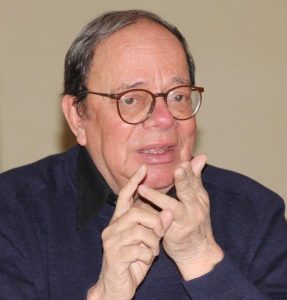
The news of Fr. Cyril Desbruslais SJ’s passing on September 8, 2025, in Pune, Maharashtra, at the age of 84, struck a deeply personal chord. For me, and countless others, Fr. Cyril was not just a towering figure in Indian Jesuit circles, a brilliant philosopher, or a transformative playwright—he was my teacher, a mentor whose compassion and wisdom shaped lives with an almost tangible grace. His death, following a battle with pneumonia, marks the end of an era, but his legacy as a guide, thinker, and champion of youth endures, etched in the hearts of those fortunate enough to have sat in his classroom or shared in his vision.
Born on December 21, 1940, in Calcutta (now Kolkata), Cyril Desbruslais entered a world of complexity and change. Orphaned in his early teens after losing both parents to tuberculosis, he and his surviving sister were raised by a loving uncle, whose care instilled in Cyril a profound empathy for those on society’s margins. This early encounter with loss did not dim his spirit but kindled a lifelong commitment to justice and human dignity. Educated at St. Xavier’s College, Calcutta, where he earned a Bachelor of Commerce, Cyril’s path took him through a brief corporate stint before he answered a higher calling, joining the Society of Jesus in the footsteps of his uncle, Vernon Desbruslais, another Jesuit luminary.
As my teacher at Jnana-Deepa Vidyapeeth (JDV) in Pune, Fr. Cyril was a philosopher whose lectures were less about abstract theory and more about igniting a passion for liberation. His courses—“Philosophy of Liberation,” “Hunger and Violence,” “Philosophy of Technology”—were intellectual feasts, blending the fire of Latin American liberation theology with the pluralistic realities of India. Drawing from thinkers like Gustavo Gutiérrez and Paulo Freire, he taught us that philosophy must serve the voiceless, dismantling structures of oppression like poverty and dogma. His 2016 book, The Philosophy of Liberation: Revisiting Genuine Religious Experiences with Special Reference to Christianity, became a touchstone for me, articulating a vision of humanity rooted in four pillars: embodiedness, social connection, rootedness in the world, and transcendence. “The glory of God is humans fully alive,” he’d say, quoting St. Irenaeus, his eyes alight with conviction. Those words weren’t just a lesson; they were a challenge to live with purpose.
Fr. Cyril’s classroom was a theater of ideas, but his actual theater was just as transformative. As a playwright, he wielded drama as a tool for social awakening, writing and directing over 30 plays since 1972. I remember watching The Impossible Dream(1972) and The White Rose (2012), the latter a stirring tribute to anti-Nazi resistance, feeling the weight of his message: art could confront injustice and inspire change. His plays tackled nuclear disarmament, gender inequities, and globalization, always with a nod to the youth he so dearly loved. Two By Two (2019, revised) was a masterclass in weaving complex issues—terrorism, marginalization—into narratives that provoked and uplifted. As a student, I saw how he used theater to make philosophy accessible, turning abstract concepts into lived experiences that stirred our consciences.
His compassion as a youth leader was perhaps his greatest gift. In 1971, Fr. Cyril founded the “Searching in Service and Unity” (SSU) group, an interfaith movement that brought together young people of all religions in a country where Christians are a small minority. I recall the SSU gatherings—vibrant, inclusive, alive with dialogue and laughter—where he fostered a sense of unity without erasing difference. His mentorship was personal; he had a way of seeing you, really seeing you, whether you were grappling with existential questions or personal doubts. His 84th birthday celebration in December 2024 in Pune’s Camp area was a testament to his enduring connection with youth, a joyous affair that felt like a family reunion. Even Shashi Tharoor, the noted politician and one of his former students at St. Xavier’s, credited Fr. Cyril with shaping his worldview through a compelling argument for God’s existence. I, too, felt that intellectual spark in his presence, a gentle push to question deeply and act boldly.
His literary legacy is vast—books like Interpretations of Transcendence (1989), The Philosophy of the Human Person (1997), Postmodernity: An Indian Christian Philosophical Appraisal (2019), and Ancient, Medieval and Modern Philosophy (2021) bridged Eastern and Western thought, faith and reason. Yet, for all his erudition, Fr. Cyril remained approachable, his humor and warmth disarming even the most skeptical student. His 50th anniversary as a Jesuit at De Nobili College was a celebration of a life poured out in service, surrounded by a community he had nurtured.
Fr. Cyril’s passing leaves a void, but his lessons linger. He taught me that liberation is not just a concept but a way of life—embracing the body, building community, engaging the world, and reaching for the divine. As I reflect on his plays, his lectures, and those quiet moments of guidance, I hear his call to be “fully alive” in a world that often demands conformity. In Pune, as Jesuits and students gather for his funeral rites, I join them in spirit, grateful for a teacher who showed me that philosophy, faith, and compassion can change the world.
Rest in peace, Fr. Cyril, my guide and inspiration. Your light continues to lead us toward a more just and vibrant tomorrow.